On This Day: Reagan’s ‘We begin bombing in five minutes’ joke caused a political stir
Key Takeaways
- •Reagan's joke was made during a live microphone check at his California ranch on August 11, 1984, just under two weeks before the Republican National Convention confirmed him as the party's presidential candidate.
- •Major networks CBS and CNN initially kept the recording private under an agreement among White House correspondents not to publicize off-the-record remarks, but the Associated Press and Gannett News Service eventually broke the story.
- •The Soviet state news agency TASS denounced the comment as bellicose and provocative, though the incident did not cause lasting harm to superpower relations.
- •Democratic nominee Walter Mondale attempted to capitalize on the controversy by arguing a president must be careful with his words, but voters largely dismissed the incident.
- •Reagan went on to win 49 of 50 states in November 1984, securing a 525-13 Electoral College victory that remains the second-largest in U.S. history.
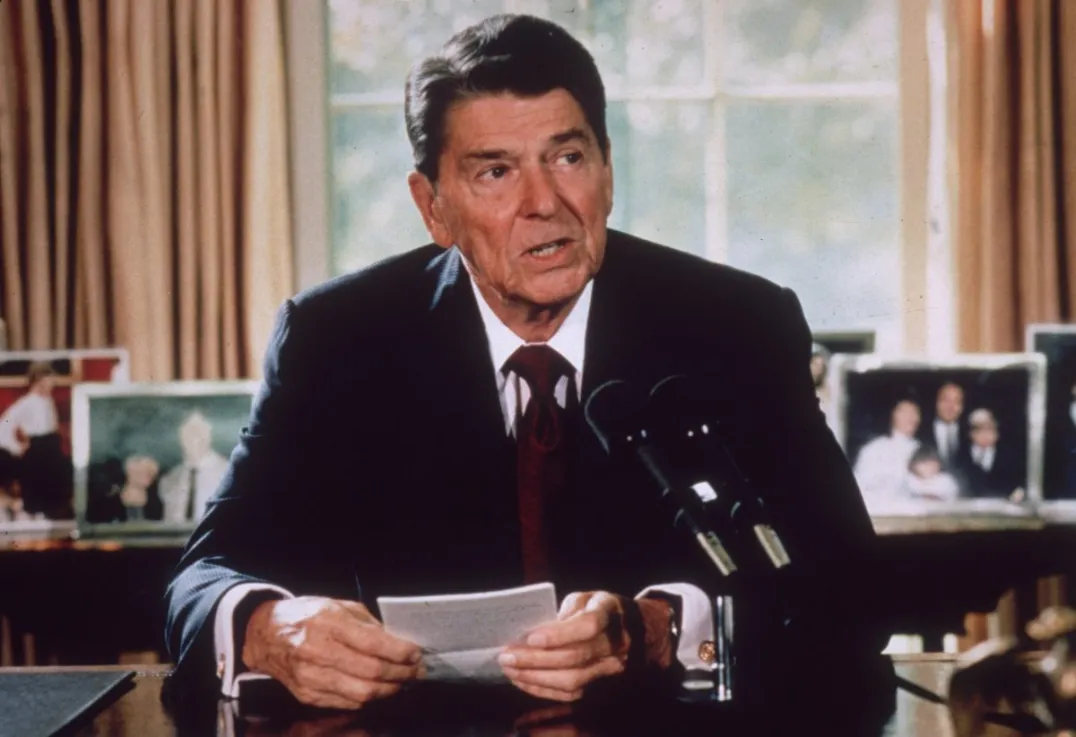
On this day in 1984, a lighthearted quip from Ronald Reagan nearly sparked World War Three, writes Eliot Wilson.
Ronald Reagan was an old pro. By the summer of 1984, more than 50 years had passed since his radio debut as a sports broadcaster for WOC in Davenport, Iowa, where he commentated on baseball games.
In 1982, he had revived President Franklin Roosevelt's practice of delivering weekly addresses to the nation on Saturday mornings, a tradition that continued until Donald Trump's first presidency; it met its match in the 45th president's New York-minute attention span.
To understand the moment, it is worth going back 20 years. A week before the 1964 presidential election, Reagan delivered an electrifying television address in support of Republican candidate Senator Barry Goldwater of Arizona. A Time for Choosing set out the conservative case in honest, direct and fiercely heartfelt terms. Although President Lyndon Johnson crushed Goldwater by 16 million votes, the speech lifted Reagan into the first rank of Republican conservatism. It also caught the attention of William A. Rusher, the link between William F. Buckley Jr.'s National Review and the wider conservative movement.
In March 1982, Rusher wrote an article for Universal Press Syndicate titled “Let's Have 'Fireside Chats' by Ronald Reagan,” in which he explicitly linked Reagan to Roosevelt and called him “a man of great personal charm and powerful qualities of leadership”. He argued, with the mild paranoia to which many conservatives are prone, that regular broadcasts would help the president speak directly to voters, over the heads of the media.
“If he is to win, for all of us, the battle to change America's direction, that voice will have to be raised, and raised regularly, where the American people can hear it.”
The format suited Reagan perfectly. With help from writers such as Ken Khachigian, Peggy Noonan and Peter Robinson, he could match historic occasions with memorable phrases: “'We the people', this breed called Americans”; “These are the boys of Pointe du Hoc. These are the men who took the cliffs”; “Mr Gorbachev, tear down this wall”; “A tall, proud city built on rocks stronger than oceans”. But he could also converse, not just declaim.
Radio has an intimacy of its own. It also demands precision and craft; when there are no images to rely on, every phrase and every pause has to be right, and a mistimed rhythm or poorly ordered sentence will stand out immediately. Speaking directly to voters, unfiltered and unparsed by the media, the “fireside chats” were ideally suited to Reagan's folksy charm, his natural self-deprecating humour and his gift for storytelling.
This was the profession in which Reagan had grown up. “Talk to your audience,” he later wrote, “not over their heads or through them. Don't try to talk in a special language of broadcasting or even of politics, just use normal everyday words.”
On Saturday 11 August 1984, less than two weeks before the Republican National Convention would confirm him as the party's candidate for November's election, Reagan was at Rancho del Cielo, his holiday home near Santa Barbara in California's Santa Ynez Mountains. He was due to begin his weekly radio address at 9.05am and was scheduled to speak about the Equal Access Act, which he had signed into law that day.
The backdrop was one of the most fraught periods of the Cold War. Reagan had branded the Soviet Union an “evil empire” in March 1983, the Soviet military had shot down Korean Air Lines Flight 007 in September of that year killing all 269 people aboard, and the United States had begun deploying Pershing II and cruise missiles in Western Europe, prompting mass protests. Arms control talks between the two superpowers had broken down, and within months the Soviet leadership would boycott the Los Angeles Olympics in retaliation for the American-led boycott of the 1980 Moscow Games.
Before beginning the address, he was joking with the sound engineers. When asked to perform a microphone check, he improvised a parody of the speech he was about to deliver.
“My fellow Americans,” he said, “I'm pleased to tell you today that I've signed legislation that will outlaw Russia forever. We begin bombing in five minutes.”
It was clearly a joke, but the feed from Rancho del Cielo was live to radio stations across the country, many of which were already recording in anticipation of the president's address. Broadcasters and reporters heard the remark, but — unimaginable today — both CBS and CNN kept the recording secret. After a rude remark about the Polish government in October 1982, the White House Correspondents' Association had agreed not to publicise obviously off-the-record comments.
Nothing in politics stays secret for long. The Associated Press and Gannett News Service reported Reagan's remarks, and on Monday The New York Times soberly said the president had “reportedly made a joke about national security”. Burt Reinhardt, president of CNN, rejected the light-hearted interpretation, saying: “I'm told the President says a lot of funny things from time to time.” When asked whether he found the joke about outlawing Russia funny, he replied, “Not particularly”. Pearls were being clutched hard.
The Soviet state news agency, TASS, issued its own condemnation, calling the remark “bellicose, arrogant and provocative.” The incident did not derail superpower relations for long: in March 1985 Mikhail Gorbachev came to power in the Kremlin, and within two years Reagan and Gorbachev would sign the Intermediate-Range Nuclear Forces Treaty, eliminating an entire category of nuclear weapons for the first time in history.
Former vice president Walter Mondale, confirmed as the Democrats' presidential candidate a few weeks earlier, tried to turn the controversy to his advantage. “A president has to be very, very careful with his words,” he said at a press conference. “I am willing to accept he saw it as a joke… but others will think it is serious… I don't think it is very funny.”
There was a small flutter in Reagan's poll lead, but voters preferred hot sauce to humbug: Mondale appeared hypersensitive, while the president seemed relaxed and human. America delivered its final verdict on 6 November, and it was emphatic. Reagan won 49 of the 50 states — Mondale carried only his home state, Minnesota — and the president's 525-13 Electoral College victory was, and remains, the second-largest in US history.
The reaction to Reagan's humour showed the power of his weekly addresses to the nation. Journalists pretended to be scandalised, politicians shook their heads in anxious sorrow, but the American public shrugged off the overblown parsing of what they all understood was a joke. Voters were being asked whether they wanted the country run by a liberal worrywart or by an experienced incumbent with a sense of proportion, and the ability to tell and take a joke. Their answer was thunderous for Reagan. They went out on polling day with all they had, and won one for the Gipper.
Eliot Wilson is a writer and historian, Senior Fellow for National Security at the Coalition for Global Prosperity, and a Contributing Editor at Defence on the Brink.

