Quantum Isn't Coming for Your Bitcoin: Bitcoin Magazine Print Issue Argues Quantum Threat Remains FUD
Key Takeaways
- •Brandon Black's essay in Bitcoin Magazine's The Quantum Issue argues that the threat of a cryptographically relevant quantum computer to Bitcoin is FUD, with no evidence such a machine will exist within a decade and uncertainty over whether one can be built at all.
- •Black asserts that no quantum computer to date has performed a computation beyond the reach of a precocious six-year-old, and that current devices require enormous power, setup time, and post-processing even for trivial tasks.
- •The essay cites SpaceX's Falcon 9, which cost under $5 billion to reach its first crewed mission versus roughly $50 billion for NASA's Space Shuttle, to argue that funding alone cannot make an unready technology practicable.
- •Black dismisses Google's recently redacted quantum circuit as pure theater, since no existing hardware comes close to the stability and scale needed to run it, and says hardware progress represents a breadth-first search marked by dead ends rather than linear advancement.
- •Despite his skepticism, Black maintains Bitcoin must continue developing post-quantum signature schemes such as SPHINCS and ML-DSA, since other cryptographic weaknesses could emerge even if a CRQC is never built.
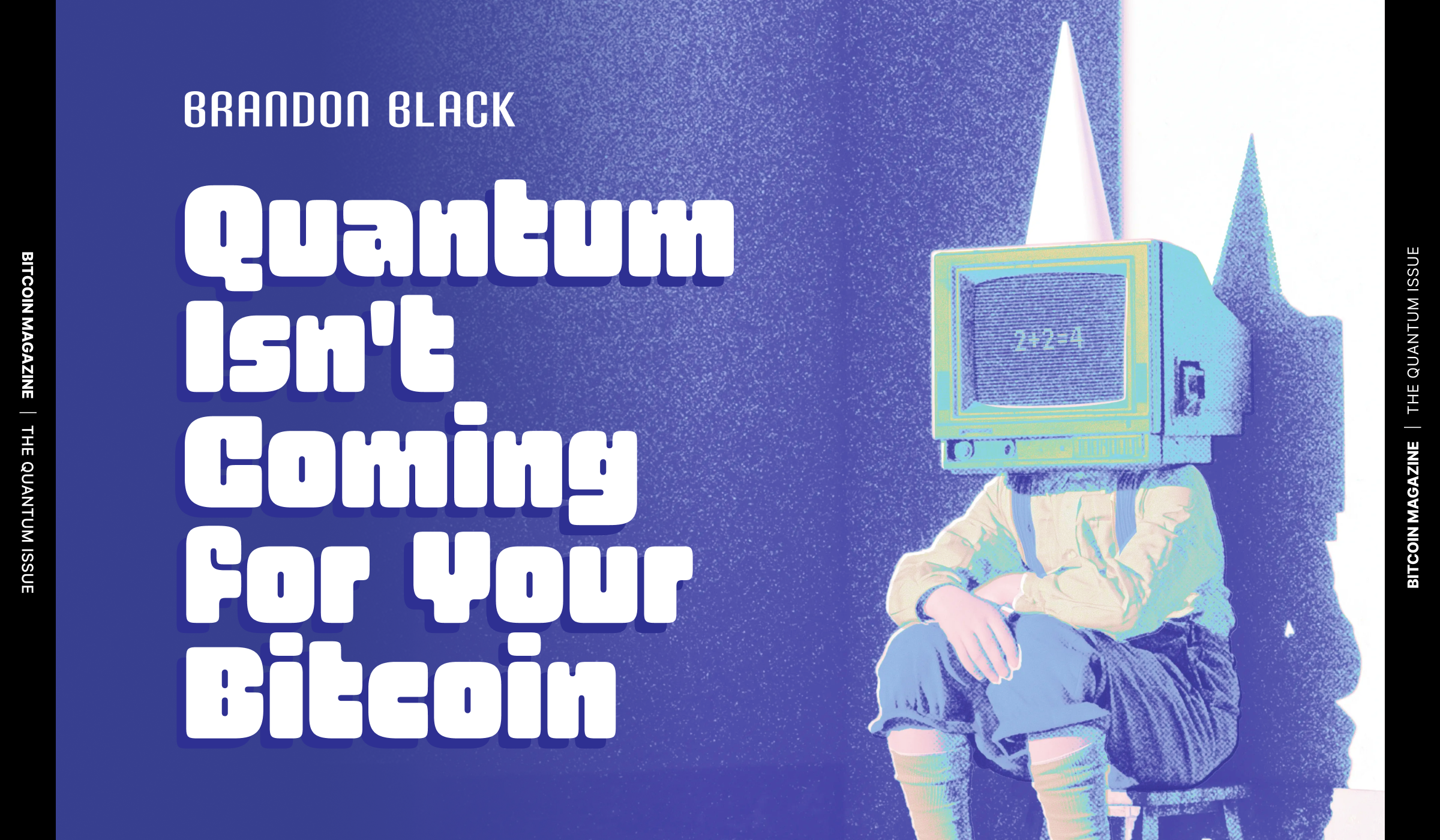
Bitcoin Magazine's latest print edition, The Quantum Issue, features an essay by Brandon Black arguing that the threat of a cryptographically relevant quantum computer (CRQC) — a machine capable of recreating secret keys from public keys and signing Bitcoin transactions that move other people's coins — remains fear, uncertainty, and doubt (FUD) rather than a realistic danger. There is no evidence, the essay states, that such a machine will be built within a decade, and it remains unknown whether one will ever be built at all.
For as long as Bitcoin has existed, new forms of FUD have been deployed to predict its demise. Despite those recurring predictions, Bitcoin has grown into a multi-trillion dollar asset and begun to take its place in the global monetary order. In recent months, the specter of a CRQC has returned as an evolved form of that familiar pattern. "Is this a realistic threat to Bitcoin's continued growth? In a word, no," Black writes in the piece, which is presented as an early look at the ideas explored throughout the full issue.
State of the Art
Black's assessment of the field's current condition is blunt. To date, he writes, no quantum computing machine has computed anything beyond the reach of "a precocious 6-year-old" — a claim he describes as confirmed empirically.
He acknowledges that quantum computers are remarkable technology, showcasing capabilities worthy of science fiction. The devices harness foundational technologies including optical tweezers, laser cooling, superconducting flux qubits, electromagnetic traps, and dilution refrigerators, among others. Within these machines, individual qubits are coerced into specific subatomic states — different for each candidate technology — entangled into superpositions, and manipulated to represent computations, after which their subatomic properties are read and interpreted.
The astounding truth, the essay notes, is that these devices exist and can be manipulated to produce meaningful computations across a handful of inputs. The cold reality check, however, is scale: for one example candidate technology, performing a computation that a small child can do requires enough power to air condition a Texas high school, many hours of setup, and further hours of post-processing.
Money In, Machines Out?
The essay takes direct aim at the argument that heavy investment into quantum computing signals imminent breakthroughs. Does money flowing into a field correlate with the rate of real-world technological progress in that field? Not really, Black writes. In fact, he argues, until the correct underlying technology has been developed and product-market fit confirmed, money flowing into an area can have a negative correlation with the likelihood of applicable technology being developed.
He illustrates the point by comparing NASA's Space Shuttle program to SpaceX's Falcon 9. SpaceX took (mostly known science and reduced it to practice to satisfy a demonstrable market need for reliable and lower-cost access to space, at a program cost of less than $5 billion to first crewed mission. The Space Shuttle cost roughly $50 billion to reach its first crewed mission. Falcon 9 not only cost an order of magnitude less to develop, but also holds a perfect crew safety record to date. While many factors explain the difference, the lesson per the essay is that no amount of money makes a technology that is not ready practicable.
Translated to quantum computing: with tons of money thrown at the problem, technology demonstrations at massive cost are possible. But that says nothing about whether more money will deliver the holy grail of stable, low-error qubits — the reliability equivalent of the Falcon 9. Just as no amount of continued development on the Space Shuttle program would ever have produced the Falcon 9's low cost and high reliability, Black writes, it is entirely probable that no amount of continued development, at any cost, will make any of the current quantum computing technologies reliable enough to break a single key pair.
Reading the Recent Advancements
The essay sets out two important caveats about recently published advancements in the field.
First, many of these advancements have been advancements in pure mathematics only. Black cites the recent Google paper, whose result was deemed so significant that the team chose to redact the theoretical quantum circuit rather than risk it being used to break important cryptographic systems. That may look like massive progress toward future CRQCs, but in fact it changed nothing: unless or until quantum hardware has its Falcon 9 moment, no device comes anywhere near the stability and scale needed to run the redacted circuit. Hiding a circuit designed for a device that may never exist, he argues, is pure theater.
Second, on the hardware side, many new results and bits of progress are published in a given year — but how many relate to the same quantum computing candidate technology? How many represent merely starting over after a prior result ended in a dead end? These advancements do not represent a linear track toward eventual success, the essay contends. They represent the breadth-first search of an infinite possibility space, within which quantum researchers hope to find a path along which they can proceed for even a modest distance without reaching yet another dead end.
Looking at the reality of the future of quantum computing, Black describes it as hazy at best. There are promising technological developments — especially, in his view, in the area of neutral atom devices — but it is far too early to tell whether a path toward an eventual CRQC is open along any currently known branch, or whether more restarts lie ahead. If, at some point, many iterations of the same candidate technology implement progressively more capable devices and compute meaningful results that a precocious child cannot also compute, he writes, the discussion can be revisited with different evidence.
In Theory
The essay outlines two possible explanations for the repeated failure of quantum research to develop a CRQC over many decades. The first is that it is simply a hard problem, and continued application of science and engineering will one day prevail — as the ingenuity of the human species has in the development of the Internet, the smartphone, social media, and Bitcoin, with the reader left to decide which of these are positive developments. The second is that developing a CRQC may be impossible, or will remain forever outside humanity's grasp.
Black invites consideration of what it would mean for a CRQC to exist: the machine would have to represent within its superposition a field of possibilities the same size as the complexity of the cryptographic problem to be solved. To break the 128-bit security of the elliptic curve discrete log problem on Bitcoin's secp256k1 curve, the quantum superposition would have to represent all possible values of a 128-bit number. In classical computing, representing all such values would require more computer storage — by many orders of magnitude — than humans have ever produced.
The essay further argues that if there is even the slightest granularity to the quantum superposition — that is, if the superposition is not perfectly continuous across all possible values — then a quantum computer cannot ever become cryptographically relevant. Likewise, if the energy required to hold a superposition scales with the complexity of the field being represented, then a quantum computer cannot ever become cryptographically relevant. The contemporary understanding of quantum physics, Black notes, does not rule out either of these possibilities.
Conclusion: Bitcoin Cannot Rest
For all of the foregoing, the essay concludes that Bitcoin's development toward new cryptographic algorithms must continue. While a quantum attack on Bitcoin's cryptography is not imminent by any means, it is entirely possible that another flaw could be found through other means. Certain elliptic curves have been found to have weaknesses, and secp256k1 could be next.
The article's stated benchmark for revisiting the quantum question is therefore concrete progress rather than funding or isolated announcements: repeated iterations of the same candidate technology would need to produce increasingly capable devices and meaningful computations beyond what a precocious child can perform. In parallel, Bitcoin's work on alternative cryptographic algorithms remains relevant regardless of whether a CRQC is ever developed.
Bitcoin has survived as long as it has because attacks on the system have strengthened it, the essay argues, and that will continue to be true as the quantum FUD attack plays out. The development of P2MR or P2TRv2, of SHRINCS, SPHINCS, IBC, ML-DSA, and more post-quantum signature schemes will eventually lead to improvements in Bitcoin's resilience in the face of future attacks — even if an actual CRQC is never developed.
The piece is featured in the latest print edition of Bitcoin Magazine, The Quantum Issue, and is being shared as an early look at the ideas explored throughout the full issue. The post first appeared on Bitcoin Magazine and is written by Brandon Black.

