Quantum-Resistant Bitcoin Transaction Confirmed on Mainnet Without Any Consensus Change
Key Takeaways
- •StarkWare reported that the first quantum-safe Bitcoin transaction was mined on the network's mainnet, and its hash, inputs, and timestamp are publicly viewable on Mempool.space.
- •The quantum-resistant properties were built into the transaction itself, requiring no changes to Bitcoin's consensus rules and avoiding a soft fork.
- •The single transaction does not make Bitcoin quantum-safe, as most bitcoin remains in addresses secured by standard elliptic-curve cryptography and current quantum computers remain far below the scale estimated to break it.
- •For ordinary holders, nothing changes immediately; this is a research milestone rather than a network-wide migration, with no action required and no urgent threat.
- •Related industry activity includes quantum-resistant account protection demonstrated on Ethereum, TRON preparing post-quantum signatures for its mainnet, and NIST finalizing its first post-quantum cryptography standards in 2024.
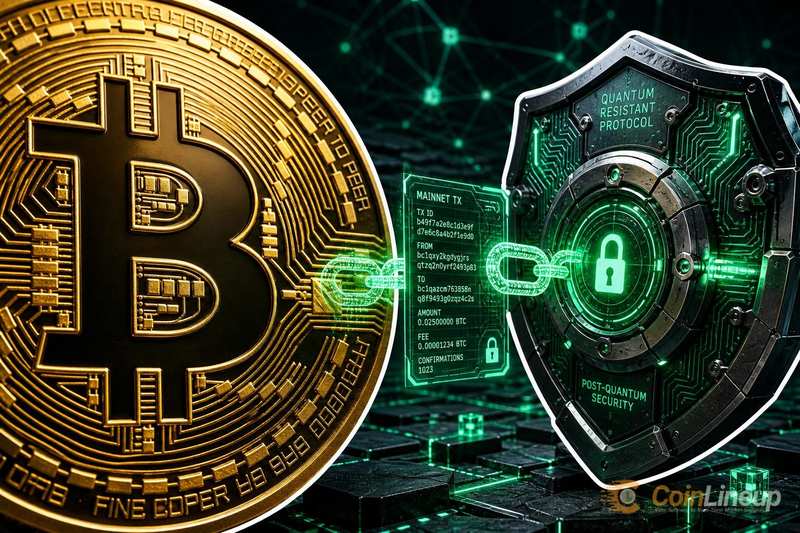
Bitcoin has recorded a quantum-resistant transaction on its mainnet without any change to the network's consensus rules, demonstrating that post-quantum experiments can already run on the live network today. The transaction was confirmed on Bitcoin's main chain — not a test network — and achieved its quantum-safe properties through transaction design rather than a protocol upgrade.
What Happened on Bitcoin's Main Chain
StarkWare, a blockchain research and engineering firm, reported that the first quantum-safe Bitcoin transaction was mined on the network's live chain, according to the company's announcement.
The transaction settled on Bitcoin mainnet, the real network where actual bitcoin moves. A mainnet result carries far more weight than a demonstration on a test network, where coins have no value.
"Quantum-safe" refers to cryptography designed to resist attacks from future quantum computers. Bitcoin's signatures today rely on elliptic-curve cryptography (ECDSA), a scheme that a sufficiently powerful quantum computer could theoretically break — the reason researchers across the industry have spent years preparing post-quantum alternatives.
The confirmed transaction can be viewed on a public block explorer, which displays its hash, inputs, and timestamp, on Mempool.space.
On-chain data:
- Transaction hash: 305a24ff…ab07
- Network: Bitcoin mainnet (live chain)
- Type: Quantum-safe transaction
How It Worked Without a Bitcoin Upgrade
The key detail is that no consensus rules changed. Consensus rules are the shared rulebook every Bitcoin node follows to agree on which transactions are valid. Rather than altering that rulebook, the team built quantum-safe properties into the transaction itself. Bitcoin's existing nodes then validated it under today's rules, as StarkWare explained in a separate post on achieving this without a soft fork.
A soft fork is a coordinated upgrade to Bitcoin's rules that all participants must adopt. Avoiding one means the approach fits within the Bitcoin that exists right now, not a future version of it.
The work mirrors activity elsewhere in the industry. Researchers have demonstrated quantum-resistant account protection on Ethereum, and the TRON network is preparing post-quantum signatures for its mainnet. It also parallels a broader migration across the software world, where the U.S. National Institute of Standards and Technology finalized its first post-quantum cryptography standards in 2024, giving the industry a common reference point.
Why It Matters — and What It Does Not Prove
The practical takeaway is a proof of viability: post-quantum experimentation can happen on Bitcoin before any formal upgrade, which is useful for wallet builders, custodians, and researchers.
However, a single transaction does not make Bitcoin quantum-safe today. The vast majority of bitcoin still sits in addresses secured by standard cryptography, and this event does not change that. Today's quantum computers also remain far smaller than the scale researchers estimate would be required to break elliptic-curve cryptography, and no such break has been demonstrated; the engineering interest is long-horizon preparedness rather than a present-day emergency.
For a regular holder keeping a small amount of BTC on an exchange such as Coinbase, nothing changes right now. There is no action to take and no urgent threat. This is a research milestone, not a network-wide migration. What matters next is repetition and adoption — in particular, whether wallet developers and custodians begin supporting similar transaction patterns in production tools, and whether Bitcoin's open development process takes up formal proposals for quantum-resistant address types.
The early work sits alongside broader institutional activity in Bitcoin, from BlackRock adjusting its self-custody rules to strong ETF inflows. For deeper background on this specific milestone, see earlier coverage of the quantum-safe Bitcoin transaction reaching mainnet.
Disclaimer: This article is for informational purposes only and does not constitute financial or investment advice. Cryptocurrency and digital asset markets carry significant risk. Always do your own research before making decisions.

