Quant Secures US and UK Bank Deals as QNT Rallies More Than 300% in One Week
Key Takeaways
- •QNT rose more than 300% in one week, from roughly $64 to a high near $371, making it the top performer among the 100 largest cryptocurrencies before falling back to about $260.
- •The Clearing House, owned by 25 of largest US banks and settling over $2 trillion daily, selected Quant to provide the interoperability layer for a tokenized deposit network expected to go live in the first half of 2027.
- •Seven major UK banks, including Barclays, HSBC, Lloyds, NatWest and Santander, completed the first interbank transactions using tokenized pound deposits on a platform built by Quant as part of a live pilot.
- •QNT's daily relative strength index reached about 86, its most extended reading in five years, and the token pulled back roughly 10% after stalling near $320, indicating the rally has become stretched.
- •Neither banking announcement specified how the QNT token will generate activity or demand, so part of the price surge reflects trader expectations rather than disclosed revenue.
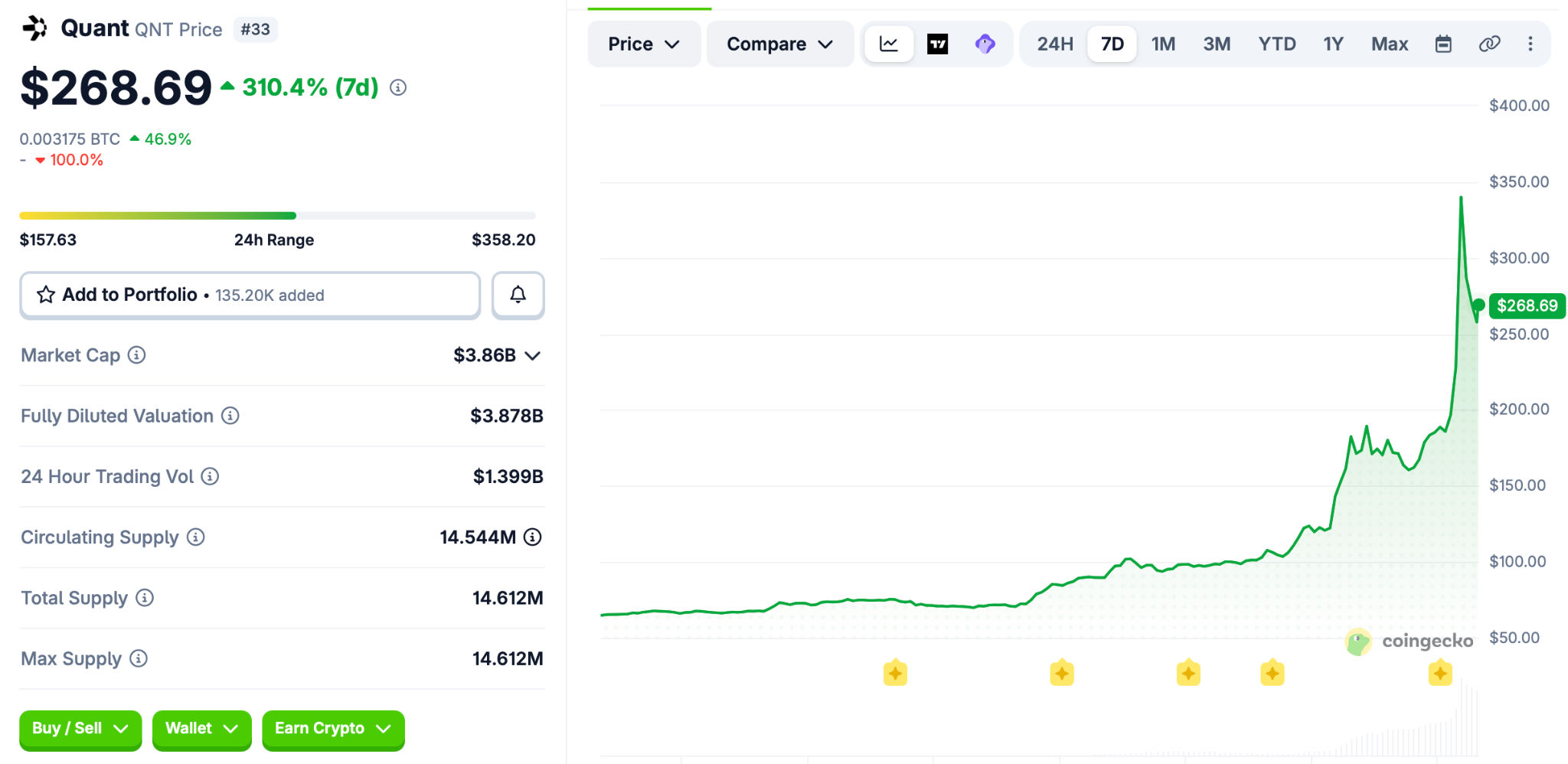
Quant (QNT) has been the best-performing crypto asset among the top 100 by market capitalization over the past week, following two banking announcements involving Quant’s technology. QNT rose from approximately $64 to a high of $371 over seven days before retracing to around $260 at the time of writing.
Quant is a London-based company that develops Overledger, software designed to help banks and enterprises connect existing systems across multiple blockchains. QNT is the company’s token and is used to pay for access to the network.
The catalyst for the more than 300% rally came on September 24, when separate announcements from the United States and the United Kingdom placed Quant within traditional banks’ efforts to move deposits onchain. Tokenized deposits are the instrument at the center of those efforts: they represent claims on the issuing banks and remain within the regulated banking system, distinguishing them from stablecoins, which are typically issued by non-bank entities.
The Clearing House Selects Quant for Tokenized Deposit Network
The Clearing House selected Quant to power a new tokenized deposit network. The Clearing House is owned by 25 of the largest US banks, including JPMorgan Chase, Bank of America and Citi. Its payment networks settle more than $2 trillion each day.
According to The Clearing House’s announcement, the network is expected to go live during the first half of 2027. Quant’s stated role is to provide the interoperability layer that lets tokenized deposits move between participating banks within the regulated system, rather than remaining confined to each bank’s own infrastructure.
Big news: Quant is partnering with @TCHtweets to bring on-chain, #programmablemoney to the US. We will provide the interoperability layer that lets #tokeniseddeposits move freely within the regulated banking system. This builds on our work in the UK, Europe and beyond. Read… pic.twitter.com/ZdHOd0txRP — Quant (@quantnetwork) September 24, 2026
Big news: Quant is partnering with @TCHtweets to bring on-chain, #programmablemoney to the US. We will provide the interoperability layer that lets #tokeniseddeposits move freely within the regulated banking system. This builds on our work in the UK, Europe and beyond. Read… pic.twitter.com/ZdHOd0txRP
The Clearing House is involved in a large share of US dollar payments, meaning that any tokenized product it launches could influence the broader financial industry.
Seven UK Banks Complete Tokenized-Pound Transactions
On the same day, some of the largest banks in the UK, including Barclays, HSBC, Lloyds, NatWest and Santander, completed the first interbank transactions using tokenized pound deposits. The transfers occurred on a platform built by Quant as part of a live pilot. Because the transactions ran between separate institutions, the pilot tested whether tokenized deposits can be recognized and settled across banks, a function that trials within a single institution cannot demonstrate.
The two developments placed Quant’s technology within both the US and UK banking systems during the same week, though at different stages: the US network carries a scheduled launch window in the first half of 2027, while the UK effort remains a live pilot.
QNT Faces Resistance at $320
On the daily chart, QNT opened near $286, reached $320 and then fell back to approximately $258, representing a decline of about 10%. An earlier blow-off wick during the rally reached close to $370. Traders may monitor the $320-to-$370 range as the first area for the token to reclaim.
QNT is also trading within a historically significant range. Following its 2021 all-time high, the token moved between $250 and $300 for several months before breaking down in 2022. That range again acted as a ceiling during the latest move. Above it, the remaining major resistance area is the 2021 peak zone between $400 and $430.
If the rally loses momentum, the 2022 high near $210 to $225 represents the first support area. The December 2024 high around $160 to $170 is the next level. Below that range, the chart has limited price structure until approximately $100 because QNT moved through the area rapidly, leaving little historical trading activity behind.
Daily RSI Reaches Five-Year High
The daily relative strength index (RSI) is around 86, its most extended reading on the five-year chart. Combined with the long upper wick, the reading indicates that the rally has become stretched. A pullback or a period of sideways trading could occur in the short term, while the limited support below $200 could leave the token vulnerable to a rapid decline.
The announcements also concern Quant the company rather than directly specifying how the QNT token will be used. The extent to which either banking mandate will generate activity or demand for QNT has not been disclosed. As a result, part of the week’s move reflects traders pricing in potential implications rather than revenue that has already been signed. The first half of 2027 launch window for the US network, and any future disclosure about the token’s role in either system, are the concrete milestones against which those assumptions can later be measured.

