PYTH Rally Reaches $0.09 as Market Awaits Key Daily Close
Key Takeaways
- •PYTH reached approximately $0.089 on October 12 after an intraday peak near $0.091, extending its recovery beyond the September high and out of the summer trading range.
- •Confirmation of the breakout depends on a daily candle closing above the $0.090–$0.091 zone, since intraday moves alone can fade before the candle prints.
- •The token trades above its 50-day, 100-day and 200-day moving averages, reflecting a recovery across short-, medium- and long-term horizons.
- •On October 8, the Pyth DAO passed the '100% Rule' (OP-PIP-136), which automatically channels all eligible product revenue received by the DAO into open-market PYTH purchases for its reserve.
- •Tokens bought under the policy enter the DAO reserve rather than being burned, so supply is not reduced; the first purchases were executed on September 30, and Pyth reported $11.5 million in September annual recurring revenue.
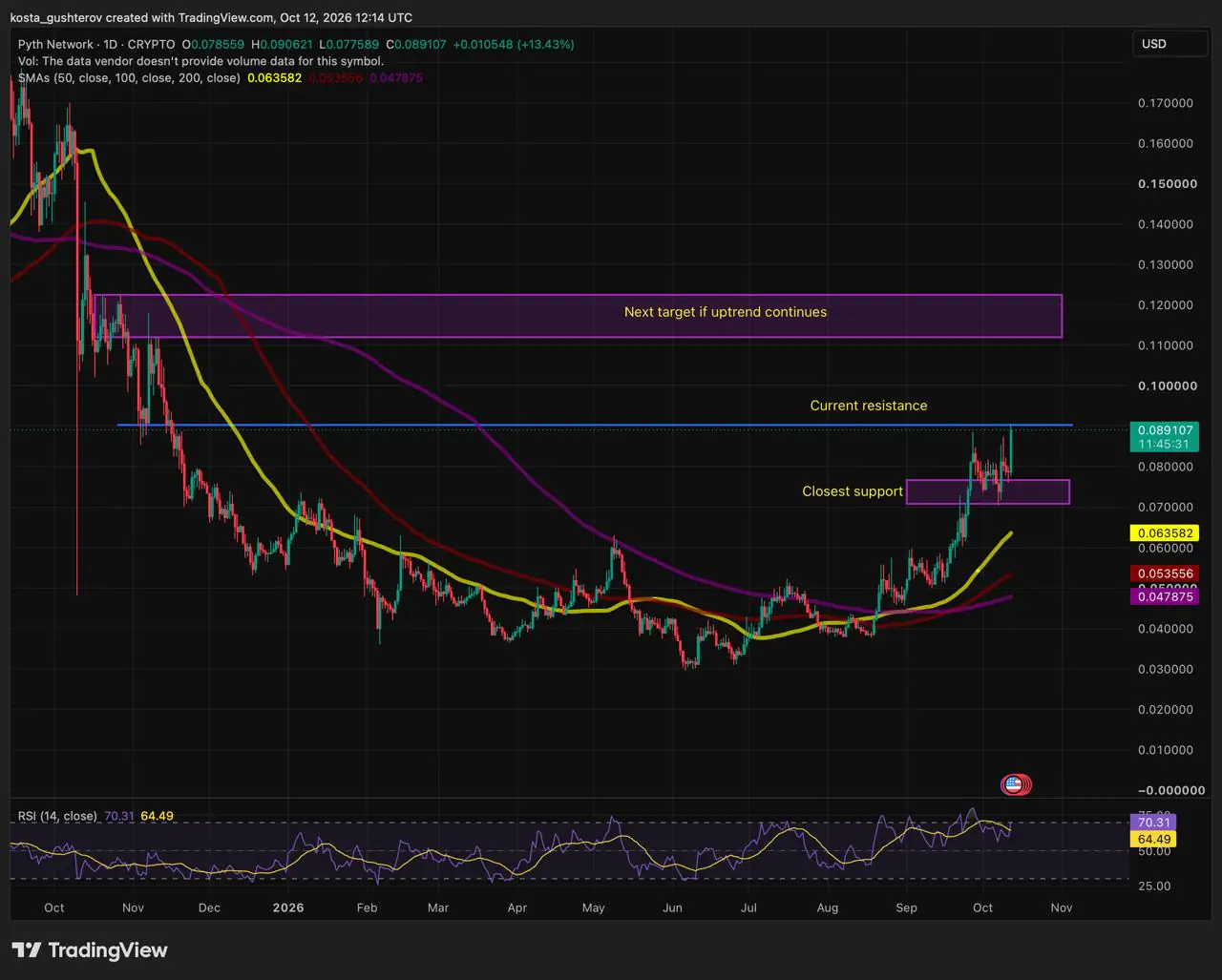
PYTH climbed to roughly $0.089 on October 12 after touching about $0.091 intraday, extending a recovery that has carried the token beyond the ceiling of its September advance and out of the range that contained it for much of the summer. With the daily candle still open at the time of writing, attention now turns to whether the token can secure a close above the $0.090–$0.091 zone. That distinction matters because intraday pushes can fade before a candle prints; the close is the reference chart-watchers use to separate a sustained breakout from a brief spike.
Breakout attempt at the first serious barrier
The latest move took PYTH beyond the $0.063–$0.065 area that limited the September rally, and away from the broader $0.030–$0.060 range where the token spent much of the summer. That earlier range matters because it separates the current advance from the long stretch of sideways trading that preceded it.
PYTH now trades above its 50-day, 100-day and 200-day moving averages. The 50-day average, near $0.064, has become the closest moving-average reference below the market. Averages over these periods are among the most widely watched references in technical analysis, and price holding above all three at once reflects a recovery spanning short-, medium- and longer-term horizons rather than a single short burst.
The immediate technical question sits at $0.090–$0.091. Price traded into that horizontal area during the day, but the candle remained open. A close above it would indicate that buyers have carried the move beyond the first obstacle; a return beneath it would leave the recent gain as an attempt rather than a completed breakout.
Where could form if the rally pauses
Strong rallies can pause without undoing the wider recovery. For PYTH, the first pullback zone lies between $0.070 and $0.076, where price consolidated after its initial September run. A hold there would preserve the pattern of higher lows underpinning the latest advance. Prior trading areas carry weight as potential support because buyers have already appeared there once, which is why the zones below do much of the work in framing the pullback picture.
The levels that frame the near-term picture:
- $0.070–$0.076 — the recent consolidation area and the first zone where a pullback could settle.
- $0.063–$0.065 — the rising 50-day average and the former September ceiling.
- $0.112–$0.122 — the next visible resistance range if PYTH establishes itself above the current barrier.
The deeper 100-day and 200-day averages remain near $0.05, supporting the broader improvement in trend. The nearer two zones, however, are likely to matter more if traders take profit after the rapid rise.
The "100% Rule" ties product revenue directly to PYTH purchases
Token economics provide a separate reason the rally has drawn attention. On October 8, Pyth announced that its DAO had passed OP-PIP-136, known as the "100% Rule". The policy directs 100% of the eligible funds the DAO receives from Pyth products into open-market PYTH purchases for its reserve.
The rule replaces the earlier framework, under which one-third of the DAO's non-PYTH balance was allocated to purchases through recurring votes. The practical difference is procedural: rather than depending on each recurring vote to allocate a fraction of non-PYTH balances, the new rule applies the full allocation automatically as eligible funds arrive.
The wording sets an important limit: it applies to funds that reach the DAO, not to every dollar of gross product sales across the Pyth ecosystem. Tokens bought under the policy also enter the reserve; they are not automatically burned or distributed to holders. That distinction is central to how the mechanism works: purchases accumulate tokens on the DAO's balance sheet rather than reducing total supply, so the rule ties revenue to ongoing buying rather than to scarcity. Even so, the change gives the network's commercial activity a more direct route to the token than the previous process.
Pyth said the first purchases under the new authorization were executed on September 30, and reported September annual recurring revenue of $11.5 million. Those figures describe the scale of the model rather than a guaranteed level of future buying.
The Data Marketplace behind the revenue model
Pyth launched its Data Marketplace in April, adding Euronext FX, Exchange Data International, Fidelity Investments, OTC Markets Group, SGX FX and Tradeweb as publishers. The service allows institutions to distribute data such as foreign-exchange benchmarks, ETF valuations and over-the-counter pricing while retaining control over attribution and commercial terms.
That announcement predates the October price move and cannot by itself explain why PYTH rose today. Its relevance lies in the new buyback policy: the Marketplace is one of the products whose eligible revenue can feed the DAO reserve. Continued use of those products, rather than the publishers' names alone, will determine whether the policy creates a meaningful source of recurring purchases.
The daily close may define the next stage
PYTH has already moved above September's high, giving the recovery a firmer structure than its earlier rallies. A confirmed break through the current barrier would place the $0.112–$0.122 range on the chart's horizon, while a retracement that holds the first support band would leave the wider uptrend intact. In practice, that means watching the daily close against $0.090–$0.091, the behavior of any pullback around $0.070–$0.076, and the pace of purchases recorded under the 100% Rule, which began with the September 30 execution.
This article is for informational purposes only and does not constitute investment or trading advice. Technical levels are approximate and do not guarantee future price movements.
Originally reported by Coindoo.

