Angry Investors Storm PXES Offices in Nigeria Amid Suspected Ponzi Scheme Collapse
Key Takeaways
- •PXES investors stormed offices in Kabba, Kogi State and Yola, Adamawa State after the platform halted withdrawals in early September 2026.
- •PXES, which claims Melbourne headquarters and entered Nigeria in July 2025, paid users commissions for simple online promotional tasks and is described by experts as a Ponzi scheme.
- •The PXES collapse follows a series of major Nigerian Ponzi failures, including CBEX with estimated losses of ₦1.3 trillion in 2025 and MBA Forex, which raised about ₦171 billion before shutting down in 2020.
- •Task-based and referral-driven platforms operate in a regulatory grey area that complicates early intervention by Nigeria's Securities and Exchange Commission.
- •One investor reported losing ₦209,000, and it remains uncertain whether victims will recover funds through regulatory action, law enforcement, or the courts.
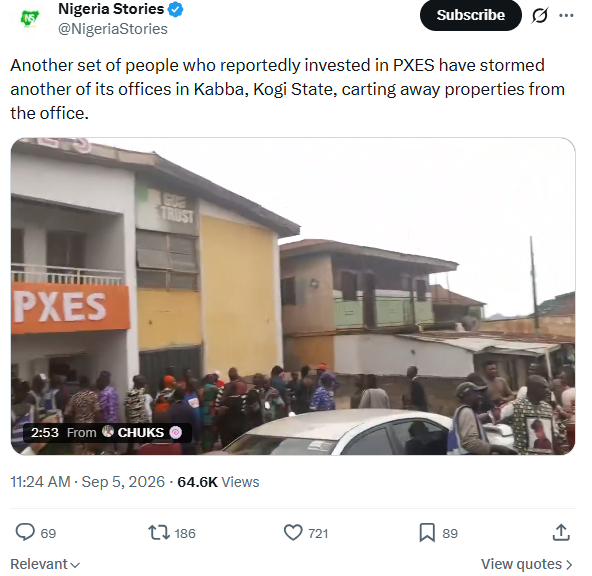
Frustrated investors in PXES, an online investment platform, stormed the company's office in Kabba, Kogi State, after losing access to their funds, with reports indicating that they removed office furniture and equipment in protest. The confrontation followed a similar incident at PXES' Yola office in Adamawa State, where investors reportedly forced their way onto the premises after withdrawal requests failed.
PXES describes itself as a global e-commerce and digital marketing company headquartered in Melbourne, Australia, and entered the Nigerian market in July 2025. Members could earn commissions by completing simple promotional tasks, such as reviewing products online. According to the company, it returned 60% of service fees to participants as an incentive. Task-based earning apps of this kind have proliferated in Nigeria in recent years, in part because they tap into a large population of young, digitally connected Nigerians seeking income opportunities amid high youth unemployment — a demographic that fraud researchers have repeatedly noted is heavily targeted by such platforms.
Many experts, however, now describe the platform's structure as a Ponzi scheme: it relied on funds from new members to pay returns to existing ones rather than generating legitimate profits. The situation deteriorated in early September 2026, when the platform became inaccessible and withdrawals were halted, triggering widespread panic among investors.
Viral videos circulating on social media show investors confronting PXES staff and demanding their money back. One distressed investor reported losing ₦209,000. With the company offering no clear answers, some frustrated individuals resorted to taking office items as a form of informal recovery — a pattern seen in previous collapses, including the 2025 CBEX failure, when crowds similarly stormed the firm's offices after withdrawals froze.
PXES is only the latest in a long line of Ponzi schemes that have drained the savings of many Nigerian families, often within just a few months of launching.
In 2025, a scheme known as CBEX, or Crypto Bridge, collapsed with losses estimated at ₦1.3 trillion, making it one of the largest Ponzi failures in Nigerian history. Earlier, MBA Capital and Trading — commonly referred to as MBA Forex and led by Maxwell Odum — raised approximately ₦171 billion before shutting down in 2020.
Wales Kingdom Capital lost investors around ₦40 billion, while Imagine Global Solutions accounted for roughly ₦22 billion in losses. Among the most notorious cases, MMM Nigeria, which captured the country's attention in 2016, resulted in ₦18 billion in losses and is still vividly remembered. Racksterli, which was endorsed by several Nigerian celebrities, led to losses of about ₦1 billion, and Zedekiah Money Train affected more than a million people.
Just a few months ago, XM Future Music Group attracted investors by promising 100% returns within 30 days simply for listening to music, with participation costs ranging from ₦21,600 to a staggering ₦93 million.
The pattern across these schemes, including PXES, is a familiar one. They promise high and unrealistic returns for minimal effort. Early investors receive payouts funded by money from new participants, creating a false impression of success. This "social proof," reinforced by referral bonuses, drives rapid growth — pulling in participants faster than any legitimate business could sustain.
Eventually, once the influx of new money slows — as it always does — the scheme fails to pay out, communication breaks down, and the operators either vanish or blame technical issues, leaving investors empty-handed.
The human cost of these collapses is often obscured by aggregate loss figures. Every naira lost to PXES represents someone's rent, a child's school fees, or emergency savings. The investor who lost ₦209,000 is not alone; he stands for countless Nigerians in Kogi, Adamawa, and likely other states who trusted a platform that could never deliver the returns it promised.
The repeated failure of such platforms underscores a broader problem: the absence of effective regulatory measures before these schemes inflict massive financial damage. Nigeria's Securities and Exchange Commission (SEC), which maintains a public watchlist of unregistered investment platforms and periodically warns Nigerians against them, has repeatedly cautioned that only SEC-registered entities are authorized to pool public funds for investment. However, many task-based and referral-driven platforms operate in a grey area outside the scope of conventional securities regulation, which complicates early intervention. By the time authorities or the public become aware, the money is typically already gone and the operators are difficult to trace — a challenge made harder when, as with PXES, the claimed headquarters lies abroad.
For many Nigerians, the lesson of the PXES experience echoes those of past failures such as CBEX, MBA Forex, and MMM Nigeria: be cautious of any platform promising exceptionally high returns with little risk or effort, particularly one that depends on recruiting others or performing simple online tasks. No matter how professional a website or office may appear, scepticism remains warranted. Whether the victims of PXES recover anything — through regulatory action, law enforcement, or the courts — is the question that will now determine how this collapse is remembered.
Related reading: 8 Ponzi schemes that wiped out trillions from Nigerian investors and Ponzi Scheme: SEC flags Glorious Wealth Fund as an illegal investment platform
