PVFARM Launches Commercial RE STACK Platform for Utility-Scale BESS Layout Design
Key Takeaways
- •PVFARM has commercially launched RE STACK, a platform that enables engineers to configure utility-scale BESS projects and explore site layouts prior to detailed engineering.
- •The platform allows rapid evaluation of equipment spacing, road networks, medium-voltage collection topologies, and fire safety access using manufacturer specifications.
- •PVFARM is currently testing RE PILOT, a complementary tool that identifies optimal solar site layouts by evaluating energy output, CapEx, LCOE, storage potential, and grid interconnection constraints.
- •More than 80 companies participated in beta testing both platforms, providing feedback on equipment selection, power conversion system architecture, augmentation planning, and site topology.
- •The tools aim to help engineering teams explore more layout options early in the design process as utility-scale renewable energy projects grow in complexity and interconnection queues lengthen.
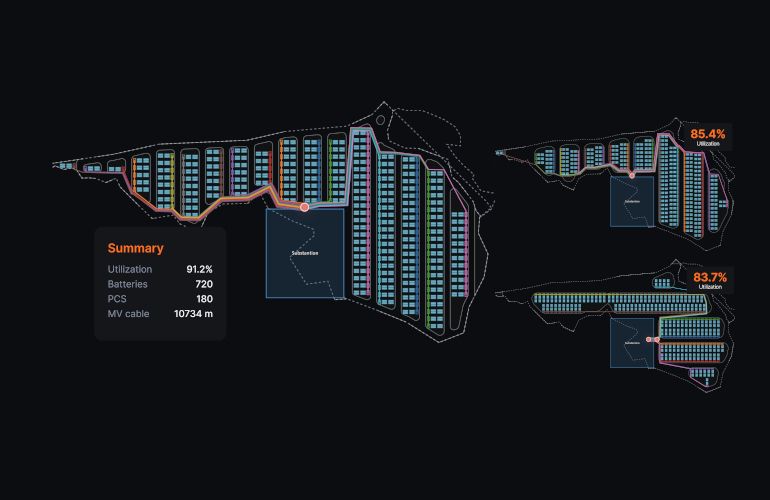
PVFARM has entered the energy storage design market with the commercial launch of RE STACK, a platform for utility-scale battery energy storage system (BESS) layout exploration. The launch comes as utility-scale storage deployment accelerates globally, driven by renewable energy expansion and grid-reliability needs, placing growing pressure on engineering teams to deliver projects faster and with fewer costly late-stage design changes. Together with the original PVFARM solar design platform, RE STACK forms part of an expanding suite of tools that enables engineering teams to evaluate a broad range of layout options before advancing to detailed engineering.
RE STACK allows engineers to configure utility-scale BESS projects using manufacturer specifications and rapidly explore site layouts, road networks, and medium-voltage collection topologies prior to the detailed engineering phase. Early-stage layout decisions—covering equipment spacing, road access for maintenance and fire safety, and electrical collection design—are among the most consequential for project cost and constructability, yet have traditionally relied on time-intensive manual iteration. The platform is available at restack.pvfarm.io.
In addition, PVFARM is currently testing RE PILOT, a complementary tool designed to rapidly identify optimal solar site layouts by evaluating energy output, capital expenditures (CapEx), levelized cost of energy (LCOE), and energy storage potential. RE PILOT also addresses point-of-interconnection (POI) and grid-limit constraints across thousands of site configurations—factors that increasingly determine project viability as interconnection queues lengthen and grid operators impose stricter connection limits.
More than 80 companies collaborated during the beta testing of RE STACK and RE PILOT, directly influencing the platforms' development. Beta participants provided feedback on critical design considerations including equipment selection, power conversion system (PCS) architecture, augmentation planning, fire safety access, and site topology. PVFARM stated that this collaboration ensured the platforms address real-world project challenges while reflecting current technology trends and market dynamics.
"The future of engineering isn't just designing faster. It's exploring more before you design," said Maksim Markevich, Chief Technology Officer of PVFARM. "With RE STACK and RE PILOT, we're giving engineering teams the ability to evaluate far more possibilities before committing to detailed engineering. The result is better-informed decisions, greater confidence, and a workflow that keeps pace with the growing complexity of utility-scale renewable energy projects."
Source: Solar Power World
