Pump.fun Launches Perpetual Futures Trading Powered by Hyperliquid
Key Takeaways
- •Pump.fun now offers Bitcoin perpetual futures with up to 40x leverage and Ethereum perpetuals with up to 25x leverage, with trades executed on Hyperliquid's infrastructure rather than a proprietary engine.
- •Under the arrangement, Pump.fun provides only the front-end interface, while Hyperliquid's HyperCore manages order matching, margin balances, funding payments and liquidations.
- •The launch marks a strategic shift for Pump.fun, which launched in January 2024 as a Solana-based memecoin launchpad and is now adding derivatives alongside its spot trading services.
- •Pump.fun had recently surpassed Hyperliquid in both weekly and 30-day protocol revenue, making it simultaneously a competitor and an infrastructure customer of the exchange.
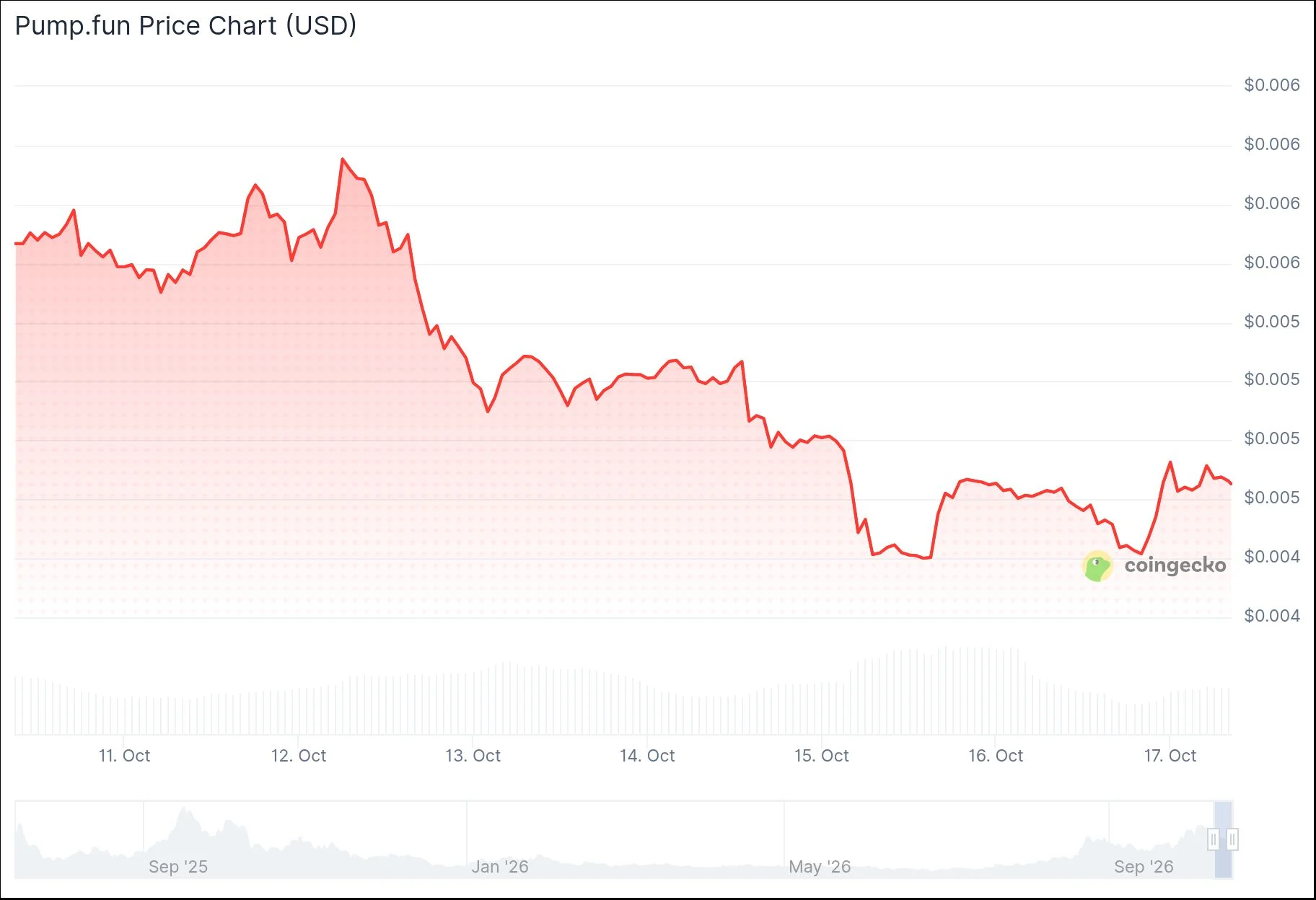
- •Despite the launch, access to the leveraged products is restricted in the United States, Ontario and other prohibited jurisdictions, and the PUMP token fell 5.35% over the past 24 hours to $0.004320.
Pump.fun has expanded beyond its memecoin-launchpad roots with the launch of crypto perpetual futures trading. The new service runs on Hyperliquid's decentralized trading infrastructure, and eligible users can now trade leveraged contracts directly from the Pump.fun interface.
News of the rollout circulated on X on October 16, 2026:
Pumpfun is launching perpetual futures. The memecoin launchpad is adding BTC and ETH perps powered by Hyperliquid, using Hyperliquid's order book instead of building its own derivatives engine. W? pic.twitter.com/r3jQNN6nFI
— 0xMarioNawfal (@RoundtableSpace) October 16, 2026 (x.com)
The platform is offering Bitcoin (BTC) perpetual contracts with leverage of up to 40x, while Ethereum (ETH) contracts carry leverage of up to 25x. Traders do not need to own the underlying assets to take positions on either market.
The public launch followed the discovery of perpetual trading data in Pump.fun's application programming interface on October 9, roughly a week earlier. That data included funding rates, open interest and trading volumes sourced from Hyperliquid's HyperCore mainnet, indicating a derivatives rollout was already in progress. Because matching, margin and funding all run on HyperCore, those same metrics offer a public window into how much activity the new markets attract over time.
How the Hyperliquid Integration Works
Pump.fun did not build its own derivatives engine. Instead, it uses Hyperliquid's existing order books and liquidity. Users interact with the Pump.fun interface while their trades execute on Hyperliquid, and the platform's terms split responsibilities accordingly: HyperCore manages order matching, margin balances, funding payments and liquidations, while Pump.fun provides the front end.
Perpetual futures are derivative contracts with no expiration date. The funding rate is a periodic payment exchanged between long and short traders, and it keeps the contract price close to the underlying market price.
The two platforms already had an established connection. In August, Pump.fun added support for HyperEVM, Hyperliquid's smart contract environment, which allowed users to trade spot pairs with USDC. At the end of August, Hyperliquid recorded approximately $12.43 billion in daily perpetual futures trading volume. That level of liquidity enables Pump.fun to offer derivatives without operating a separate order book of its own. The setup also gives Hyperliquid another distribution channel for its existing order books. Hyperliquid has also been working on bringing commodity futures to regulated U.S. markets.
Pump.fun's Shift From Memecoins
Pump.fun launched in January 2024 as a memecoin launchpad and built its business around Solana-based memecoin launches and trading. The new product adds derivatives alongside its existing spot trading services, marking a clear shift in the platform's direction.
The platform has also competed directly with Hyperliquid on protocol revenue during 2026. In late September, Pump.fun's weekly revenue reached $15.16 million, narrowly ahead of Hyperliquid's $15.06 million. By early October, Pump.fun had additionally passed Hyperliquid in 30-day revenue. The derivatives launch adds a wrinkle to that rivalry: Pump.fun is now simultaneously a revenue competitor and an infrastructure customer of the exchange it is racing against.
Pump.fun is not entering the market unopposed. Rival platform FOMO introduced Hyperliquid-based perpetuals trading in June 2026, meaning Pump.fun is following a competitor into the niche. The launch nonetheless gives Pump.fun a new way to earn fees from derivatives activity — income tied to trading in major assets such as BTC and ETH rather than to new memecoin issuance.
Access to perpetual futures on Pump.fun is restricted in the United States, Ontario and other prohibited jurisdictions, keeping the leveraged products out of several major markets.
Despite the launch, the platform's PUMP token fell 5.35% over the past 24 hours, trading at $0.004320.
Source: CoinCentral

