Pump.fun Token Count Raises Questions After 30% PUMP Price Drop
Key Takeaways
- •A widely shared X post claims that only 312 of 24.4 million Pump.fun tokens—about 0.00128%—currently hold a market capitalization above $100,000, though the underlying dataset could not be independently verified.
- •The tally reflects current valuations rather than tokens that historically reached the threshold, and comparisons with Stonk.fun's roughly 0.038% share require consistent collection times and valuation methods.
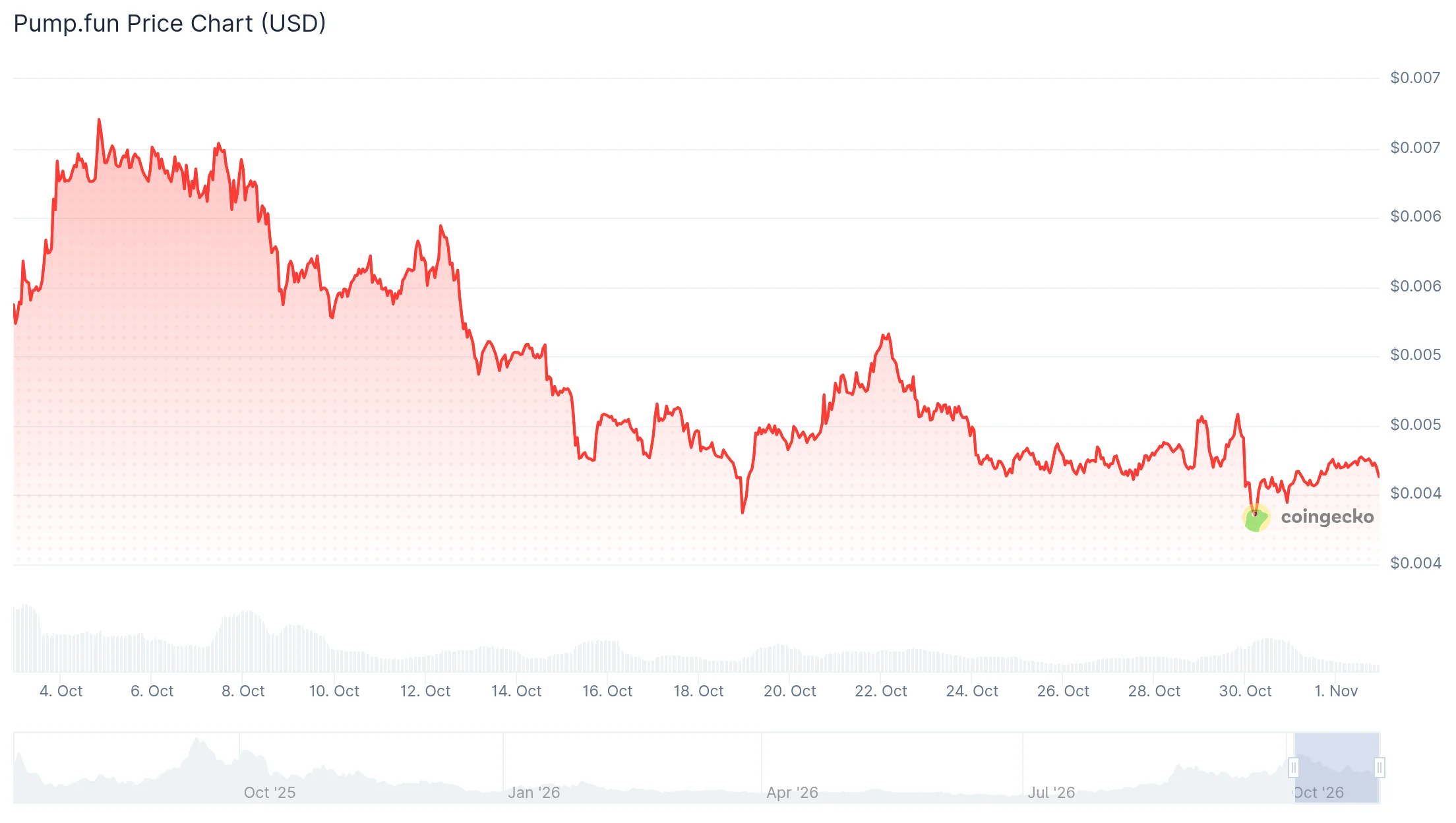
- •PUMP fell nearly 30% in October as the memecoin market lost 15% of its capitalization, shedding more than $5 billion, underperforming Dogecoin's near-20% and Ethereum's roughly 16% declines.
- •Co-founder Alon attributed the token's short-term weakness to broader market conditions while expressing optimism about longer-term prospects, and analysts have identified $0.004 as a support level.
- •Pump.fun charges no fee to create tokens but earns a 0.95% protocol share of its 1.25% bonding-curve trading fees, making its revenue dependent on sustained trading activity across hosted tokens.
Pump.fun is facing renewed scrutiny after an X post claimed that only 312 tokens launched on the platform currently have a market capitalization above $100,000. The tally covered 24.4 million launches, suggesting that approximately 0.00128% of them—about one token for every 78,205 launches—held that valuation when counted.
The figure measures current valuations, however, and does not show how many tokens previously exceeded $100,000 before losing value. That distinction is important when comparing launch platforms or evaluating how activity translates into lasting value. Ratios like this one draw attention because they offer a quick way to judge how often launches hold value over time, even though a single market-cap threshold captures only part of that picture. The underlying dataset behind the widely shared posts could not be independently verified.
Pump.fun Token Figures Raise Questions Over Lasting Demand
An archived Market Insider post listed 24.4 million Pump.fun launches and 312 tokens currently above $100,000. Rounding the launch total to 24 million produces the widely cited 0.0013% share. Both calculations refer to tokens holding that valuation at the time of measurement, rather than every token that reached it historically.
The same comparison cited 75 tokens above $100,000 among 197,664 launches on Stonk.fun. That represents approximately 0.038%, or around 30 times the share calculated using Pump.fun’s 24.4 million launches.
holders will become very rich in better market conditions if you have the foresight to see the end at the light of the tunnel, you'll see just how bright things are — alon (@a1lon9) October 31, 2026
Comparisons between the platforms require consistent collection times and valuation methods. Different coverage of tokens traded elsewhere could also affect the results, particularly because the platforms have very different launch totals. Token age is another factor: newer launches have had less time to attract buyers or lose value. Until such methodology is clear, the 0.00128% figure functions best as one snapshot rather than a definitive ranking of launch platforms.
Neither social media count establishes the likelihood of an individual trader making money. For Pump.fun, the figures provide only a limited measure of current valuations. Active traders, repeat users and transaction volume would offer more direct evidence of demand for the platform.
A token can trade actively while remaining below a specific market-capitalization threshold. Conversely, a token above $100,000 may have limited liquidity, affecting how easily holders can sell. Market capitalization is calculated by multiplying token supply by price, but it does not show how much money buyers could withdraw from trading pools. Evaluating token outcomes therefore also requires information about trading depth, holding periods and actual returns.
According to Pump.fun’s documentation, the platform charges no fee to create a coin. Creators still pay network transaction costs and deposits required for on-chain accounts, which lowers the financial barrier to launching. That structure helps explain the scale of the launch count itself: when creation costs little, total launches reflect how easy it is to start a token as much as sustained interest in any of them.
PUMP Price Falls as Memecoin Market Loses Ground
PUMP fell nearly 30% in October as the memecoin market lost 15% of its capitalization, shedding more than $5 billion. The same report put the decline in the broader cryptocurrency market at approximately $250 billion. Memecoins therefore accounted for about 2% of those reported dollar losses. Their smaller contribution reflects the category’s relative size, while the percentage decline indicates weakness within the segment.
Dogecoin dropped almost 20% during the period, while Ethereum lost about 16%. PUMP underperformed both, with its near-30% decline exceeding those reported losses.
Pump.fun co-founder Alon linked the token’s short-term weakness to broader market conditions and remained optimistic about its longer-term prospects. The parallel price declines are consistent with shared market pressure, although price comparisons alone cannot establish the causes of selling.
Pump.fun depends on continued trading across newly launched tokens and existing pools. Weaker turnover could reduce fee income even if creators continue producing new coins, making sustained participation relevant to the platform’s business and to activity surrounding PUMP. Trading volume and repeat usage therefore double as indicators to monitor alongside token prices when assessing how platform demand is holding up.
Analysts have identified $0.004 as a support level for the token. Whether buyers defend that area depends on demand, available liquidity and broader trading conditions. Any updated tallies of tokens above the $100,000 threshold would be most comparable if they used the same collection times and valuation methods as earlier counts.
Pump.fun’s published fee schedule provides further detail about its revenue model. Its bonding curve charges total trading fees of 1.25%, consisting of a 0.95% protocol share and a 0.30% creator share. A bonding curve is an automated pricing mechanism that ties a token’s price to its supply, which is why the platform’s revenue rises and falls with trading activity across the tokens it hosts.

