Psychologist Points to 'Dementia' Signs in Three 'Peculiar' Trump Encounters
Key Takeaways
- •Dr. John Paul Garrison, a clinical and forensic psychologist who specializes in body language, identified three recent encounters involving President Trump that he says resemble dementia-related behavior, though he emphasized this is not a formal diagnosis.
- •In a viral video, Trump appeared to salute near Marine One and waved twice toward areas where no saluting Marines or clearly visible people appeared once the camera pulled back, although Reuters reported he may have been waving at construction workers.
- •At a Dalton, Georgia event, Trump walked past his open-door limousine, known as "The Beast," toward an open field, prompting Secret Service agents to guide him back to the vehicle.
- •Garrison cited Trump's heated confrontation with Independent reporter Andrew Feinberg as showing evident agitation, noting that people as dementia advances tend to struggle with regulating emotions.
- •Garrison said misinterpreting one's surroundings can occur in people with neurodegenerative disease, and he plans to continue observing the president, whose health is treated as a matter of public interest given the office's broad consequences.
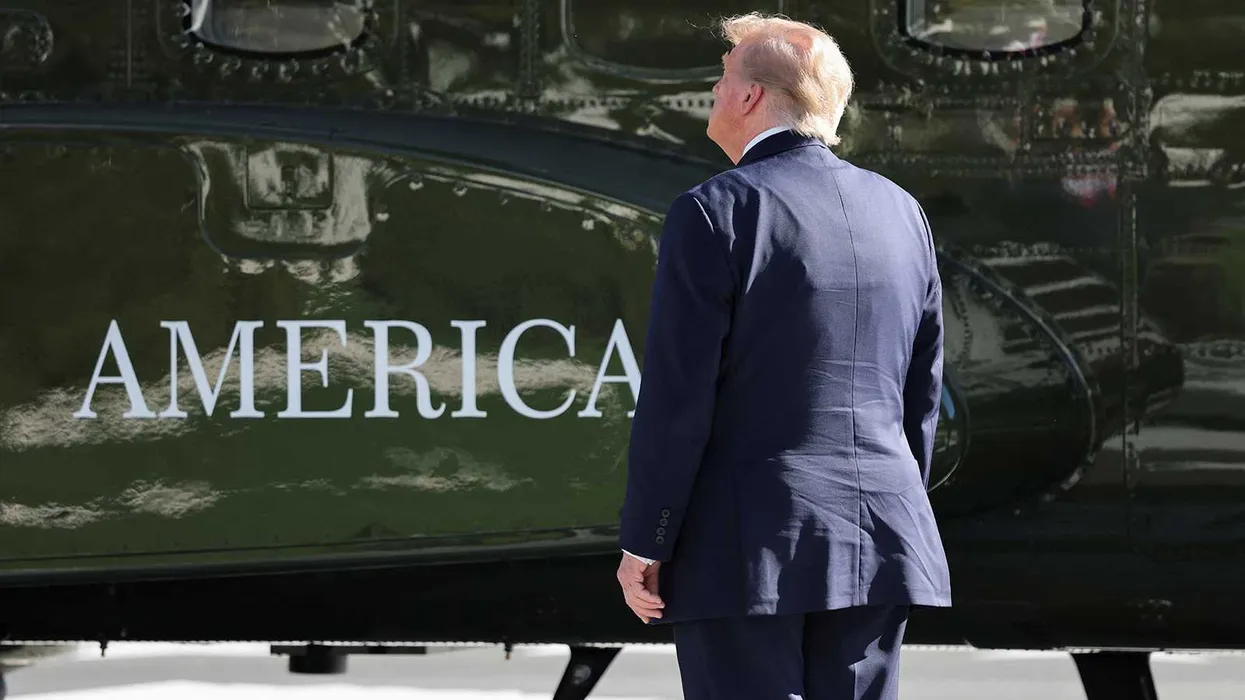
Dr. John Paul Garrison, a clinical and forensic psychologist who specializes in interpreting body language, has flagged what he considers a problematic moment of confusion by President Donald Trump, pointing to three recent encounters that he says resemble behavior seen in people with dementia. His remarks are drawn from publicly available footage and describe patterns he associates with dementia rather than a formal diagnosis, which would require direct clinical evaluation.
The first incident involved a video that went viral this week showing Trump appearing to salute his Marine One helicopter. Under the typical arrangement, two Marines stand on either side of the stairs when Trump boards the aircraft, and presidents usually return their salute. In the clip, Trump did return a salute — but no one was standing there saluting in the first place.
"So, if you notice in the background, there is a construction worker back there. He is not positioned where President Trump is going to be looking in a minute, but I do want to acknowledge that there is somebody back there," Garrison said. "And down at the bottom of the hill there, it appears that those might be police or something similar. Some sort of law enforcement appears to be at the bottom of the hill."
In the footage, Trump appears to wave toward the law enforcement officers, then looks up and off into the distance. When the camera pans out, no one else is visible in the frame.
"Now, Reuters has said that he was waving at construction workers. They have a photograph that is captioned that. So, it is possible maybe that there's some back there. I can't see them when the camera pulls back," he acknowledged.
"So, to do it twice is peculiar behavior," the doctor noted. "Obviously, it's more peculiar if absolutely nobody's there, but it would be surprising if he waved at them and then did it again shortly afterward. So, as the camera pulls back, we can clearly see that there doesn't appear to be anybody else unaccounted for in the frame."
Garrison said such moments are known to occur in people who have neurodegenerative disease and people who have dementia.
"They misinterpret their environment around them. Sometimes they see things that aren't there. But something like this could happen from neurodegenerative problems," Garrison explained. "It's also impossible that this is socially inappropriate behavior because somebody was way far away and couldn't even see him. Maybe he thought that they could. There could be misunderstandings about how the world around him is functioning."
He said it is something he intends to keep an eye on. The scrutiny is a fixture of the modern presidency: presidents are filmed almost continuously, and the health of whoever holds an office with consequences this broad is treated as a matter of public interest.
The second incident took place in Dalton, Georgia. In that video, Trump leaves the stage as his Village People song plays. The presidential limousine, known as "The Beast," is parked with its doors open and ready for him, but Trump appears to walk past it and toward an open field. Secret Service agents scramble to usher him toward the car.
"This is the type of behavior you would expect for someone who is dealing with dementia, who's dealing with Alzheimer's type dementia or vascular dementia potentially," Garrison explained. "There's a wide variety of different issues that could contribute to this kind of behavior. But this type of wandering off, the lack of social awareness, all of those do seem like they are related to some form of neurological decline."
Finally, Garrison addressed Trump's clash with Independent reporter Andrew Feinberg. The agitation was evident in the encounter, he noted, adding that as people advance further into dementia, they tend to struggle with regulating their emotions.
"He doesn't know how to control these strong feelings he's having," Garrison said.

