ProvidusUnity Bank customers report service disruptions two months after merger
Key Takeaways
- •Customers of the newly merged ProvidusUnity Bank have reported delayed or failed transfers, app login failures, missing alerts, and network outages that prevented some businesses from paying staff.
- •ProvidusUnity Bank became Nigeria's ninth-largest bank by assets after the merger, operating 229 branches, serving roughly 3.6 million customers, and reporting ₦4.49 trillion in total assets as of fiscal year 2024.
- •The Central Bank of Nigeria supported the merger with a ₦700 billion loan as part of its broader recapitalisation push following its 2024 directive raising minimum capital thresholds.
- •The Supreme Court finalised the merger in mid-2026 by dissolving Unity Bank's board and approving the ProvidusUnity name, resolving a shareholder legal dispute.
- •The bank has not publicly responded to the complaints, and the service issues are seen as a test of how smoothly recapitalisation-era consolidations can be executed.
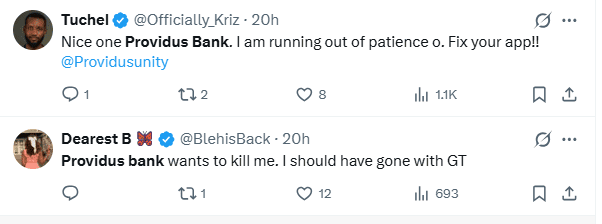
Two months after Providus Bank and Unity Bank combined to form ProvidusUnity Bank Limited, customers are voicing frustration online over persistent service problems at the newly merged institution.
The complaints include transfers that vanish for hours or even days, login failures on the bank's mobile app, missing transaction alerts, and businesses unable to pay staff because of ongoing network failures. One customer reported that a transfer had still not gone through nearly a full day after it was initiated — the second time that week the same problem had occurred. Another user said they had been unable to log into the app or receive alerts since the merger took effect. A business owner described being unable to pay salaries for two consecutive days due to the bank's poor service.
Several clients who had previously relied on the bank for significant transactions, such as car purchases, said funds had been stuck for hours during crucial payments.
A common thread runs through many of the complaints: customers directly attribute the decline in service to the merger, with some noting that Providus had built a strong reputation for digital banking before teaming up with Unity Bank. "Ever since Providus Bank merged with Unity Bank, their services have really declined," one user commented on X, a sentiment echoed by many others. Some users also observed that complaints about the bank have become increasingly frequent.
Not every customer has had a negative experience, however. At least one user stated that their banking services have worked well since the merger, a reminder that these issues can affect customers differently depending on their location, account type, or the system their account was on before the consolidation.
The wave of complaints stands in stark contrast to how the merger was presented when it was finalised in mid-2026. At that time, the Supreme Court dissolved Unity Bank's board and approved the ProvidusUnity Bank name for the combined entity, resolving a legal dispute between two Unity Bank shareholders that had threatened to delay one of Nigeria's most significant banking consolidations.
Following the merger, ProvidusUnity Bank became the ninth-largest bank in Nigeria by assets, with 229 branches and roughly 3.6 million customers. The combined institution reported a total asset base of ₦4.49 trillion as of the fiscal year 2024. The deal brought together two very different lenders: Providus Bank, known since 2017 for its digital-first approach and focus on small and medium-sized enterprises (SMEs), and Unity Bank, recognised for its extensive physical branch network and long-established presence across the country.
The Central Bank of Nigeria backed the merger with a ₦700 billion loan, underscoring its role in a broader push to consolidate the banking sector and ensure banks meet new capital requirements. That push dates to the CBN's 2024 recapitalisation directive, which raised minimum capital thresholds for commercial banks and gave smaller lenders a deadline to shore up their capital bases — pressure that pushed several institutions toward mergers and acquisitions rather than trying to raise capital alone. For mid-sized banks like Providus and Unity, combining assets was one route to meeting the new thresholds, and how smoothly such consolidations are executed has become a wider test of the recapitalisation exercise. At the outset, the two banks framed the combination as a way to blend Unity's tradition of seamless service with Providus's strengths in technology and digital banking, with the aim of creating a stronger competitor to Nigeria's largest banks.
Integrating two banks requires complex work to unify their systems and databases, a process that can take considerable time. Providus's existing infrastructure was built for its own customer base, making it challenging to absorb Unity Bank's 3.6 million customers and larger branch network. As a result, issues such as transfer delays, login problems, and missing alerts have emerged.
So far, the bank has not publicly addressed the complaints. That silence is particularly notable for an institution long known for digital reliability, and it comes at a moment when the CBN is watching whether recapitalisation-era mergers deliver on their promised benefits. The success of the merger will depend on whether these issues can be resolved quickly — before customer frustration deepens.
Related reading: Providus and Unity Bank officially merge into ProvidusUnity Bank Limited; Supreme Court sanctions Unity-Providus Bank merger, ending legal battle

