Proposed Federal Rule Could Broaden Crypto Access Within U.S. 401(k) Retirement Plans
Key Takeaways
- •The proposal could broaden access to cryptocurrency in employer-sponsored 401(k) plans, but no specific plan is required to add it.
- •The White House has directed regulators to review how alternative assets can be included in retirement accounts, reversing the tone of the Labor Department’s 2022 cautionary guidance.
- •Fidelity introduced a Digital Assets Account in 2022 that allowed some plan participants to allocate to Bitcoin, though adoption was limited.
- •Plan sponsors would still have to meet ERISA fiduciary duties, and concerns remain about crypto volatility and compliance obligations.
- •Key next steps include proposal text, a public comment period, and possible revised or final Labor Department guidance.
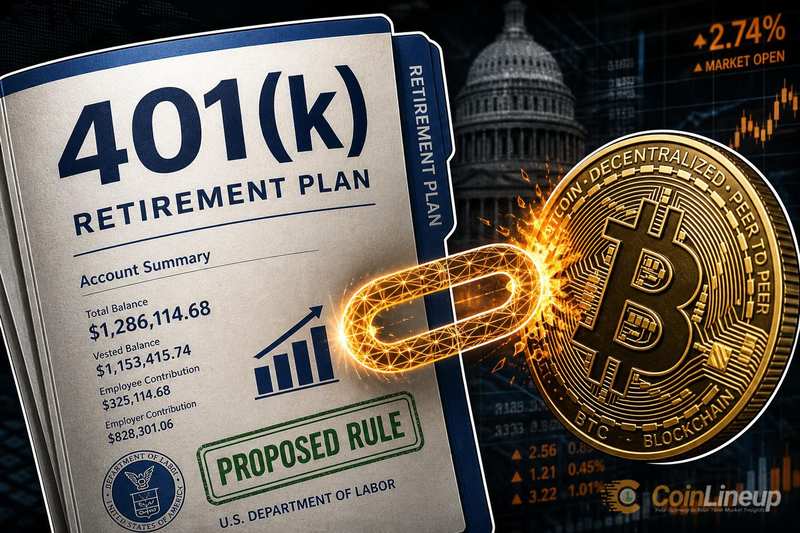
A proposed federal rule could expand 401(k) crypto access for U.S. retirement savers, potentially making digital assets such as Bitcoin easier to offer within employer-sponsored retirement plans. The measure remains a proposal rather than a final rule, and any real-world availability would still depend on decisions made at the individual plan level.
What the Proposed 401(k) Rule Could Change
A 401(k) is an employer-sponsored retirement account that allows workers to set aside pre-tax income for long-term savings, typically selecting from an investment menu chosen by their employer. These plans operate under the Employee Retirement Income Security Act of 1974 (ERISA), the federal statute that imposes fiduciary standards on plan sponsors and administrators. Historically, those menus have centered on stocks, bonds, and target-date funds, with digital assets rarely included.
The current policy direction traces back to a White House action titled "Democratizing Access to Alternative Assets for 401(k) Investors," which directs regulators to reexamine how alternative assets can be offered within retirement plans. This represents a notable shift from the Department of Labor's March 2022 Compliance Assistance Release No. 2022-01, which warned plan fiduciaries to exercise "extreme care" before adding cryptocurrency to 401(k) menus — guidance that discouraged many employers from considering digital-asset options.
The Department of Labor's Employee Benefits Security Administration has moved forward on retirement-plan guidance, including a May 2025 announcement and a further 2026 release. For savers, the key takeaway is that this remains a proposed shift in how plans may treat crypto — not a guarantee that any specific plan will add it.
Why It Could Matter for Retirement Savers
If crypto becomes easier to offer inside retirement accounts, the practical effect would be greater choice on some plan menus, giving participants who want digital-asset exposure a pathway to it within a tax-advantaged account. Americans hold trillions of dollars collectively in 401(k) plan assets, meaning even gradual adoption could broaden the population with retirement-linked exposure to digital assets.
Much of the framing centers on employers and plan administrators gaining more discretion to include alternative assets. Fidelity Investments, among the largest 401(k) plan providers, introduced a Digital Assets Account product in 2022 enabling employer-plan participants to allocate to Bitcoin, though uptake remained limited amid the prior regulatory climate. One report argued that everyday savers could gain Bitcoin exposure through their retirement plans without directly using a crypto app.
Potential access, however, is not the same as suitability. Whether crypto fits any individual saver's goals remains a separate question, and adoption would still hinge on plan-level decisions by employers rather than an automatic, market-wide rollout.
Risks, Open Questions, and Next Steps
Offering crypto inside retirement plans raises fiduciary and compliance concerns, as plan sponsors carry legal duties under ERISA to act in participants' best interests. The legal tensions surrounding this issue were highlighted in 2022 when crypto-focused 401(k) provider ForUsAll sued the Department of Labor over its cautionary guidance, arguing it unlawfully restricted plan sponsors from offering digital assets. Digital-asset volatility also sits uneasily against the long-horizon, capital-preservation priorities that typically govern retirement saving.
Several key questions remain unanswered, including timing, the scope of eligible assets, and how any final requirements would be enforced. Rulemaking can change substantially between proposal and final adoption, meaning the details visible today may differ from those that ultimately apply.
The retirement-plan debate is unfolding alongside broader uncertainty in U.S. digital-asset policy, from the stalled push for comprehensive crypto legislation to the SEC's move toward tailored crypto offering rules. State-level measures, such as Hawaii's restrictions on crypto ATM cash deposits, illustrate how quickly the regulatory backdrop can shift.
The next milestones to watch are the formal rulemaking steps: the release of proposal text, any public comment period, and whether the Department of Labor issues revised or final guidance before plans begin adjusting their investment menus.
Disclaimer: This article is for informational purposes only and does not constitute financial or investment advice. Cryptocurrency and digital asset markets carry significant risk. Always conduct your own research before making decisions.

