Proof of Stake vs. Proof of Work: How the Two Consensus Systems Stack Up
Key Takeaways
- •Proof of stake can consume up to 99.9% less energy than proof of work, and Ethereum's 2022 move to proof of stake reduced its energy use by more than 99%.
- •Bitcoin has run on proof of work since 2009 without ever being compromised, yet it averages roughly 10 minutes per block compared with Ethereum's about 12 seconds.
- •Attacking a proof of work network requires controlling more than half its computing power, while attacking a proof of stake network requires buying and staking a majority of its coins, a move that would devalue the attacker's own holdings.
- •Both systems risk power concentration, since mining pools can dominate proof of work computing while large token holders or staking platforms can control proof of stake validation.
- •Bitcoin is unlikely to adopt proof of stake because a switch would demand near-unanimous agreement among developers, miners and users who prize security, decentralization and censorship resistance.
Proof of work and proof of stake are the two dominant mechanisms cryptocurrencies use to validate and record transactions. Both are designed to stop anyone from spending the same coin twice without a bank in the middle, but they go about it in very different ways. Those differences are not academic: they shape how much energy a network consumes, how quickly payments clear, and what it costs an attacker to interfere—angles examined below.
This comparison draws on figures and claims from five published sources—Coinbase, Business Insider, Hedera, Fidelity and Mercado Bitcoin—to examine how the two systems differ on energy use, speed, security and track record.
What Consensus Mechanisms Do
A blockchain is a shared record of who owns what. Thousands of computers keep copies of it, and all of the copies must match. A consensus mechanism is the set of rules that keeps those copies in agreement, letting the network confirm each transaction without a central authority such as Visa or PayPal.
Consensus also blocks double spending—the fraud in which one person tries to use the same digital coin in two different payments.
Mercado Bitcoin lists four jobs for consensus: confirming each transaction, grouping them into blocks, keeping every participant's copy in sync, and protecting confirmed records from change. Coinbase notes that it helps to understand proof of work before proof of stake, which is why the two are often explained together.
Every consensus system asks participants to prove their commitment by putting something at risk. In one system it is computing power and electricity; in the other, it is the participant's own coins.
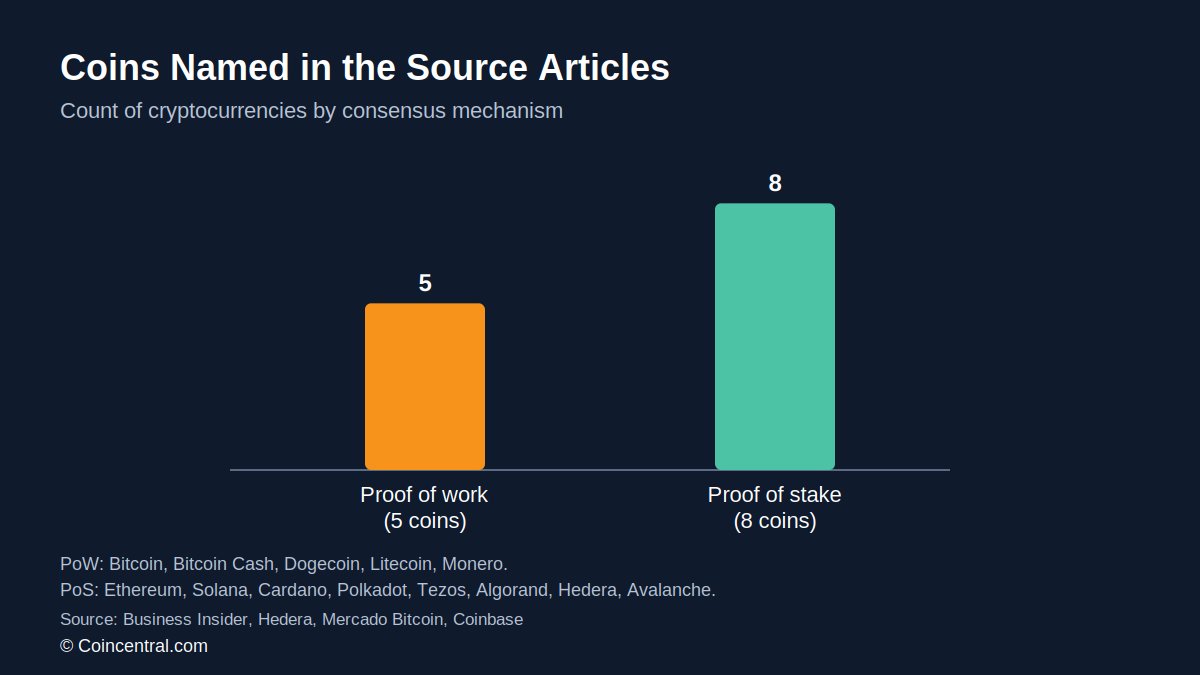
Proof of work is the older model. Bitcoin launched with it in 2009, and Business Insider reports that proof of stake was first put into use in 2012. The source articles name 13 cryptocurrencies across the two groups: five run on proof of work and eight run on proof of stake. The count reflects only the coins named in the sources, not every coin on the market.
Mercado Bitcoin sums up the main differences in a short table, and the sections below look at each area in more detail.
Proof of Work: How Mining Works
Under proof of work, miners compete to solve a math puzzle, and the first to solve it adds the next block of transactions to the blockchain. Fidelity compares the puzzle to guessing a locker combination with 1 million numbers: whoever guesses first wins, so speed matters.
Hedera's article gives more detail. Miners look for a number that, when combined with the transaction data, produces a hash with a set number of leading zeros. They use ASICs—chips built for one task—and GPUs, which are graphics chips, and they keep adding computing power to stay competitive.
The winner earns a reward paid in the network's own coin. Mercado Bitcoin adds that the reward covers new coins plus the transaction fees in the block. Other computers check the winning answer quickly, and if it passes, the block joins the chain.
Cost is what protects the system. To change an old transaction, an attacker would have to redo the work for that block and every block after it.
Proof of work suits a simple but valuable coin like Bitcoin, which mostly handles coin transfers, according to Coinbase. As a coin gains value, more miners join and add computing power, making it impractical for any person or group to meddle with the blockchain. Coinbase calls proof of work a proven and robust way to secure a decentralized network.
Bitcoin has run on proof of work since 2009, and Fidelity notes that, as of June 2026, it has never been compromised. Other coins on proof of work include Bitcoin Cash, Dogecoin, Litecoin and Monero. Ethereum used proof of work until 2022.
The main drawback is power use. Business Insider adds that miners replace older machines with newer ones, which creates electronic waste. Cost also raises a concern about centralization: Hedera's article says large mining operations can gain a bigger share of the network because of their money and equipment.
Proof of Stake: How Staking Works
Proof of stake swaps the puzzle race for a selection process. Validators lock up coins, called a stake, for a chance to add the next block. Fidelity likens staking to putting money in a special account: the coins stay locked and cannot be spent unless the holder withdraws them.
The network picks validators by chance, and the odds rise with the size of the stake. Coinbase adds that some networks also look at how long the coins have been staked. After a block is proposed, other validators confirm it, and once enough confirmations come in, the network updates the chain.
Rewards go to validators in proportion to their stake. Garrick Hileman, a blockchain consultant, says stakers are paid in newly created cryptocurrency over time.
Bad behavior has a price. If a validator approves a bad block or goes offline, the network can cut part of the stake in a process called slashing.
Entry costs can be high. Coinbase reports that the minimum for an Ethereum validator was set at 32 ETH. Smaller holders can join a staking pool, which is often called delegating. Becoming a validator also takes technical skill—Coinbase calls it a major responsibility, since going offline can cost part of the stake. Mercado Bitcoin says the barrier to entry is lower in one respect: validators do not need special hardware, only the network's tokens.
Business Insider names three features of the system: energy efficiency, scalability, and staking rewards that give holders a reason to protect the chain. Mercado Bitcoin says returns in some networks exceed 4% per year, paid in the token itself. As an illustration only, the source material models a flat 4% return on a 32 ETH stake over five years; real rates change over time and differ from one network to the next.
Cardano, Solana, Polkadot, Tezos, Algorand and Avalanche all use proof of stake. Ethereum joined them in 2022 with the switch known as the Merge.
Energy Use: The Biggest Gap
Energy is the clearest difference between the two systems. Proof of work needs many machines racing to solve the same puzzle, and most of that effort does not win. Proof of stake removes the race. Mercado Bitcoin says it uses up to 99.9% less energy than proof of work.
Ethereum offers a real test. Fidelity says its move to proof of stake in 2022 cut its energy use sharply, and Mercado Bitcoin puts the drop at more than 99%. The comparison index cited in the source material is not a measured figure; it simply turns the reported percentage cuts into a baseline anyone can read at a glance.
Hedera's article gives another view, saying the Bitcoin network uses more energy each year than some small countries. Catherine Mulligan of Imperial College London says the more computers a proof of work network needs to stay robust, the more energy it consumes. Proof of stake needs far less hardware, which Business Insider says makes it more sustainable over time. Hedera also says its own system uses a tiny fraction of the energy of a Bitcoin transaction—that claim comes from Hedera itself, so readers should weigh it with that in mind.
Supporters of proof of work argue that mining is shifting toward renewable power; critics question whether that justifies the emissions, according to Fidelity. Mercado Bitcoin notes that investors are paying more attention to environmental, social and governance factors, which adds pressure on networks to show they use power responsibly.
Security and Decentralization
Both systems aim to make attacks too costly to try, but they set that cost in different places.
In proof of work, an attacker would need more than 50% of the network's computing power. Fidelity says that would mean controlling much of the computer chip supply and paying for huge amounts of electricity. In proof of stake, an attacker would need to buy and stake a majority of the coins. Fidelity points out that this needs no supply chain or power plant, which is why critics see a weaker tie to the real world. Supporters answer that buying that many coins would hurt the value of the attacker's own holdings—a point Mercado Bitcoin makes.
Slashing adds another guard. Catherine Mulligan of Imperial College London says validators who approve bad transactions or blocks are penalized.
Experts also split on decentralization. Business Insider says open competition makes proof of work arguably more democratic, because no limit on staking lets one validator hold a large share. Mulligan warns that some proof of stake systems pick only the validators with the most money, which she says could make them less democratic than Bitcoin in many cases.
Both systems can concentrate power. Mercado Bitcoin notes that mining groups can hold much of the computing power, while large token holders or staking platforms can hold much of the validation power.
Track record matters too. Business Insider says proof of work is the only system proven at scale, while proof of stake is not yet fully tested at that level. Fidelity adds that the code behind Ethereum's proof of stake is more complex, which may bring more risk, and that proof of stake could face attacks no one has seen yet. Mercado Bitcoin notes that proof of stake security depends on the value of the native token, which can be a weak point for networks with a low market value. Hedera's article lists resistance to 51% attacks as a strength of proof of work: gaining over half of the computing power is very costly, which deters attackers.
Speed, Fees and Scalability
Speed shows up in block times. Fidelity reports that Bitcoin takes about 10 minutes on average to create a new block, while Ethereum takes about 12 seconds. Proof of stake skips the puzzle, so blocks can be approved faster. Business Insider says this promises greater scalability and throughput, though it has not been shown at proof of work's scale. Hedera's article says the time spent solving puzzles and the gaps between blocks add delays on proof of work networks, and Fidelity says Bitcoin's pace could make it less practical for everyday use.
Fees follow a similar pattern. Mercado Bitcoin says proof of stake networks usually handle more transactions per second at lower fees, while proof of work fees can rise and confirmations can slow when the network is busy. Coinbase describes how Ethereum struggled to keep up as decentralized finance grew and fees spiked; its blockchain handles stablecoin contracts and NFT sales, not just coin transfers.
Hedera reports an average cost of $0.001 per transaction and settlement in 3 to 5 seconds, and says its services can scale to 10,000 transactions per second and beyond. These are company figures from Hedera's own article. Bitcoin's community accepts the slower pace because it puts security first.
Pros and Cons Side by Side
The sources list the strengths and weaknesses of each system in similar terms. Hedera's article lists three pros and three cons for proof of work, and four pros and two cons for proof of stake. A longer list does not make one system better—the items carry different weight depending on what a project needs.
Mercado Bitcoin says there is no universally better system. The right pick depends on the balance a project wants between security, decentralization and scalability. Proof of work puts security and long-tested decentralization first; proof of stake puts energy efficiency and processing capacity first. Hedera's article suggests choosing by priority: if security and decentralization are must-haves, proof of work has the track record, while proof of stake is the stronger fit if sustainability, speed and scale matter most.
Track Record, Bitcoin and What Comes Next
Time in operation is a simple measure of track record. Bitcoin has run on proof of work for 17 years as of 2026. Proof of stake was first used in 2012, about 14 years ago, but Fidelity says it did not run at a scale like Bitcoin's until Ethereum switched in 2022, which gives it about four years at that level.
Coinbase notes that Ethereum's developers knew early that proof of work would limit scale. The upgrade began rolling out in December 2020, and the switch to proof of stake came in 2022.
Mercado Bitcoin says many experts see proof of stake as the future of blockchain because of its sustainability and scalability. Bitcoin, however, is unlikely to change. Mercado Bitcoin says a switch would need near-unanimous agreement among developers, miners and users, and the Bitcoin community values security, decentralization and resistance to censorship—qualities many see proof of work as the foundation of.
Business Insider says proof of stake could become the leading system, since some of the most popular coins already use it, and it notes that both could one day be replaced by a newer approach. Three newer models are named: delegated proof of stake, which lets users vote validators in; proof of authority, which picks approved validators; and proof of activity, which mixes mining with random validator checks. For readers tracking where the debate goes, the observable signals are concrete: which mechanism new projects and popular coins choose, whether any of the newer models gains real-world use, and whether the near-unanimous agreement a Bitcoin switch would need ever comes together.
For investors, Mercado Bitcoin says proof of work assets are often seen as a store of value, like digital gold, while proof of stake assets add the chance of staking income. Fidelity cautions that both types of coin are volatile, says neither system makes a coin more likely to rise or fall in price, and suggests only buying an amount you can afford to lose.
The numbers show two systems built for different goals. Proof of work has the longer record and the higher energy bill, while proof of stake uses far less power and moves faster but has less time proving itself at scale.
Sources
- What is “proof of work” or “proof of stake”? (Coinbase)
- Proof of Work vs. Proof of Stake: Comparing blockchain consensus (Business Insider)
- Proof of Stake (PoS) vs. Proof of Work (PoW) (Hedera)
- Proof of work vs. proof of stake (Fidelity Viewpoints)
- Proof of Work vs. Proof of Stake: The Complete Guide to Consensus Mechanisms in 2026 (Mercado Bitcoin)
This article first appeared on CoinCentral.

