Federal Jury Convicts Profit Connect Owner Brent Kovar in $24 Million AI Crypto Ponzi Scheme
Key Takeaways
- •A federal jury found Brent Kovar, owner of Las Vegas company Profit Connect, guilty in a fraud case tied to roughly $24 million.
- •Prosecutors described the operation as a Ponzi scheme that promised reliable returns from AI and cryptocurrency while paying earlier investors with newer investors' money.
- •The conviction followed a full criminal trial, and the case now moves to sentencing, where potential outcomes include prison terms, restitution to victims, and forfeiture of proceeds.
- •The U.S. Securities and Exchange Commission had taken earlier action in the matter, demonstrating that both civil and criminal enforcement can follow crypto-linked investment pitches.
- •The verdict comes amid tightening U.S. oversight of digital assets, including the SEC's crypto custody rule overhaul and policy efforts such as the CLARITY Act.
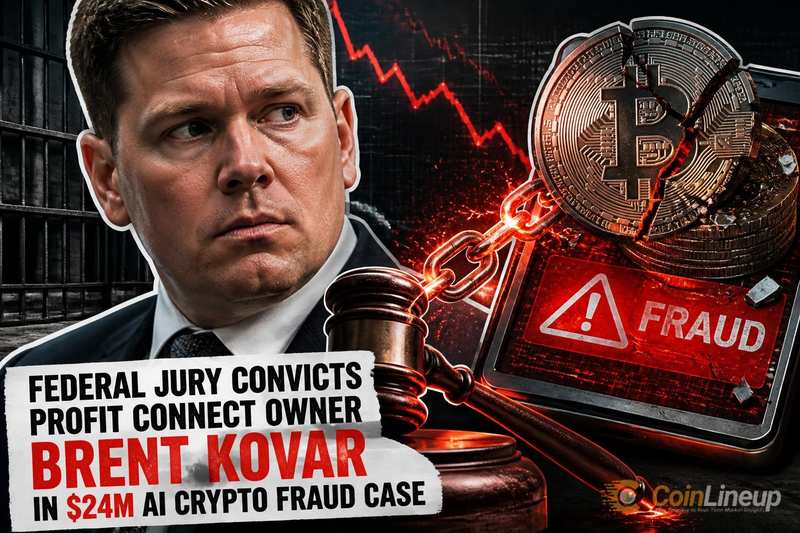
A federal jury has convicted Brent Kovar, the owner of Las Vegas company Profit Connect, in a $24 million fraud case that prosecutors described as a cryptocurrency Ponzi scheme dressed up with promises of artificial intelligence. The verdict marks a completed criminal milestone in one of the most closely watched AI crypto fraud cases.
What the federal jury convicted Brent Kovar of
Kovar owned Profit Connect, the Las Vegas business at the center of the case. A jury found him guilty following the federal prosecution, according to the U.S. Attorney's Office for the District of Nevada.
Prosecutors tied the scheme to roughly $24 million, as reported by CoinDesk. The case combined two of the most heavily marketed ideas in finance today: artificial intelligence and cryptocurrency. Pitches that borrow the credibility of a fashionable technology are a recurring feature of financial fraud enforcement, and AI is the latest such label.
How prosecutors said the Profit Connect scheme worked
Profit Connect pitched investors on an offering built around AI and crypto. In plain terms, the company told people that advanced computer software and digital assets would generate strong, reliable returns on their money.
The government described the operation as a Ponzi scheme, according to CryptoSlate. A Ponzi scheme pays earlier investors using money collected from newer investors, rather than from real profits. That structure is why the pitch supported fraud charges: when the promised AI-driven crypto returns are not real, the money simply moves from one group of investors to another until the scheme collapses.
Why the verdict matters for crypto investors
The case was not just a civil complaint. A federal jury conviction means the matter went through a full criminal trial and ended in a finding of guilt. The verdict also moves the case into its next phase: sentencing. In the federal system, a judge sets the sentence after a guilty verdict, and federal fraud convictions can carry prison terms, restitution to victims, and forfeiture of proceeds — outcomes that will be decided at a sentencing hearing the court will schedule.
Regulators had already flagged concerns about this type of offering. The U.S. Securities and Exchange Commission announced earlier action in the matter, showing that both civil and criminal enforcement can follow crypto-linked investment pitches.
For everyday crypto holders, the practical lesson is simple: promises of high, guaranteed returns powered by “AI” and cryptocurrency are a classic warning sign, and real investments do not pay fixed profits like a savings account. Anyone weighing a first crypto purchase is reminded to treat any operator that guarantees returns with deep caution.
The case also fits a wider pattern of tightening oversight. U.S. authorities have moved to sharpen the rules around digital assets, from the SEC's overhaul of crypto custody rules for investment firms to broader policy efforts like the push behind the CLARITY Act at the White House crypto summit.
The Profit Connect verdict shows that criminal courts, not just regulators, are now holding these schemes to account.
Disclaimer: This article is for informational purposes only and does not constitute financial or investment advice. Cryptocurrency and digital asset markets carry significant risk. Always do your own research before making decisions.
