Are Prediction Markets Becoming Too Good at Taking Money?
Key Takeaways
- •A Wall Street Journal report found that 67% of all profits on Polymarket were captured by just 0.1% of accounts.
- •Prediction markets gained mainstream visibility after Polymarket recorded billions in trading volume around the 2024 U.S. election and Kalshi won court approval to list election contracts over CFTC objections.
- •Computer-assisted wagering syndicates in U.S. horse racing used superior data and preferential execution to profit, causing retail betting to decline and sparking legal disputes.
- •Much offshore prediction market activity, including Polymarket's operations, sits outside CFTC jurisdiction, leaving participants with fewer protections than traditional markets.
- •Regulators may extend market-integrity rules to prediction markets, and platforms may adopt transparency measures to retain retail participants.
Are Prediction Markets Becoming Too Good at Taking Money?
The explosive growth in prediction markets has been difficult to ignore. Outlandish bets, rising popularity among next-generation traders, and ongoing regulatory debate have all been in focus. The sector's visibility surged after platforms like Polymarket recorded billions of dollars in trading volume around the 2024 U.S. election, while regulated venues such as Kalshi won court battles to list election contracts over CFTC objections — disputes that pushed prediction markets into mainstream financial and political discussion. Yet while much of the discussion centers on whether these products are bets or financial transactions, the more fundamental question may be whether they still function as fair markets at all.
The Purpose of Public Markets
To understand the issue, it helps to return to the original purpose of public markets. They were designed to bring willing buyers and sellers together, help both sides find a fair price for a trade, and then coordinate the transaction so settlement could be completed.
The market, along with professional intermediaries such as brokers and custody agents, took a “clip of the ticket” to compensate them for their role in the deal. That structure gave buyers and sellers confidence in the fairness of the process.
More importantly, the market functioned as a mutual utility. All participants played a part in the price-discovery process, and that collective participation helped improve market efficiency. Regulated securities and derivatives markets have historically reinforced this with rules on market manipulation, disclosures, and fair access — guardrails that evolved precisely because unfettered advantage tended to drive ordinary participants away.
The Concentration of Profits
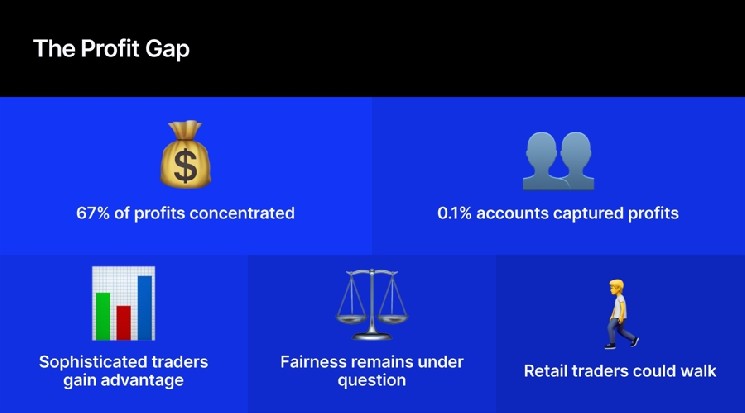
That is what made a Wall Street Journal report earlier in 2026 especially notable. The report said 67% of all profits on Polymarket were captured by just 0.1% of accounts. The implication was clear: only a very small share of participants, particularly those who were well-capitalized or well-informed, could consistently expect to win on the venue.
The easy response would be to say that a fool and their money are easily parted. But there is also a recent precedent for this kind of dynamic, where dominant participants in a limited market consistently outperform and the broader consequences become visible.
Lessons from Horse Racing
That dynamic has recently played out in the United States through computer-assisted wagering, or CAW, used by betting syndicates on horse racing tracks. Superior information processing, preferential order execution, and volume rebates have proven highly profitable for those using the tactic.
The situation is complicated by the fact that U.S. horse racing uses a totalisator, or “tote,” rather than direct trading against a bookmaker. That removes the peer-to-peer element that can act as a “flywheel of fairness.”
As U.S. horse betting became increasingly one-sided, traditional retail betting on the races fell sharply, as participants realized it was becoming harder to win. The issue is now tied up in legal disputes and class-action lawsuits, and the stakes placed by CAW have also dropped significantly. Even so, it offers a useful lesson in what can happen when institutional behavior in limited-market environments is allowed to run unchecked.
Are Prediction Markets Heading the Same Way?
On their current trajectory, prediction markets may be heading in the same direction. The technology available to the largest players improves every day, as does their understanding of human behavior.
At the same time, prediction markets currently operate in what appears to be a Wild West environment, with little that resembles an effective rule book. In that setting, price manipulation can be easier than it should be. In the United States, event contracts fall under the Commodity Futures Trading Commission's jurisdiction for registered venues, but much offshore activity — including Polymarket's operations, which have drawn CFTC scrutiny and a past settlement over unregistered trading — sits outside that perimeter, leaving participants with fewer protections than in traditional markets.
Whether the issue is opacity in the underlying market or a platform operator sending overt messages to users that a trade is mispriced — while arguing that this is content marketing, not analysis — it is difficult to see how these products clearly resemble the financial markets or financial promotions structures that have evolved over time.
Prediction markets can serve a valuable purpose at the peer-to-peer level, allowing trades to be placed outside traditional exchanges while still being conducted in a controlled manner. Ideally, they should serve both buyer and seller, with the market taking a fair cut along the way.
But if they become a one-sided proposition, with punters betting against faceless “hedge-style” liquidity providers backed by an expanding information arsenal, the model is unlikely to last for long.
The Risk of Losing Retail Participants
The horse betting example suggests that retail participants will walk away if the counterparty becomes so efficient that the proposition is no longer attractive. Rather than debating whether this is gambling or finance, the more basic question may be whether it resembles a fair market in any meaningful sense.
For prediction markets to prosper, they need to behave like markets. That means preserving enough informational friction to incentivize genuine price discovery and reward the views of retail traders. What to watch next is whether regulators extend traditional market-integrity rules to these venues, and whether platforms voluntarily adopt transparency and fairness measures before the retail base erodes.

