A Failed $3 Million Hedge, a Midterm Test and a Push Beyond Elections: Inside NEXTPredict
Key Takeaways
- •NEXTPredict attracted over 2,000 attendees, 180 speakers, and participants from 47 countries to New York ahead of the U.S. midterm elections.
- •NEXTPredict paid a $12,000 premium on Kalshi contracts tied to JFK airport cancellations that would have returned about $3 million, but the trade lost, illustrating gaps in traditional event insurance coverage.
- •Kalshi said small businesses are hedging on its exchange, and any CFTC-certified contract with a verifiable data source can be listed.
- •Robinhood reported that contracts on Bitcoin, crude oil, and gold are its fastest-growing prediction markets, while sports remain the largest category.
- •Polymarket gave Luiz Inácio Lula da Silva only about a 20% chance before Brazil's runoff, which he won, with experts attributing the miss to the country's ban on prediction markets.
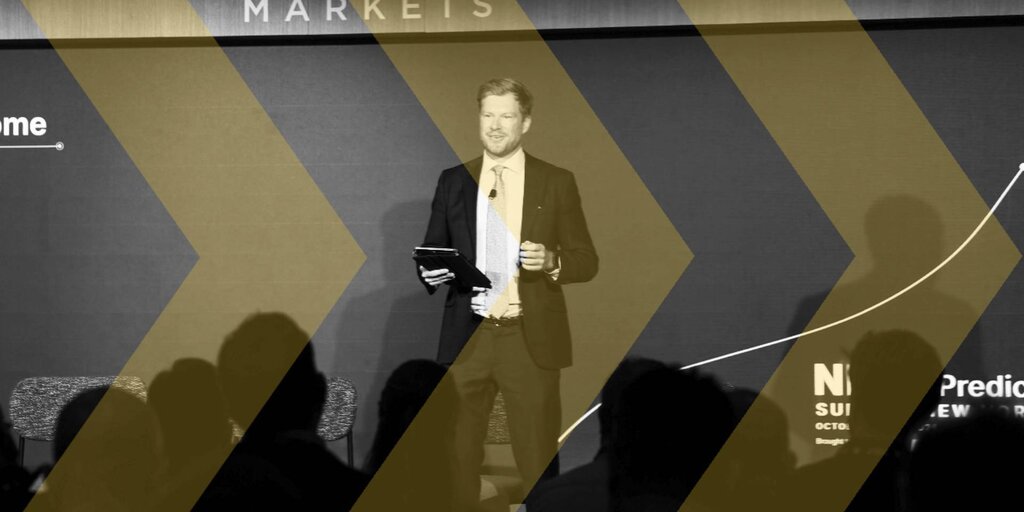
Prediction markets are exchanges where traders buy and sell contracts that pay out based on how real-world events resolve, turning the odds of an outcome into a live price. That model brought prediction market exchanges, trading firms and policymakers to Convene Hudson Yards in New York on October 22 and 23 for NEXTPredict, a two-day summit held less than two weeks before the U.S. midterm elections. According to organizers, the event drew more than 2,000 attendees, 180 speakers and participants from 47 countries.
Elections dominated the conversation, but the industry's biggest players were just as focused on what comes next. Executives from Kalshi, Polymarket and Robinhood pointed to small-business hedging, contracts on financial benchmarks and a shifting regulatory landscape as the next frontiers beyond elections and sports.
The hedge that lost
The conference opened with a trade that didn't pay out. NEXTPredict had paid a $12,000 premium on Kalshi for contracts that would have returned around $3 million if more than half of scheduled arrivals at New York's JFK airport were cancelled the day before the event.
"We ended up losing that trade yesterday, right?" NEXTPredict co-founder Pierre Lindh said on Thursday's "Hedging the Unhedgeable" panel. "And I can only say I'm very happy that we lost that trade, because that means we're all here today."
Lindh explained the gap the trade was designed to highlight: traditional event insurance covers outright cancellation, but "most of these type of force majeure situations won't cancel the event. It will severely damage the event."
Joe Grubb, head of business development at Susquehanna, which took the other side of the trade, said the firm modeled the risk in-house in about a day or two. "It's sort of in our DNA at Susquehanna to price strange things," he said.
Kalshi's director of business development, Nicolas Hull, said small businesses are now hedging on the exchange, starting with a New York bar that covered a Knicks playoff promotion. As long as a contract is certified with the CFTC and has a verifiable data source, "we can list almost anything on our exchange," he said. That certification sits with the Commodity Futures Trading Commission, the U.S. agency that oversees derivatives, including event contracts, on regulated exchanges.
This is the team behind NEXTPredict Summit New York. Months of planning. More late nights than we'll admit. And then, last week, it all came together at Convene, 30 Hudson Yards. 2,000+ of you in the room. 180 speakers. 47 countries. Two weeks before the midterms, the… pic.twitter.com/KCA9TpDCV4
— NEXTpredict (@nextpredictio) October 26, 2026
Chuck Todd and the midterms
U.S. midterm elections decide every seat in the 435-member House of Representatives and roughly a third of the Senate, making them the broadest recurring test of American election forecasting. Chuck Todd, the former NBC News political director, had told Lindh before the event that he was "open minded" about whether markets or pollsters would call the midterms better. By Friday's "Who Calls the Midterms" panel, he sounded closer to a convert.
"This is my argument of why I'm bullish on prediction markets for the future of journalism and that it should be this, in its own way, a fact checker," Todd said. "With money being involved, there's more incentive to get it right."
He argued that prediction markets have effectively replaced exit polls — the voter surveys U.S. networks have long used to frame election-night coverage — but pushed back on the idea that polling is broken. "You can still do a good poll. It just costs a lot," he said.
His panelists were more cautious. "Speed is not necessarily the same as accuracy," said Columbia University professor Rajiv Sethi, while PredictIt CEO John Phillips reminded the audience that "it's called wisdom of crowds, not wisdom of whales."
That caution looked well placed days later. Before Brazil's presidential runoff on Sunday, Polymarket gave Luiz Inácio Lula da Silva only about a 20% chance of beating Flávio Bolsonaro, but he went on to win a fourth term, Decrypt reported. Experts blamed Brazil's ban on prediction markets, which left the odds largely to traders outside the country.
Beyond elections
Event contracts typically pay a fixed amount when a stated outcome — an election result, a price level, a benchmark reading — occurs by a set deadline, which is what lets traders deal in probabilities directly. For Robinhood, elections were only the starting point. "When I started doing this two years ago, it was about elections," JB Mackenzie, the brokerage's vice president and general manager for futures and prediction markets, told CNBC's Contessa Brewer, one of several working journalists the organizers booked for the program. "Then it transformed into politics and sports, and now it's moving into economics and financials."
Sports remain the biggest category, Mackenzie said, but contracts on Bitcoin, crude oil and gold are now the fastest-growing. "The simplicity of a probability is much more consumable for customers," he said.
Polymarket's Bailey Springer, who works on regulatory strategy outside the U.S., said regulators in global financial hubs increasingly recognize that "prediction markets aren't going away" and have real uses for investment and hedging. "At Polymarket, our position is that these are derivatives and should be regulated as such," she said.
Trading the news
Speed was another recurring theme. On Thursday's "Race to Zero Latency" panel, Farokh Sarmad, president and co-founder of Decrypt Media, said ordinary traders are usually a step behind professional firms when news breaks. "By the time you open Polymarket or Kalshi or Myriad or all the other prediction markets, you're usually a little too late," he said.
His answer is to cut out the gap between reading and trading, which Decrypt is doing with its Information Exchange built on Solana, a public blockchain network. "The best way to reduce that latency is to be able to consume it and trade it directly on the same platform," Sarmad said, adding that for any of this to work, "everything has to move on chain" — meaning data and settlement would run on public blockchains.
Institutional money also featured heavily at the summit, with Morgan Stanley, one of Wall Street's largest investment banks, leading sessions on the second day.
Lindh, for his part, sees the industry's next debate already taking shape. "I think the next step will be the comparison between prediction markets and insurance," he said. How regulators ultimately classify event contracts — Springer's derivatives argument on one side, Lindh's insurance comparison on the other — remains an open question as exchanges push past election cycles.
Disclosure: Myriad is a prediction market developed by Decrypt's parent company, Dastan.

