Prediction Market Open Interest Declines as World Cup Trading Winds Down
Key Takeaways
- •Kalshi retained the largest share of prediction market open interest at approximately 59% in July, down from about 62% the prior month.
- •Polymarket's market share increased from roughly 27% to 41%, driven mainly by steeper capital withdrawals from smaller competitors rather than net new inflows.
- •Total prediction market open interest stood at $923.61 million, reflecting a continued downward trajectory following the World Cup's conclusion.
- •Polymarket led daily trading volume with $12.48 million compared to Kalshi's $9.89 million, despite Kalshi listing significantly more active markets.
- •Geopolitical and political contracts, including those related to Iran, are increasingly prominent on prediction platforms and may sustain engagement over longer, open-ended timelines.
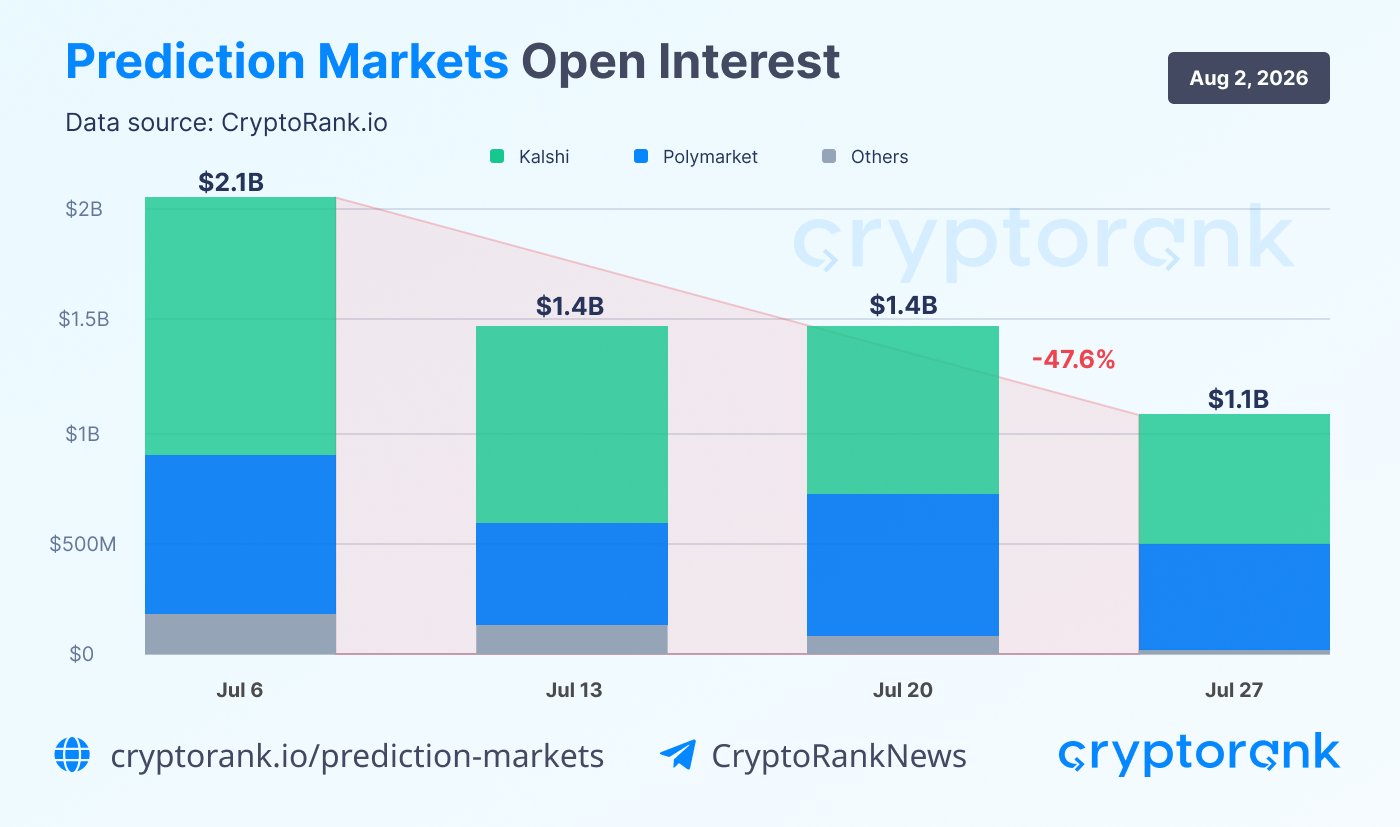
Prediction market open interest declined following the conclusion of the World Cup, illustrating how rapidly event-driven capital can exit forecasting platforms once the events conclude. July data shows that Kalshi maintained roughly 59% of total open positions, while Polymarket's market share climbed from approximately 27% to 41% — even as open interest fell across both venues.
This shift was not driven by stronger market-wide demand. Rather, capital withdrew from smaller platforms at a faster pace, concentrating remaining exposure among the two leading venues. Kalshi continues to hold the larger base, though its advantage narrowed over the month. The duopoly that has emerged between a CFTC-regulated exchange (Kalshi) and a blockchain-native platform operating on Polygon (Polymarket) now defines the competitive structure of the sector, with both venues vying for traders seeking to wager on outcomes ranging from sports to geopolitics.
Open Interest Weakens Post-World Cup
Prediction market open interest softened during July as World Cup contracts settled and traders released their committed capital. Kalshi experienced the larger impact, a reflection of its heavier concentration of event-linked positions during the tournament. Its share dipped from approximately 62% to 59% — a modest percentage decline, but one that meaningfully reduced its lead over Polymarket at a pivotal moment for the sector.
Polymarket also recorded fewer open positions in July. Nevertheless, its market share rose from roughly 27% to 41%. This increase primarily reflected steeper capital withdrawals from smaller competitors rather than an influx of new funds into Polymarket contracts. The platform thus captured a larger slice of a shrinking pool.
The latest data places total open interest at $923.61 million, representing a 0.04% decline over 24 hours. Polymarket accounted for $321.54 million, down 1.09%. Its tracked open interest moved from $352 million on July 28 to $321 million by August 2. While the sequence included brief rebounds, the broader trajectory remained downward.
This pattern underscores the distinction between absolute growth and relative market share. A platform can shed open interest while simultaneously gaining industry weight when competitors contract at a faster rate. Open interest figures alone therefore tell only part of the story. Share movements, by contrast, reveal where traders choose to keep capital after a major event cycle concludes.
Meanwhile, the 37,036 listed markets across platforms marked a 0.66% daily increase, indicating that contract creation persisted even as open positions declined. This divergence suggests that platform operators continued expanding their market catalogues — a key competitive metric — even as traders pulled back committed capital.
Polymarket Gains Share as Kalshi Retains Lead
Kalshi's open interest still constitutes the largest share in the July comparison. Its 59% stake keeps it firmly ahead of Polymarket, albeit with a narrower margin. Kalshi also lists substantially more active markets — Cryptorank data shows 28,996 Kalshi markets compared with 8,040 on Polymarket.
Trading volume, however, tells a different story over the most recent 24-hour period. Combined volume reached $22.38 million, representing an 11.3% increase. Polymarket generated $12.48 million, while Kalshi recorded $9.89 million — a split that placed Polymarket ahead in daily turnover despite Kalshi's larger share of open positions and market listings. The volume gap highlights a structural difference between the two venues: Kalshi's CFTC-regulated model appeals to US-based traders within a defined compliance framework, while Polymarket's on-chain settlement and global accessibility continue to attract a distinct user base.
Political and geopolitical contracts now account for a significant portion of visible market activity. Among the active predictions are contracts tied to Iran's leadership changes and the control of Kharg Island. Another contract poses the question of whether the United States will invade Iran before a specified deadline. That particular market recorded $2.71 million in daily volume and $1.40 million in liquidity.
These contracts differ markedly from the concentrated sports schedule that drove World Cup trading activity. Political outcome markets may sustain capital engagement over longer periods, given that such events typically unfold over extended timelines. At the same time, they can generate irregular trading spikes in response to breaking news and policy developments. The presence of Middle East geopolitical contracts alongside election-related markets signals that prediction platforms are increasingly becoming go-to venues for trading on real-world uncertainty — a category that, unlike tournament schedules, does not have a fixed end date.
The current landscape reflects a more concentrated competitive field. Kalshi commands the largest share, while Polymarket has narrowed the gap through stronger relative retention. Smaller platforms lost enough capital to reshape the market structure, though this did not reverse the overall downward trend in open interest. Kalshi remains in front, and Polymarket continues closing the distance through volume, liquidity, and a growing share of remaining positions.

