Port Congestion Absorbs 2.3m TEU as Container Shipping Faces Looming Capacity Shock
Key Takeaways
- •Worsening delays have rendered 6.6% of the global containership fleet effectively unavailable, equivalent to about 2.3m teu — capacity that would rank as the world's sixth largest carrier if it stood alone.
- •Global schedule reliability fell 6.1 percentage points in July to 56.4%, the sharpest monthly drop since January 2021, with late ships averaging 6.06 days behind schedule.
- •All 14 of Asia's busiest ports saw deteriorating reliability in July, with Shanghai at 21%, Ningbo at 34.6%, and Singapore at 43.2%, compounded by successive typhoons.
- •Around 19% of Asia-Europe capacity is shifting back to the Suez Canal from the Cape route, and Sea-Intelligence estimates full Suez normalisation would cut global head-haul teu-mile demand by 8.7% year-on-year in the first half of 2027.
- •The containership orderbook stands at about 40% of the existing fleet, implying substantial new tonnage will arrive just as congestion-based capacity absorption potentially fades.
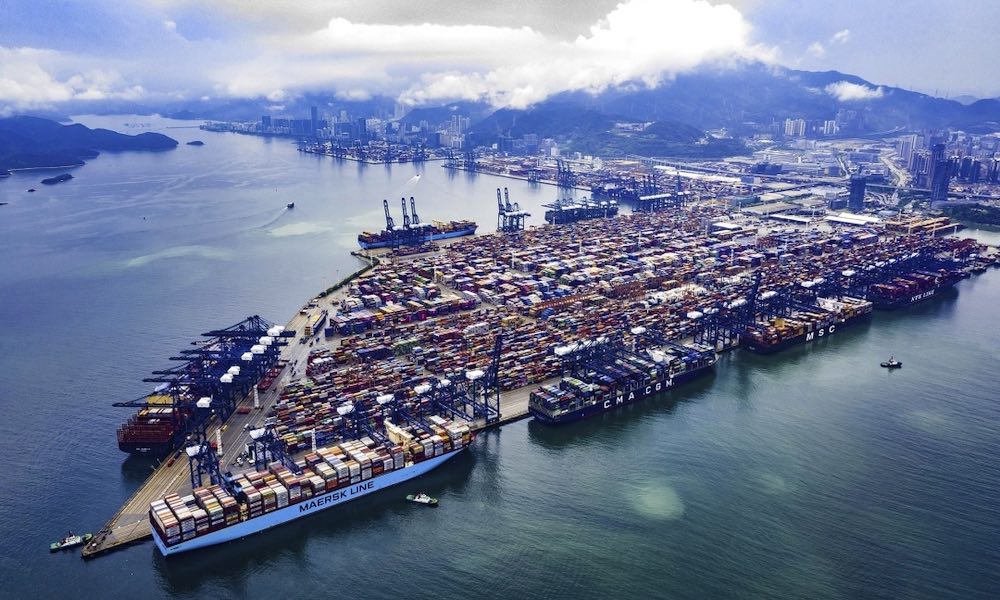
Port congestion is currently doing container shipping an enormous favour, absorbing 2.3m teu of vessel capacity at precisely the moment the industry is bracing for a potentially brutal release of tonnage from both newbuildings and a return to the Suez Canal.
The dynamic underscores a long-standing feature of liner economics: because vessels effectively earn their capacity only when deployed on schedule, congestion acts as a hidden form of supply removal that can prop up freight rates even when underlying demand is soft — and conversely, its unwinding can pressure rates without a single new ship being delivered.
New data from Sea-Intelligence shows that worsening delays have rendered 6.6% of the global containership fleet effectively unavailable, up sharply from around 5% in June and three times the pre-pandemic baseline of 2.2%.
If the 2.3m teu currently swallowed by delays were a standalone carrier, it would rank as the world's sixth largest, only marginally behind Hapag-Lloyd.
The deterioration has been remarkably rapid. Global schedule reliability fell 6.1 percentage points in July to 56.4%, the sharpest monthly decline since January 2021. Late ships were running an average of 6.06 days behind schedule, a level largely unseen outside the pandemic and the immediate aftermath of the Red Sea crisis.
Asia lies at the centre of the problem. All 14 of the region's busiest ports recorded deteriorating reliability in July, with successive typhoons compounding already stretched terminal networks. Shanghai's schedule reliability collapsed to just 21%, Ningbo managed 34.6%, and Singapore stood at 43.2%. For shippers and consignees, delays of this kind ripple through supply chains as longer transit times, rolled cargo and the need to build inventory buffers — costs that fall well beyond carriers' own schedules.
These figures tally with the increasingly extraordinary congestion data reported by Splash in recent weeks. Linerlytica calculated last week that more than 4.3m teu of containership capacity was waiting to berth worldwide, surpassing even the absolute covid-era peak. Drewry, meanwhile, has warned that global vessel waiting times have nearly doubled compared with 2019 as ports struggle with increasingly concentrated waves of ship arrivals.
The capacity squeeze, however, could unwind rapidly. Sea-Intelligence estimates that, based on previous congestion cycles, the current disruption would take around four-and-a-half to six months to return to the lows seen in June 2025, or just two to three-and-a-half months to get back to end-2025 levels.
At the same time, another, much larger capacity release is taking shape. Mediterranean Shipping Co (MSC), Maersk, CMA CGM and others are progressively returning services to Suez, with around 19% of Asia-Europe capacity now shifting back from the Cape route. The Cape of Good Hope diversion, adopted widely after attacks on commercial shipping in the Red Sea forced carriers to reroute, absorbs capacity by lengthening voyages; unwinding it releases that capacity back onto the market.
Sea-Intelligence calculates that a full Suez normalisation would produce an 8.7% year-on-year contraction in global head-haul teu-mile demand during the first half of 2027, despite assuming underlying container demand growth of a healthy 6.6%. Even a 50% return to Suez would push teu-mile growth into negative territory. That matters with the containership orderbook already standing at around 40% of the existing fleet — a historically high ratio that implies substantial new tonnage arriving just as effective capacity absorption could fade. What to watch next is the pace of Suez rerouting by major alliances, monthly schedule reliability data, and orderbook delivery slippage, each of which will shape how quickly the hidden supply cushion disappears.
Source: Splash247
