PONS Climbs 57% in 24 Hours as Meme Tokens Blur the Line With Utility
Key Takeaways
- •PONS, the native token of the Pons launchpad rather than a conventional meme coin, rose 57.68% in 24 hours to $0.58424 and 371.55% over the past week on Robinhood Chain.
- •Pons generated $40.84 million in fees over 30 days and nearly $600 million in DEX volume, ranking it among DeFi's top fee-generating protocols, and Binance Alpha added PONS trading on September 2.
- •Bitcoin Hyper has raised $33 million in its presale for an SVM-based Bitcoin Layer 2 priced at $0.01368 per token with 35% staking APY.
- •LiquidChain's Layer 3 presale has reached $960,000 at $0.0149 per token, aiming to coordinate activity across Bitcoin, Ethereum, and Solana through a shared execution environment.
- •Maxi Doge, a meme coin with $4.85 million raised and audited contracts from SolidProof and Coinsult, plans trading competitions and futures platform partnerships to sustain community engagement.
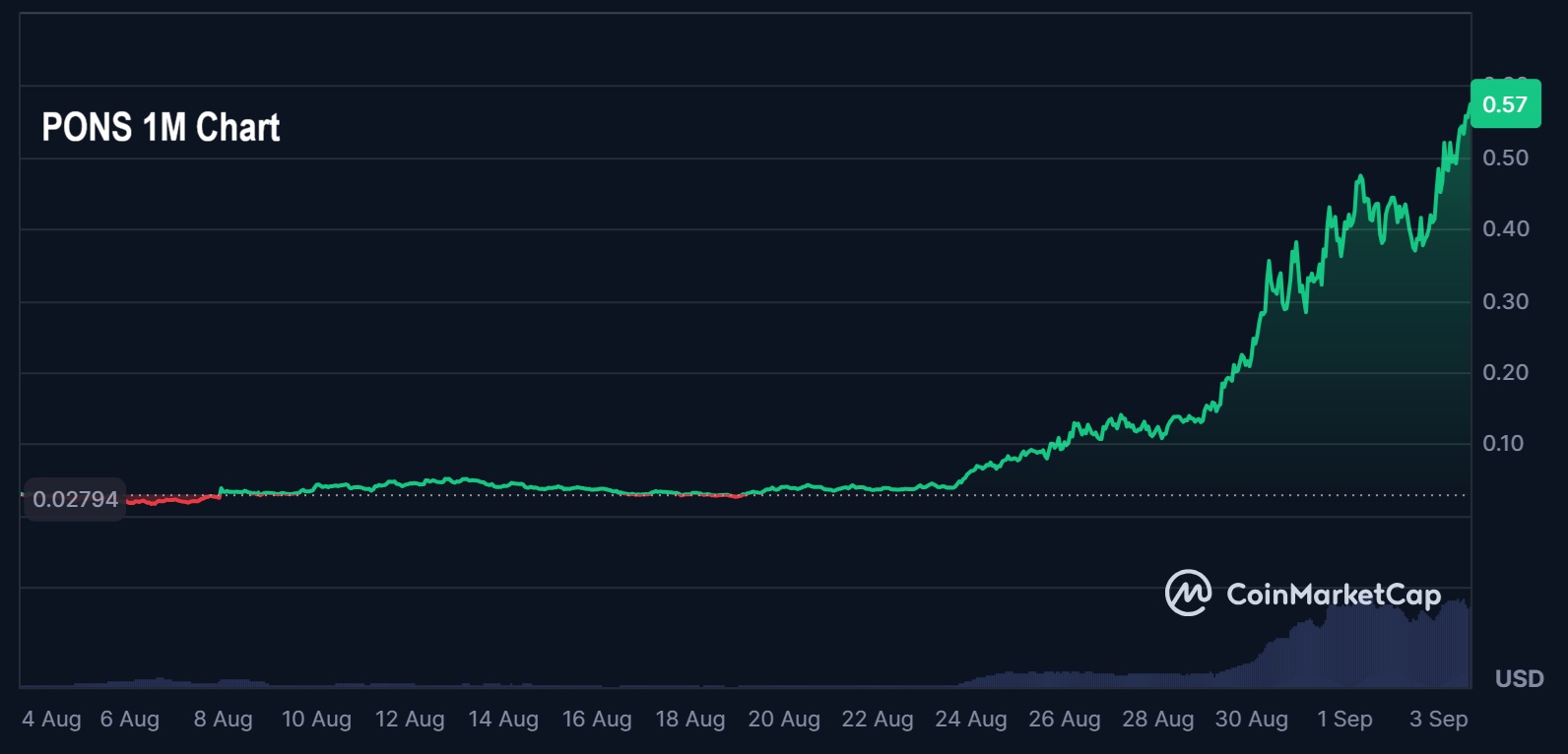
PONS is surging again, but the most notable aspect of its rally is that it is not really a conventional meme coin.
The Robinhood Chain token trades at $0.58424 after gaining 57.68% in 24 hours and 371.55% over the past week. PONS has clearly benefited from the explosion of meme-token trading on Robinhood Chain — the consumer trading app's own blockchain network, built to bring on-chain trading directly to its massive retail user base — yet it is in fact the native token of Pons, the launchpad powering much of that activity.
The platform has become a substantial business at remarkable speed. DeFiLlama recorded $5.95 million in Pons fees over 24 hours, with 30-day fees of $40.84 million and DEX volume approaching $600 million. To put that in perspective, a 30-day fee haul of more than $40 million would rank Pons among the top fee-generating protocols in decentralized finance, territory usually occupied by long-established DEXs and lending platforms rather than a launchpad this young. Binance Alpha also added PONS trading on September 2, widening access to the token.
PONS therefore offers an instructive case for anyone tracking the meme-token space. Meme culture can attract users, but tokens with substance beneath the branding may have more ways to capture the activity that speculation generates. It is a dynamic familiar from previous cycles: launchpads and DEXs that surfaced during earlier meme booms showed how the platforms hosting speculative trading could end up capturing more durable value than most of the tokens being traded on them.
Bitcoin Hyper, LiquidChain, and Maxi Doge approach that idea from different angles. The first two are infrastructure projects aimed at the same retail presale market, while MAXI is an outright meme coin that aims to give its community more to do than simply hold the token.
Bitcoin Hyper (HYPER): Meme-Era Branding Meets Serious Bitcoin Infrastructure
Bitcoin Hyper (HYPER) carries the kind of loud branding designed to stand out in a crowded presale market, but the project underneath it addresses a very real limitation of Bitcoin.
Its Layer 2 uses the Solana Virtual Machine (SVM) — the high-speed execution environment behind Solana applications — to add a programmable layer to Bitcoin capable of much faster activity. The approach reflects a broader trend: Bitcoin's base layer settles blocks roughly every ten minutes and lacks native smart contract functionality, which is why a wave of Layer 2 projects has emerged seeking to make the network's trillion-dollar market cap productive without altering the base chain itself.
The $HYPER space program is looking healthy. pic.twitter.com/N7Nw7JC6ps — Bitcoin Hyper (@BTC_Hyper2) August 31, 2026
Bitcoin continues to serve as the underlying settlement network, while the Layer 2 handles transactions and smart contract execution. BTC can thus be used for real-world payments and applications without requiring Bitcoin's comparatively slow base chain to process every interaction directly.
The HYPER token functions as gas for activity on the Layer 2, and holders can also stake it and take part in governance.
Investors have committed $33 million to the presale so far, with HYPER currently priced at $0.01368. Staking offers 35% APY, and Coinsult and SpyWolf have reviewed the token contracts.
PONS illustrates how a token can benefit from the infrastructure beneath a speculative market. HYPER is placing a much larger version of that bet on Bitcoin itself.
LiquidChain (LIQUID): The Picks-and-Shovels Bet on a Multichain Market
LiquidChain (LIQUID) has even less in common with a traditional meme coin — it only dresses as one at the mascot level — but PONS offers a useful comparison.
Some traders buy the tokens launched through Pons; others instead buy exposure to the infrastructure enabling those launches and trades. It is the same logic as the classic picks-and-shovels trade from gold-rush history: rather than betting on which prospector strikes it rich, invest in whoever sells them the tools.
The council is now in session. pic.twitter.com/C8dfzgKgwK — LiquidChain (@getliquidchain) September 3, 2026
LiquidChain applies that approach to the wider blockchain market. Its Layer 3 is designed to coordinate activity across Bitcoin, Ethereum, and Solana through a shared execution environment. A cross-chain virtual machine and a unified proof engine allow the protocol to verify the states of all three networks rather than forcing every action onto a single blockchain.
That can simplify experiences that are currently awkwardly multistep: a user managing assets across several networks can work through a single interface instead of repeatedly switching networks and routing funds through bridges — a persistent pain point in an industry where billions of dollars in value have been lost to bridge exploits over the past several years.
Longer transactions spanning two chains can be executed atomically, meaning the entire sequence either completes or rolls back as one unit. The protocol's most notable feature may be creating a single shared liquidity pool from crypto's three deepest liquidity sources.
The presale has reached $960,000, moving LIQUID toward its first $1 million milestone at $0.0149 per token. Staking currently offers 1,188% APY.
Exchange listings and continued Layer 3 development follow the presale, and if crypto activity keeps spreading across multiple successful networks, LIQUID aims to make the divisions between them increasingly irrelevant to users.
Maxi Doge (MAXI): This One Really Is a Meme Coin
Maxi Doge (MAXI) makes no attempt to disguise what it is: the project turns Dogecoin's familiar Shiba Inu into an overleveraged bodybuilder obsessed with charts, gym gains, and outperforming everyone around him. It targets precisely the kind of retail audience currently turning Robinhood Chain into a meme-token factory.
Maxi Doge is also trying to build activity around the meme. Its roadmap includes trading competitions and tournaments that reward community members for performance rather than leaving holders with nothing to do after buying. That attempt to add utility echoes a pattern seen across the meme-token sector, where projects that offered nothing beyond a joke have historically struggled to sustain engagement once initial hype faded.
Planned partnerships with futures platforms could further reinforce that competitive trading identity after launch.
We need a new crypto king … $MAXI pic.twitter.com/J7ydcJ5py4 — MaxiDoge (@MaxiDoge_) August 5, 2026
MAXI has raised $4.85 million before reaching exchanges, a substantial figure for a meme presale. Tokens cost $0.00028, while staking currently offers 64% APY. SolidProof and Coinsult have audited the token contracts — a notable measure for a meme coin — with exchange listings and community competitions sitting further along the roadmap.
PONS has demonstrated how much activity meme traders can generate when they congregate around the right platform. Maxi Doge is building a recognizable community before public trading even begins.
Meme Coins Are Starting to Look More Complicated
PONS gaining nearly 47% in a day is eye-catching, but the launchpad underneath the token may be the more consequential story. Pons has turned meme speculation into millions of dollars in fees and hundreds of millions in trading activity.
The line between memes and utility is becoming increasingly blurred: HYPER uses retail-friendly branding to market serious Bitcoin infrastructure, LIQUID is a pure infrastructure bet on multichain activity, and MAXI takes the meme route while adding competitions and planned trading partnerships.
The meme may bring people through the door, but the projects most likely to hold attention are the ones that give them a reason to stay. For readers watching this space, the metrics worth tracking are the ones PONS has made visible: fee revenue, trading volume, and whether platforms — and the tokens attached to them — can sustain activity once the initial speculative wave recedes.
