Pons (PONS) Is Listed on edgeX: Inside Robinhood Chain’s Decentralized Token Launchpad
Key Takeaways
- •edgeX listed the PONSUSDC perpetual on September 2, 2026, following a surge in Robinhood Chain activity.
- •Pons is a decentralized, non-custodial launchpad that enables fixed-supply token creation through wallet-submitted transactions.
- •Pons V2 uses a bonding curve for early price discovery and can graduate qualifying launches into Uniswap v4 liquidity.
- •PONS launched with a maximum supply of 1 billion tokens, and its value thesis depends on protocol activity, fees, and fee-funded burns.
- •PONSUSDC is a leveraged perpetual derivative that does not deliver native PONS or confer ownership in the protocol.
Quick Answer
Pons is a decentralized, non-custodial token launchpad on Robinhood Chain. It lowers the technical barrier to creating a fixed-supply token, starts price discovery through an on-chain curve, and moves successful launches into decentralized-exchange liquidity. PONS is the protocol’s associated token, with its investment narrative tied to launch activity, trading fees, and fee-funded token economics. PONSUSDC on edgeX is a leveraged perpetual derivative, not delivery of native PONS or an ownership interest in the protocol.
PONS Arrives on edgeX as Launchpad Activity Becomes the Trade
Token launchpads sit at the most reflexive end of crypto. More creators attract more traders; more trading produces more fees; visible winners attract the next wave of creators. The same loop can reverse quickly when launches fail, liquidity thins, or users move to a competing venue. Pons turns that cycle into a single protocol thesis on Robinhood Chain.
edgeX listed the PONSUSDC perpetual on September 2, 2026. The timing follows an exceptional burst of activity on Robinhood Chain. CoinDesk reported that the network processed a record 5.52 million transactions on August 30 as users launched 22,600 tokens, with token-launch and memecoin tools driving much of the day’s activity.
That backdrop makes PONS a current trade rather than a generic protocol profile. Traders are testing whether Pons can remain a primary entry point to Robinhood Chain’s speculative economy, convert activity into durable fees, and make its token economics legible enough to survive after the initial launch frenzy cools.
https://x.com/edgeX_exchange/status/2094981086782931057
What Is Pons?
Pons is a non-custodial interface and smart-contract system for launching tokens on Robinhood Chain. A creator can define a token, submit the transaction through a wallet, and open an on-chain market without handing custody of assets to the Pons team. The product is permissionless by design: access is easy, but participation does not mean Pons has vetted the creator, code, claims, or economic quality of every launched asset.
Robinhood Chain gives that product a distinctive setting. Robinhood describes the network as a permissionless, Ethereum-compatible Layer 2 built with Arbitrum technology, using Ethereum for data availability and ETH as its gas asset. The chain was designed for on-chain financial infrastructure and tokenized real-world assets, yet its earliest growth has also come from crypto-native trading and rapid token creation.
Pons sits at that intersection. It can launch conventional community tokens, experimental applications, or markets that use the chain’s wider asset environment. The bullish interpretation is that a low-friction launch engine becomes core distribution infrastructure. The skeptical interpretation is that it is a high-volume funnel for assets whose attention and liquidity may be short-lived.
Non-custodial does not mean risk-free
The interface sends transactions through the user’s wallet rather than holding funds in an exchange account. That reduces one custody dependency, but it shifts more responsibility to the user. Contract approvals, token metadata, creator behavior, bonding-curve slippage, liquidity depth, and irreversible transactions remain material risks.
How the Pons Launch Flow Works
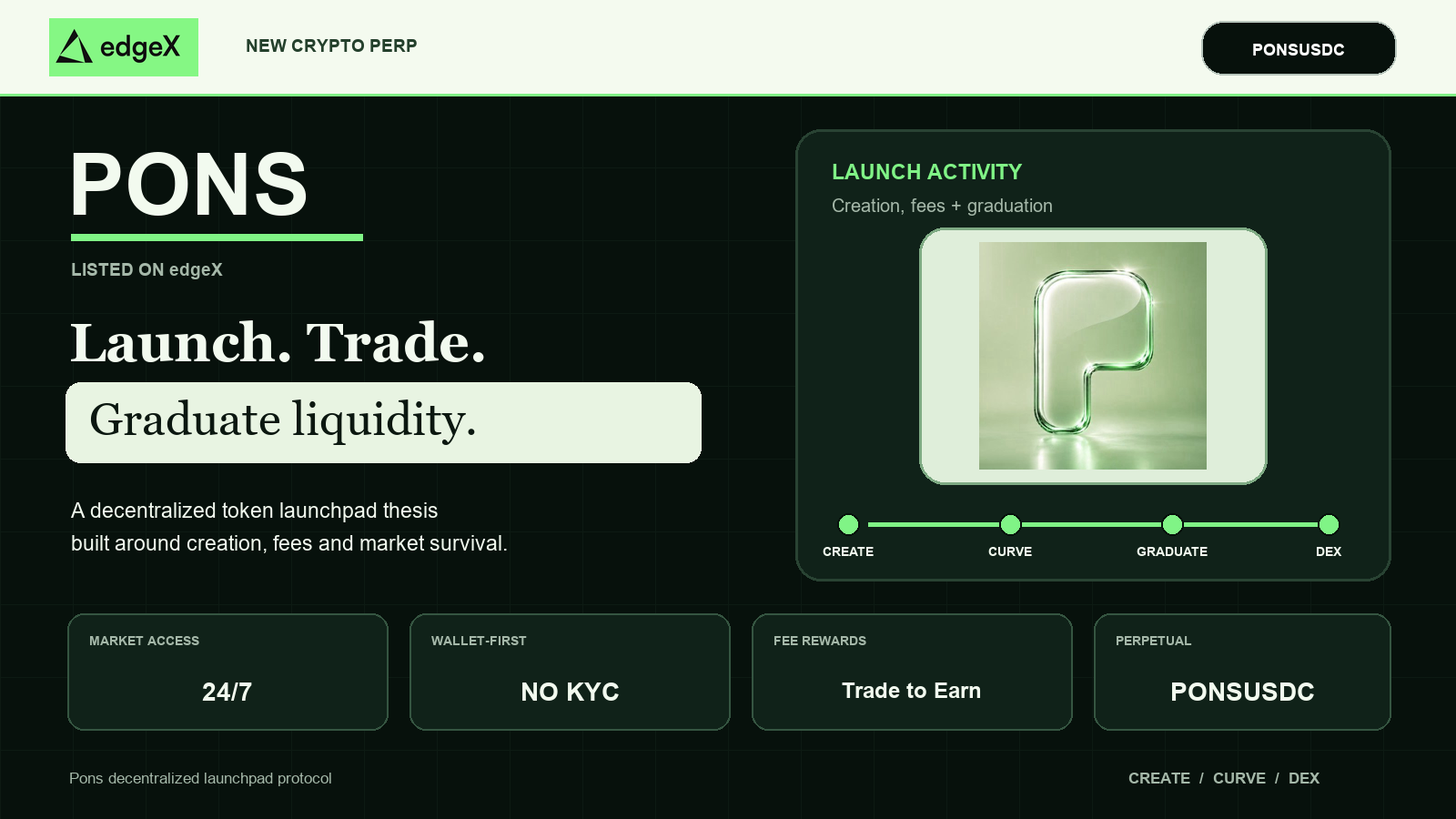
Pons’ product is best understood as a sequence rather than a single “launch” button. The protocol combines token deployment, early price discovery, fee collection, and a graduation path into open DEX liquidity.
Creation starts with a fixed-supply token
The creator selects the token’s identity and submits an on-chain deployment. Pons’ public interface describes fixed-supply launches, which gives buyers a maximum unit count for each new asset. Fixed supply does not establish fair value, prevent concentrated ownership, or guarantee that a creator cannot influence the market through wallets and promotion.
A bonding curve organizes early price discovery
Under the V2 model, buys and sells move against a bonding curve before graduation. The curve gives the market deterministic pricing rules and allows trading to begin before a conventional liquidity pool exists. Its advantage is immediate access. Its weakness is mechanical slippage: order size and curve progress can create sharp price movement, especially in thin or highly concentrated launches.
Graduation moves the market into DEX liquidity
When a launch satisfies the V2 graduation conditions, the process transitions liquidity into Uniswap v4. Earlier Pons materials describe a V1 path using locked Uniswap v3 liquidity. This distinction matters because V1 and V2 do not have identical pricing, fee, or liquidity mechanics. Traders should evaluate the version used by a particular market instead of assuming every Pons token follows one template.
| Stage | What Happens | Evidence Traders Should Watch |
| Creation | A wallet deploys a fixed-supply token through Pons | Creator identity, contract address, supply concentration, and metadata |
| Curve trading | Early buyers and sellers trade against deterministic pricing | Curve progress, slippage, turnover, and wallet concentration |
| Graduation | A qualifying V2 launch transitions into Uniswap v4 liquidity | Graduation threshold, transaction success, and initial pool depth |
| Open-market phase | The graduated token trades through DEX liquidity | Retained liquidity, repeat volume, holder growth, and price impact |
| Fee conversion | Trading activity produces creator and protocol economics | Fee split, protocol retention, buyback execution, and on-chain burns |
Why Robinhood Chain Is the Central Demand Driver
Pons does not operate in isolation. Its addressable market grows when Robinhood Chain attracts wallets, liquidity, developers, and trading themes. It contracts when activity migrates elsewhere. The chain’s record August 30 session shows the opportunity: millions of transactions and tens of thousands of token launches can create a deep stream of potential users for a launchpad.
The composition of that activity is also the central risk. CoinDesk reported that memecoin trading tools drove much of the network’s revenue surge. High throughput is useful, but raw transactions can be generated by bots, repeated curve trades, and short-lived launches. For PONS, the stronger evidence is not simply another record launch day. It is a larger share of launches graduating, maintaining liquidity, retaining holders, and producing recurring fees after incentives and novelty fade.
Tokenized assets could widen the opportunity
Robinhood Chain’s stated focus on tokenized financial assets gives Pons a possible route beyond conventional memecoins. V2’s integration with Uniswap v4 creates a flexible liquidity layer, and the broader chain supports Ethereum-compatible contracts and on-chain asset infrastructure. A launchpad that safely supports more varied quote assets or application tokens could address a richer market.
That remains a possibility, not a proven outcome. Tokenized securities carry issuer, jurisdiction, transfer, oracle, and market-hours constraints that a permissionless token launcher cannot erase. Pons must demonstrate which expansion paths are live, which are experimental, and how it prevents product ambition from outrunning risk controls.
PONS Token Economics: Fees Matter More Than the Label
PONS is the protocol-associated token, but its economic case should not be reduced to the word “utility.” The key question is whether activity on the launchpad creates observable demand for PONS or permanently reduces supply. Pons’ interface states that fees go back to Pons, while published descriptions of the V1 system connect part of protocol revenue to periodic PONS purchases and burns.
V2 complicates the picture because its curve and pool fee accounting differs from V1. Creator payouts, liquidity costs, protocol retention, and token-holder value are separate lines. A trader should not assume that every dollar of gross trading fees becomes a PONS buyback. The relevant metric is the amount retained by the protocol and verifiably converted into purchases, burns, or another holder-aligned use.
PONS launched with a maximum supply of 1 billion tokens. On-chain burns can lower the remaining supply, but circulating supply is not the same as maximum supply or burned supply. Current float depends on holder distribution, liquidity pools, bridges, treasury or team-controlled wallets, and tokens that are economically available to trade. Without a complete official allocation and vesting schedule, concentration and wallet-level movements deserve more weight.
Contract identity is a first-order trading check
The native Pons page and Robinhood Chain explorer identify PONS at `0x39dBED3a2bd333467115dE45665cC57F813C4571`. edgeX’s official listing post names an Ethereum address, `0x07f5B6823751C2E2cd4560f28aF75ff887102241`. Etherscan shows that Ethereum record as a 1 billion-supply mint-and-burn token contract, while Pons’ core launchpad activity remains associated with Robinhood Chain.
This article does not treat those addresses as interchangeable. Cross-chain representations can add access, but they also add bridge, custody, minting-authority, and index-construction questions. Before opening PONSUSDC, traders should verify the live edgeX product page, index constituents, settlement rules, and the exact asset representation used for pricing.
The Latest Evidence Behind the PONS Thesis
Pons has moved quickly from product launch to V2 documentation, Uniswap v4 graduation, an official analytics surface, and wider cross-chain attention. Its public repository also gives developers a way to inspect the project’s contract work rather than relying only on marketing claims. These are useful signs of product velocity.
The strongest macro evidence is Robinhood Chain’s growth. Its late-August transaction and revenue records show genuine demand for rapid token creation and trading. Pons’ own analytics can connect that chain-level activity to protocol launches, volume, fees, and graduations, but each metric needs context. A thousand launches with no retained market is weaker than a smaller cohort that keeps liquidity and users.
The next update should therefore prove quality of activity. Traders need a consistent reconciliation among launch count, curve volume, graduated liquidity, protocol revenue, creator payouts, buybacks, burns, and active holders. Transparent dashboards and on-chain transactions can make that case stronger than headline market-cap comparisons.
What Could Strengthen or Break the PONS Thesis
What would strengthen the case
The constructive case requires Pons to retain creators and traders while improving launch outcomes. A rising graduation rate, deeper post-graduation liquidity, repeat creator activity, lower concentration, and fee-funded burns that reconcile with protocol revenue would show that Pons is building infrastructure rather than renting attention.
Competition can also become positive evidence if Pons holds share without unsustainably cutting fees. Launchpads are easy to copy at the interface level. The defensible layer is distribution, trusted contracts, liquidity routing, analytics, creator tooling, and a community that returns for the next launch.
What would weaken the case
Low-quality issuance is the most immediate threat. Permissionless systems attract experimentation, but they also attract impersonation, manipulated launches, concentrated supply, and assets designed to disappear after early liquidity arrives. A rising launch count can conceal deteriorating user outcomes.
Pons also depends on a young chain and a competitive category. If Robinhood Chain activity slows, tokenized-asset adoption fails to broaden the user base, or rival launchpads offer better economics, Pons’ fees can fall quickly. Changes to fee policy or buyback execution would weaken the link between product usage and PONS.
Contract and bridge risk adds another layer. Smart-contract defects, compromised administration, incorrect metadata, fragmented liquidity, or uncertainty over cross-chain representations can damage confidence even if the launchpad interface continues operating.
PONS Bull, Base, and Bear Cases
| Scenario | Operating Path | What Traders Would Need to See |
| Bull | Pons remains a leading Robinhood Chain launchpad, V2 graduates durable markets, and fee conversion steadily reduces PONS supply | Higher retained liquidity, repeat creators, transparent revenue reconciliation, and verified burns |
| Base | Launch activity stays active but uneven, competition caps protocol take, and PONS follows broader Robinhood Chain sentiment | Stable launches and fees, mixed graduation quality, and no major contract or policy failure |
| Bear | Speculative churn fades, poor launch outcomes damage trust, or cross-chain and fee-policy risks break the token thesis | Falling repeat activity, shallow graduated pools, weaker revenue, or unexplained changes in token flows |
The scenarios make the next proof point clear. Pons does not need another viral launch as much as it needs evidence that launched markets survive, fees are economically meaningful, and PONS captures value in a way traders can verify.
Trade PONS Perpetuals on edgeX
The PONSUSDC perpetual on edgeX lets eligible traders express long or short views on PONS without taking delivery of the token. At production time, the live page displayed maximum leverage of 10x, a 250 PONS minimum order size, and a 1% liquidation fee; traders should recheck every specification, including funding, fees, liquidity, index methodology, and regional availability, before placing an order.
PONSUSDC is a leveraged derivative. It does not confer governance rights, protocol revenue, native token custody, or a claim on Pons. Thin liquidity, funding, basis changes, and liquidation can overwhelm a correct long-term thesis.
Put PONS Trading Fees Back to Work with Trade to Earn
PONS can reprice quickly when Robinhood Chain posts new activity records, a major launch graduates, fee-and-burn data changes, or cross-chain access expands. The Trade to Earn program gives active PONS traders a tangible benefit while managing that catalyst cycle: eligible trading fees can return through edgeX rewards in USDC and EDGE, with the live page controlling the current reward flow and eligibility.
That benefit can make repeated position adjustments more efficient, but it is not a profit guarantee and should not determine position size. The PONS thesis still depends on launch quality, liquidity, protocol economics, and contract verification.
The Bottom Line
Pons is a focused bet on the infrastructure behind permissionless token creation. Its launchpad removes technical friction, its curve creates immediate price discovery, and V2 gives successful markets a defined route into Uniswap v4 liquidity. Robinhood Chain’s recent activity shows that demand for this product category is real.
The harder question is durability. Pons must turn launch velocity into retained markets, transparent fees, and verifiable PONS value capture while managing the risks created by permissionless issuance and cross-chain expansion. The new edgeX market makes that debate tradable around the clock, but traders should treat contract identity, index construction, and leverage as part of the thesis rather than as footnotes.
Frequently Asked Questions
What is Pons?
Pons is a decentralized, non-custodial launchpad on Robinhood Chain that lets users create and trade fixed-supply tokens through wallet-submitted transactions.
How does Pons V2 launch a token?
V2 uses a bonding curve for early price discovery. When a launch satisfies its graduation conditions, liquidity transitions into a Uniswap v4 market.
What gives PONS potential value?
The thesis centers on protocol activity, retained fees, and verifiable token economics such as fee-funded purchases and burns. Gross launchpad volume does not automatically equal value captured by PONS holders.
What is the maximum PONS supply?
PONS launched with a maximum supply of 1 billion tokens. Burns may lower the remaining supply, while circulating supply and liquid float should be checked from current on-chain records.
Why are there different PONS contract addresses?
Pons’ native launchpad token is recorded on Robinhood Chain, while edgeX’s announcement names an Ethereum address. Cross-chain representations and market-index construction can create multiple relevant records, so traders should verify the live contract and pricing methodology.
Is every token launched through Pons vetted?
No. Pons is permissionless and non-custodial. Those properties do not guarantee creator identity, token quality, liquidity, security, or future value.
Is PONSUSDC the same as owning PONS?
No. PONSUSDC is a perpetual derivative that provides long or short price exposure. It does not deliver PONS or provide protocol ownership rights.
Where should traders verify current PONS market details?
Use the live edgeX PONSUSDC market for contract terms and the Pons and Robinhood Chain explorers for current token records. This article does not state a live PONS price.
