Pompliano Says a Bitcoin ETF Beats Hardware Wallets on Security
Key Takeaways
- •Anthony Pompliano stated that if optimizing purely for security, a Bitcoin ETF is probably the single most secure way for people to hold a meaningful amount of bitcoin.
- •Recent hardware wallet security problems include a malicious implant found in a Trezor Safe 5 from a former reseller, Keystone's plan to destroy 18,835 devices after an authentication key theft, and a customer data breach disclosed by Foundation.
- •Leaked buyer data has created physical danger, illustrated by investor Evan Luthra being assaulted by five masked men in Oxford who stole over $2 million in crypto within 30 minutes.
- •Critics of the ETF approach point to concentration risk, noting BlackRock's iShares Bitcoin Trust holds about 815,000 BTC with Coinbase as its sole custodian, a warning made after Binance's $6.3 billion hack.
- •ETF holders face limits on moving bitcoin onchain, making payments, and selling outside market hours, while U.S. spot bitcoin ETFs recorded $1.28 billion in outflows last week, the largest weekly drain in about four months.
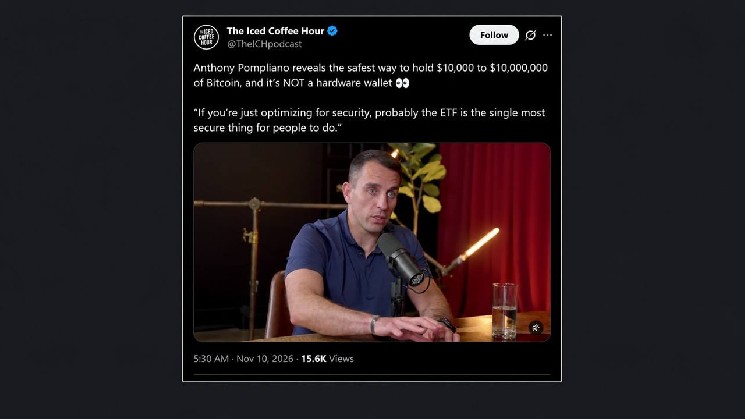
Pompliano Says a Bitcoin ETF Beats Hardware Wallets on Security
"Optimizing for Security"
Asked how someone should store a meaningful amount of bitcoin, the investor and podcast host steered away from the cold storage devices that bitcoiners have championed for years, stating: "If you're just optimizing for security, probably the ETF is the single most secure thing for people to do."
The remark is striking coming from a longtime $BTC advocate, standing in stark opposition to the "not your keys, not your coins" ethos — the idea that whoever controls the private keys controls the coins — that has been the bitcoin community's mantra from day one.
Know When Your Coins Move
Self-custody solutions let an owner hold the private keys that control their funds. Hardware wallets — small offline devices built to keep those keys away from internet-connected machines — are the most common way to do that, which is why security failures in the category strike at the heart of the self-custody pitch. An ETF, by contrast, hands those keys to a regulated custodian and gives the investor a brokerage share instead.
A Bad Few Weeks for Hardware Wallets
The timing was no accident. Over the past month alone, several hardware wallet makers have been dealing with a myriad of security problems. Trezor, for instance, warned customers about a malicious hardware implant found inside a Safe 5 bought from a former reseller — a case tied to a $93 million Ledger security scandal involving the same distributor.
Similarly, Keystone said it would be destroying a total of 18,835 hardware wallets after attackers stole the key used to verify its devices as genuine, undermining the authenticity checks buyers depend on. Passport maker Foundation also disclosed a customer data breach.
Leaked buyer data has additionally introduced a heavy physical risk component. Investor Evan Luthra recently described how five masked men forced their way into his car in Oxford, subsequently assaulted him, and took over $2 million in crypto — all within a span of just 30 minutes.
Taken together, the stretch of incidents shows the threat model for hardware wallets now runs from supply chains and device authentication to the personal data of the people who buy them.
The Case Against Pompliano
ETFs have their own concentration problem. Shortly after Binance's $6.3 billion hack, Onekey founder Yishi Wang warned that North Korean hackers could target BlackRock's iShares Bitcoin Trust (IBIT) next. He noted that the fund held about 815,000 $BTC with Coinbase as its sole custodian, and called that a single point of failure.
Coinbase has pushed back on that kind of worry after the Binance breach, saying more than 99% of customer assets sit in cold storage and that its institutional custody vault runs entirely offline.
There are trade-offs beyond hacking as well. ETF shareholders cannot move their bitcoin onchain, cannot use it for payments, and can only sell when markets are open. Peter Schiff highlighted that limitation in October, warning that ETF investors "can't sell until Monday" during a weekend slide.
ETF investors have also been heading for the exit, with U.S. spot bitcoin ETFs posting $1.28 billion in outflows last week — the largest weekly drain in about four months. Those flow figures are watched closely as a gauge of institutional demand for bitcoin exposure through fund wrappers.
Security Versus Sovereignty
Pompliano's entire argument rests on one variable: protection against loss. For many investors, the bigger danger is not a nation-state hacker but a lost seed phrase, a phishing link, or a fake device bought from the wrong seller. A regulated fund removes those failure points and replaces them with custodian, counterparty, and market-hours risk.
On the other hand, self-custody advocates measure something else: control. Bitcoin held through a broker can be frozen, delayed, or restricted by the very institutions bitcoin was built to bypass.
Pompliano's comment does not settle that contest — it forces a choice between two different sets of risks at a moment when both camps have fresh failures to point to.
The report was originally published by Bitcoin.com News.

