ACDC flags 556 Polymarket wallets as likely insider traders
Key Takeaways
- •ACDC's report identified 556 "Orca" wallets on Polymarket that win more than 75% of the time on longshot bets, compared with an overall longshot win rate of only 14% across the platform.
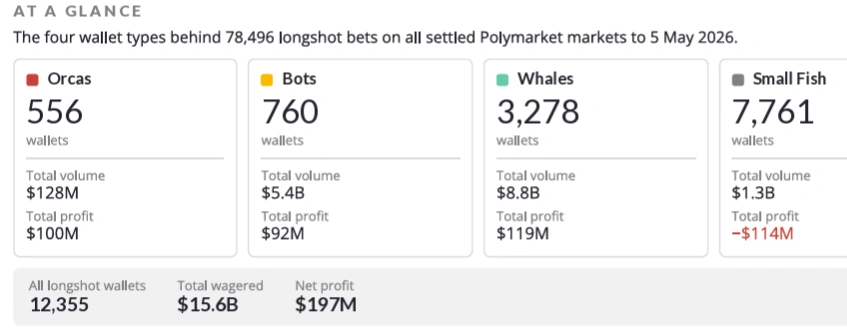
- •The study examined 78,496 longshot bets placed by 12,355 wallets and classified accounts into four groups: 556 Orcas, 3,278 Whales, 760 Bots, and 7,761 Small Fish.
- •An Orca bet on U.S. military action in Iran hours before the June 2025 strikes, and a Bot and a Whale subsequently placed copycat bets of $200,000 and $100,000 respectively.
- •Recent prosecutions include a U.S. Army soldier who allegedly turned roughly $33,034 into about $409,881 using classified raid details, and a Google engineer charged with winning $1.2 million using internal company data.
- •Because blockchain money trails are pseudonymous, ACDC concluded that banning the highest-risk market categories outright is the only viable solution.
A new report from the Anti-Corruption Data Collective (ACDC) has identified 556 Polymarket accounts, which it calls “Orcas.” These accounts reportedly place small, targeted bets on events with low odds and win more than 75% of the time — a success pattern the report links to heightened insider trading risk. Polymarket drew billions of dollars in wagers during the 2024 U.S. presidential election, and it settles its markets on a public blockchain — meaning every bet, wallet and payout is visible to anyone in real time.
What ACDC found on Polymarket
ACDC’s report, titled “Classifying Insider Trading Risk”, examined 78,496 longshot bets placed by 12,355 wallets on the prediction market platform Polymarket. The group defines a longshot as a wager of more than $2,500 placed at a price of 35 cents or less, meaning the market assigns that outcome a 35% chance or worse.
From that pool, the researchers carved out four groups: Orcas, Whales, Bots, and “Small Fish.” The 556 Orca wallets bet on only a handful of markets and topics, yet they won at a very high success rate above 75%. The 3,278 Whales trade at high volume across many markets, the 760 Bots appear at least partly automated, and the remaining 7,761 accounts make up the Small Fish.
In an earlier April report, ACDC found that only 14% of longshot bets win across all of Polymarket. In political markets, the win rate climbs to 25%, and in military and defense markets it reaches 52%. Michelle Kendler-Kretsch and David Szakonyi, who wrote the report, counted $9.3 million in winning longshot bets from military markets alone.
Why insider trading on Polymarket is a national security issue
ACDC found that when betting on major military events, Orcas place their wagers first, with Whales and Bots trailing behind — a dynamic similar to how experienced traders observe the public blockchain and copy insider-like moves in real time. This “copycat” trading is legal, but it can broadcast insider activity to the world.
When an Orca placed a bet on U.S. military action in Iran hours before the June 2025 strikes, for example, a Bot and a Whale followed with copycat bets of $200,000 and $100,000, respectively. The same blockchain transparency that allows for copycat trading will also allow foreign militaries and intelligence services to act on market signals.
Tracing an Orca account back to a person is complicated because the money trail is pseudonymous, and the exchanges that hold funds for thousands of customers would have to be subpoenaed to provide any information. ACDC concluded that banning the highest-risk market categories outright is the only solution.
Prior insider trading cases on prediction platforms
Several other incidents of insider trading on prediction platforms have already surfaced. The cases have landed as event-contract markets covering elections, geopolitics and sports draw surging volumes, and as the Commodity Futures Trading Commission — which regulates U.S. event contracts — moves to tighten oversight of the sector. Polymarket itself paid $1.4 million in 2022 to settle CFTC charges that it offered unregistered event contracts, blocked U.S. users at the time, and later acquired a CFTC-licensed exchange as part of a push to re-enter the U.S. market.
In April, the Justice Department charged a U.S. Army soldier named Gannon Ken Van Dyke, accusing him of staking roughly $33,034 on Venezuela contracts using classified details of the raid that captured Nicolás Maduro, then collecting about $409,881.
In May, prosecutors in the Southern District of New York charged Google engineer Michele Spagnuolo with using internal company data to win $1.2 million on Polymarket. Because U.S. insider-trading doctrine was written for securities and commodities markets, how it applies to event contracts remains an open question — one the recent prosecutions have pushed into public view.
Bubblemaps also recently stated on CBS’s “60 Minutes” that it had traced nine linked accounts that won more than $2.4 million in total across more than 80 Iran war bets at a 98% win rate.
“Luck alone cannot explain those numbers,” Bubblemaps CEO Nicolas Vaiman said.

