Polymarket Gives 61% Chance of U.S. Ending Iran Blockade by March 2027
Key Takeaways
- •Polymarket traders currently price a 61% chance that Washington will officially declare the end of its naval blockade of Iranian ships before March 31, 2027.
- •CENTCOM Commander Adm. Brad Cooper stated on October 16 that the blockade has stopped at least $25 billion in Iranian crude exports and that nearly $350 million in Iranian cryptocurrency has been frozen by the U.S. and its partners.
- •The prediction market contract resolves only if the U.S. government makes a clear formal announcement, with single-vessel exemptions, leaks, and hints insufficient to trigger resolution.
- •The market has recorded $41.4 million in trading volume since July, with nearly 22 percentage points of probability assigned to the first quarter of 2027 alone.
- •Iran is withholding pay across key sectors amid inflation near 90%, but Gulf neighbors' continued oil exports under U.S. military protection have kept regional flows near prewar levels, limiting any significant effect on the broader oil market and Bitcoin so far.
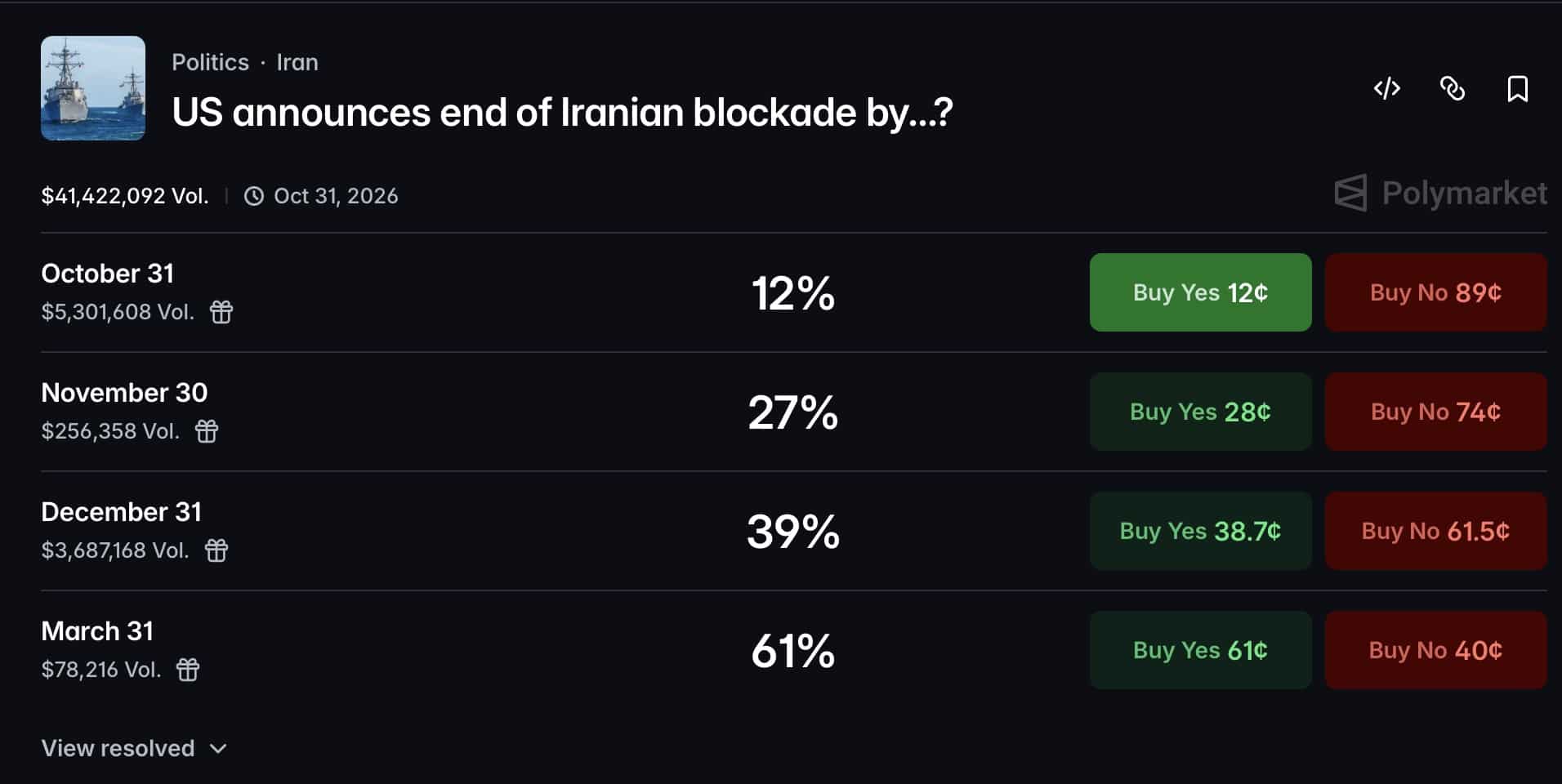
Polymarket traders give a 61% chance that the U.S. government will officially announce an end to its naval blockade on Iranian ships by March 31, 2027. The market indicates that Washington may eventually lift the pressure, but not soon, while U.S. Central Command (CENTCOM) says the blockade is already affecting Iran’s revenues.
Polymarket is a real-money prediction market, meaning the 61% figure is not any single analyst’s forecast but the aggregate probability implied by traders with funds at stake — the same mechanism that allows the odds to update continuously as new information arrives.
Adm. Brad Cooper, who leads CENTCOM, said in a video update on October 16 that the blockade had prevented Iran from exporting at least $25 billion worth of crude. He also said the U.S. and its partners had frozen nearly $350 million in Iranian cryptocurrency.
CENTCOM published the update on X: Update from CENTCOM Commander. The post was also referenced through and https://x.com/CENTCOM/status/2111156124997263405?ref_src=twsrc%5Etfw.
What the Polymarket contract measures
The Polymarket contract measures an official announcement, rather than the movement of ships. It resolves “Yes” only if the U.S. government clearly announces that it is ending, lifting or suspending the blockade on Iranian ships and their customers.
An exemption involving a single vessel, cargo or port would not qualify. Leaks and hints also would not count. However, a clear government statement would qualify even if some restrictions, including fees, remained in place. The contract is available at Polymarket.
Traders appear to be pricing continued pressure before a potential agreement. Nearly 22 percentage points of probability are assigned to the first quarter of 2027 alone. The event has recorded $41.4 million in trading volume since July and has approximately $430,000 in liquidity. That is substantial enough for the odds to receive attention, but limited enough that a single official statement could reprice the entire timeline. In practice, that makes formal U.S. government statements — rather than ship movements or media reports — the development to watch, since only such an announcement can trigger a resolution the deadline.
A $25 billion squeeze with limits
Iran is withholding pay and benefits across the energy, manufacturing, construction and security sectors, including from the Islamic Revolutionary Guard Corps (IRGC). Inflation is running near 90%, and retirees have protested over unpaid pensions.
The $25 billion figure comes from CENTCOM and has not been independently audited. The blockade’s economic pressure also has limits. Iran’s Gulf neighbors continue exporting under U.S. military protection, keeping regional oil flows near prewar levels. Iranian cargoes that were already at sea are nearly depleted, although related payments could continue into December.
As a result, Tehran’s income is under pressure, while the broader oil market has so far seen limited impact. For Bitcoin, the geopolitical-risk connection runs mainly through oil prices and interest rates. As long as Gulf crude continues to flow, the blockade alone is not expected to have a significant effect on BTC. A new disruption could revive inflation concerns and delay expectations for interest-rate cuts, a combination that typically affects risk assets first. Between now and the contract’s March 2027 deadline, the observable markers are concrete: further official CENTCOM updates on interdiction totals, the December window for residual payments tied to depleted cargoes, and whether Washington issues the formal announcement the market’s rules require.
Source: 99Bitcoins

