PodFest Naija Pushes Nigerian Creators Toward Ownership and Control
Key Takeaways
- •The second PodFest Naija festival in Lagos framed Nigeria's creator economy challenge as the distance between generating attention and owning the economic value it produces.
- •Lagos Deputy Governor Obafemi Kadri Hamzat said the creative economy is outgrowing its supporting systems, citing weak contracts, rights, finance, data and payment infrastructure, and pledged to build a website that lets applicants track state grant opportunities.
- •Salem King, co-founder of Crea8torium, attributed wide income differences between creators with similar audience sizes to knowledge gaps in pitching, negotiation and contract literacy rather than follower counts.
- •Entertainment lawyer Audu Maikori warned that artificial intelligence sharpens the ownership problem, since Nigerian creativity helps train AI systems whose infrastructure and commercial arrangements are controlled elsewhere.
- •Funke Akindele described expanding from acting into producing, directing and running a company, urging younger creatives to keep telling and owning their stories.
Nigerian creators have mastered visibility. They command large audiences, sway purchasing decisions, export slang and culture across borders, and sit at the centre of how brands communicate with young consumers. Owning the value generated by all of that attention is proving far more difficult.
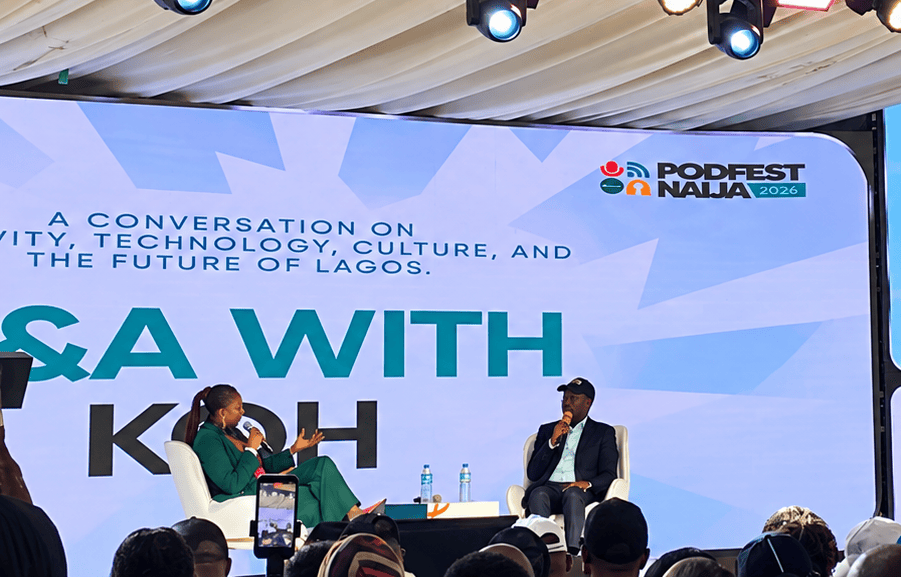
That gap between influence and economic control shaped the second edition of PodFest Naija, held on Friday at Victoria Island, Lagos. Across the festival, creators, media executives, technology companies and policymakers examined a creator economy that is growing in reach faster than its business infrastructure is maturing.
The concern was never whether Nigeria has enough creative talent. It was whether creators can build companies around that talent, protect the work they produce, negotiate fairly with brands and platforms, and keep enough of the value when their ideas become commercially useful.
PodFest made that question central to its technical stage, which was structured around the gap between "creating value and owning value" on moving African creators from visibility to lasting economic value.
Festival convener Tosin Adefeko put the stakes plainly. "We cannot continue to celebrate African creativity without having serious conversations about ownership, intellectual property, monetisation, platforms, AI," she said. "Our creativity should not just be consumed, It should also be owned."
The value gap behind the numbers
Lagos Deputy Governor Dr Obafemi Kadri Hamzat located the problem beyond content creation itself. "Our creative economy is therefore growing faster than the system that holds it," he said.
In his assessment, the weaknesses surface in contracts, rights, access to finance, data and payment systems. Creators may have audiences, but an audience is not automatically a viable business. "Too many creators still cannot turn audience into income. Too much intellectual property is produced locally and monetised elsewhere," he said.
His argument challenges the idea that follower count is a reliable measure of a creator's earning power.
Salem King, a content creator and co-founder of Crea8torium who has trained thousands of creators, contended that two people can hold roughly the same audience and earn dramatically different amounts from it. One creator may know how to pitch directly to brands, negotiate contracts, structure a proposal and identify companies that fit the audience. Another, with the same 50,000 followers, may simply wait for an Instagram DM offering a campaign.
"The strategy that allows you to get people to click on your post is different from the strategy that gets people to part with money," King said.
In his view, the income disparity between creators is often a knowledge gap. Someone earning five times more from a similar audience may simply understand something the other person does not about the platform, the market or how to monetise a particular skill. Framed that way, pitching, negotiation and contract literacy become part of the same business infrastructure Hamzat described as lagging behind the country's creative reach.
Hamzat offered a similar message. "Build businesses, not just brands," he told creators. "Own your own intellectual property, register it and protect it."
During a follow-up conversation with television host Morayo Brown, Hamzat was asked how an ordinary creator without access to political officials could navigate the different grants and support programmes offered by the state. He conceded that Lagos still has too many government databases operating separately. The result is a system in which opportunities may exist without being easy to find, apply for or track.
When challenged to build a process that allows applicants to see available opportunities and follow what happens after submitting an application, Hamzat agreed. "We should be able to track how many applied, how many got it… and how they are progressing from the website," he said. "That's a commitment." Whether that tracking system is actually built, and what it reveals about how far state support extends, is one concrete marker to watch as the festival's ownership agenda moves off stage.
At PodFest, the conversation shifts from visibility to ownership
A creator can technically own a song, video, character, format or likeness and still have little practical influence over how that asset travels, is licensed or is used to generate money. For entertainment lawyer and Chocolate City co-founder Audu Maikori, that is the more important question.
"The issue about ownership is probably the most important thing in intellectual property," he said. "But more important is the ability to control what you own."
Artificial intelligence has made the distinction sharper. Creators are producing the music, images, videos, language and cultural references feeding a new generation of digital systems, yet the infrastructure, models and commercial arrangements around those systems largely sit elsewhere. "Even though we own the creativity, we are not controlling the creativity," Maikori said. "And when you don't control, you cannot earn money from it."
The tension he described is not confined to Nigeria. Across the global industry, questions over who supplies the images, music and language that train AI systems — and on what terms — have become among the sector's most contested issues.
That means the creator economy is about more than what a brand pays for a sponsored post. Licensing, equity, trademarks and the rights attached to a creator's work increasingly matter just as much.
Funke Akindele and the business of staying power
Funke Akindele's appearance on PodFest's Uncovered stage carried the ownership conversation out of contracts and intellectual-property law and into the messy reality of building a creative career. Before producing some of Nollywood's biggest commercial films, Akindele said she went through periods when even getting cast was difficult.
She spoke about auditions where comments about her appearance were brutal, the uncertainty that followed the success of I Need to Know, and a stretch when recognition did not translate into enough acting roles to sustain her career. So she adapted.
Akindele took smaller parts in Yoruba productions. She found locations for filmmakers, worked on costumes and welfare, and learned more of what happens behind the camera. Acting eventually expanded into producing, directing and running a company. The significance of that journey was not simply that she persisted. It was that she refused to make one job title the limit of her career.
"If this way is not good, you move here a bit. But remember that purpose," she said. Her advice to younger creatives followed the same logic. "You have to keep creating. You keep telling your stories. Keep owning your stories," Akindele said. "What do you want to be known for? What are you creating for? That is your mission."
Owning a creative career does not begin only when a lawyer registers a trademark. It can start with building enough skill, leverage and structure so that a creator is not permanently dependent on someone else offering the next job.
Nigeria has already demonstrated that its creators can command attention. Its music travels, its films cross borders, its personalities build communities and its internet culture regularly escapes the platforms where it began. The next phase of the creator economy will be decided by how much of that cultural influence can be converted into intellectual property, companies,, communities and income that creators themselves can control.

