Pirated 'The Odyssey' Downloads Used to Target Crypto Wallets With Lumma Stealer
Key Takeaways
- •Pirated copies of The Odyssey serve as a delivery mechanism for Lumma Stealer malware rather than containing the actual film.
- •Lumma Stealer, first observed in 2022 and sold as malware-as-a-service, is documented to harvest browser-stored passwords, cookies, autofill and card data, cryptocurrency wallet files and extensions, and screenshots.
- •The reports describe crypto wallets as being targeted, which is distinct from confirmed theft occurring in every case.
- •In May 2025, Microsoft seized roughly 2,300 Lumma-linked domains under a U.S. court order, and the U.S. Department of Justice seized additional infrastructure in coordination with Europol and Japan's JPCERT/CC.
- •Microsoft reported that more than 394,000 Windows devices contacted Lumma command-and-control domains in the weeks before the takedown, and that operators re-registered domains after earlier disruption attempts.
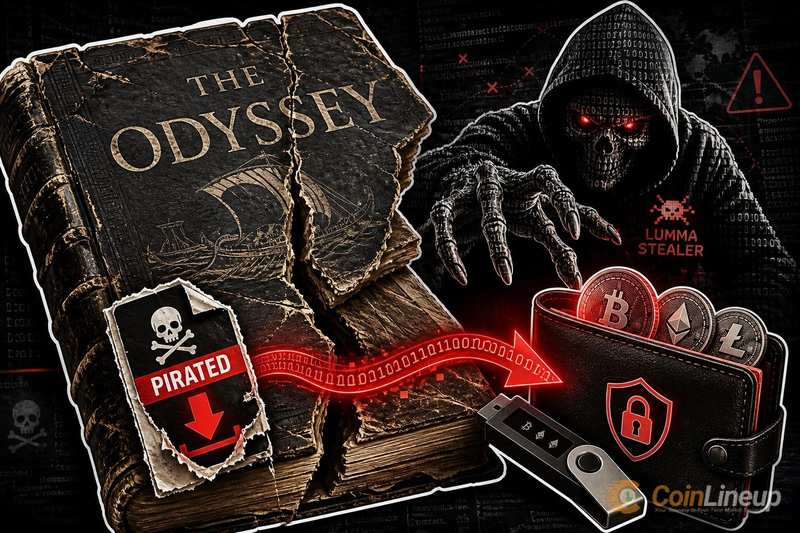
Pirated downloads of The Odyssey are reportedly being used to target cryptocurrency wallets with Lumma Stealer malware, according to security research and media reports, turning what begins as a search for a free copy of the film into a direct threat to holders of digital assets.
How the pirated downloads deliver the malware
The campaign centers on unofficial, pirated copies of The Odyssey, not on legitimate streaming or purchase channels. Rather than delivering the film, these files serve as a lure designed to install malware on the devices of the people who download them, according to Bitdefender.
The malware identified in the campaign is Lumma Stealer, an information-stealing family that has been used to harvest sensitive data from infected machines. Reporting on the campaign has tied the pirated files directly to Lumma Stealer, as detailed by Decrypt. Using pirated entertainment as bait fits a distribution pattern security vendors have documented for years, with infostealers routinely spread through fake or cracked downloads rather than conventional network intrusions.
The confirmed relationship in the reporting is narrow but clear: the download is the delivery method, and Lumma Stealer is the payload. Users who avoid pirated sources and rely on legitimate channels are not exposed to this particular lure.
Why Lumma Stealer is a serious threat to wallet holders
For cryptocurrency users, the central concern is that Lumma Stealer is designed to compromise wallet access and related credentials, rather than simply disrupting a device. First observed in 2022 and sold as a malware-as-a-service subscription through underground forums and Telegram channels, Lumma is documented to harvest browser-stored passwords, cookies, autofill and card data, and cryptocurrency wallet files and extensions, as well as capture screenshots from infected machines. That focus on credential theft is what makes an infostealer dangerous to anyone holding digital assets.
The wording of the reports deserves precision. They describe crypto wallets being targeted, which is not the same as confirmed theft in every case. The risk is the exposure of wallet data and login information once a machine has been infected.
Lumma Stealer has drawn attention well beyond this single campaign. Microsoft has described broad, coordinated action against the tool as a favored cybercrime utility in its own account of the operation. In that May 2025 action, Microsoft said it seized roughly 2,300 domains under a U.S. court order, while the U.S. Department of Justice seized additional Lumma infrastructure in coordination with Europol and Japan's JPCERT/CC. Microsoft also reported that more than 394,000 Windows devices contacted Lumma command-and-control domains in the weeks before the takedown, and noted the operators had re-registered domains after earlier disruption attempts, meaning users cannot rely on takedowns alone for protection.
The wallet-security stakes echo other recent incidents in which credential and customer-data exposure has put cryptocurrency users at risk, including the Bits of Gold third-party data breach probe, and they intersect with debates over self-custody, such as reporting on Bitstamp and self-custody wallet deposits.
What readers should watch for
The clearest prevention message supported by the reporting is straightforward: avoid pirated downloads of The Odyssey and steer clear of similar unofficial software offers. Unofficial sources should be treated as a direct wallet-security risk, not simply a piracy issue.
The broader takeaway from the campaign is that entertainment lures are being used against cryptocurrency users, folding wallet-theft attempts into something as ordinary as a movie download. For holders of digital assets, vigilance about where files come from remains the practical defense against this class of threat, since infostealers can quietly harvest sensitive data with few obvious signs that a device has been compromised.

