Pi Network: Every Click Builds the Ecosystem — Why Pioneer Participation Matters
Key Takeaways
- •Pi Network has expanded its ecosystem with multiple interconnected components, including Pi App Studio, Node infrastructure supporting Protocol 20, the SoloHost framework, and identity services like Pi Sign-in and PiVerify.
- •In March 2026, Pi Network announced that selected App Studio applications could transition from Testnet to Mainnet to integrate live Pi payments, enabling real economic transactions within the ecosystem.
- •Pi Network introduced AI-assisted application development capabilities in May 2026, allowing both technical and non-technical creators to build and connect applications within the Pi ecosystem.
- •The project is exploring Node utility for decentralized AI training and computing tasks, including a proof-of-concept with OpenMind, potentially expanding Nodes beyond traditional blockchain infrastructure.
- •Despite having tens of millions of self-reported users, Pi Network still needs to demonstrate that its ecosystem can convert that user base into sustained real-world utility and genuine economic activity.
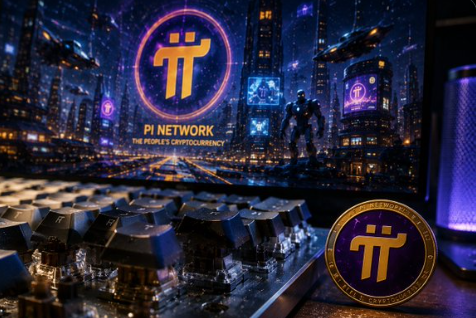
A functioning blockchain ecosystem relies on far more than its underlying token. It requires a network of people, devices, software, applications, infrastructure, and daily interactions. Without these components, a cryptocurrency remains little more than a digital asset held in a wallet. A recent message shared on X by @PiWeb3Army offers a compelling perspective on Pi Network by using the image of a keyboard and a Pi Network city to illustrate a simple but powerful idea: every individual action can become part of a much larger system.
One key on a keyboard may appear insignificant, but millions of keystrokes can create an entire digital environment. The same principle applies to Pi Network. One Pioneer using an application, one developer creating an app, one Node operator contributing infrastructure, and one merchant accepting Pi may each seem insignificant in isolation. But when those activities connect, they can potentially form the foundation of an entire digital economy. This is the broader story behind Pi Network's ongoing ecosystem development.
Pi Network Is More Than a Coin
Cryptocurrency discussions often begin and end with price. Bitcoin has a market value. Ethereum has a market value. PiCoin has a market value that attracts constant attention from its community. However, blockchain networks are more than their tokens. Ethereum's trajectory illustrates this clearly: its significance stems not just from the price of ETH but from its role as a platform supporting thousands of decentralized applications, DeFi protocols, and NFT marketplaces. A functioning blockchain requires infrastructure and active participation: users interacting with applications, developers creating software, computers supporting network operations, businesses experimenting with blockchain-based services, transactions taking place, identity systems and security mechanisms functioning, and communities creating demand for new applications.
Pi Network has increasingly positioned itself around this broader ecosystem model. Its official roadmap describes Pi Browser as a gateway to its Web3 application ecosystem, where Pioneers can interact with third-party applications, use their Pi accounts, and transact through Pi Wallet. The roadmap also highlights developer tools, APIs, SDKs, and other infrastructure intended to support application creation. The Pi story is therefore no longer simply about how many people are mining — it is increasingly about what those people do after entering the ecosystem.
Every Pioneer Can Become Part of the Network
The idea that "every key builds the network" is particularly relevant because blockchain ecosystems are ultimately constructed from individual actions. A user opens an application. Another user completes a transaction. A developer deploys an update. A merchant accepts payment. A Node operator contributes computing resources. A community member tests a new feature. Each action may look small by itself, but an ecosystem is created through the accumulation of those activities.
Pi Network's own announcements increasingly describe the ecosystem in terms of Pioneers, developers, Node operators, app teams, merchants, and third-party services contributing to utility creation. The message reflects an important principle of Web3: the network becomes more useful when more participants actually use and build on it.
From Mining to Building
Pi Network began with a mobile mining experience designed to make cryptocurrency participation more accessible. That model helped introduce tens of millions of engaged Pioneers to the project, according to Pi Network's own communications, making it one of the largest self-reported user communities in the cryptocurrency sector. But mining alone cannot create a complete digital economy. At some point, users need practical reasons to use what they have accumulated, and that is where applications become critical.
Pi App Studio has become one of the project's primary efforts to encourage community-driven application development. Pi Network has continued expanding the platform, including AI-assisted creation and easier integration with Pi services. In January 2026, the project introduced simplified Pi payment integration in App Studio, allowing creators to add payment functionality without traditional coding work. More people can experiment, more experiments generate more ideas, more ideas can lead to more applications, and some applications may eventually provide genuine utility.
A Single Application Can Create a New Use Case
Consider a straightforward example. A developer creates an application that helps local businesses connect with Pi users. Initially, perhaps only a small group of merchants joins. A few hundred Pioneers begin using it. Those users create demand for the service. More merchants notice the activity, and additional businesses decide to participate. The application expands. Eventually, another developer creates a complementary service. What started as one small application becomes part of a larger ecosystem.
This is how digital platforms typically develop. The important factor is not necessarily the size of the first application but whether it solves a real problem. Pi Network does not need every Pioneer to build the next global technology company — it needs enough useful products to make participation increasingly valuable.
AI Could Accelerate the Process
The emergence of AI-assisted development could further accelerate this process. Software development is becoming more accessible as artificial intelligence tools help creators write code, design applications, and prototype ideas. Pi Network has explicitly embraced this trend. In May 2026, Pi Network announced that creators using AI-assisted coding platforms could bring those applications into Pi App Studio and connect them with Pi's ecosystem. The project stated that this approach was designed to support both technical developers and non-technical creators.
This could potentially increase the number of people capable of experimenting with Web3 applications. Someone with an idea does not necessarily need to assemble an entire development team before testing it. They can create a prototype, gather feedback, improve the product, and determine whether users actually need it. AI does not eliminate the need for security, testing, design, and technical judgment, but it can reduce some barriers. For a community as large as Pi Network's, even a modest reduction in the barrier to application creation could result in significantly more experimentation.
The Network Also Needs Infrastructure
Applications represent only one part of the picture. A digital ecosystem also needs infrastructure, and this is where Pi Nodes become important. Pi Network has continued developing its Node and Pi Desktop infrastructure while exploring broader computing possibilities.
In its 2026 Pi Day announcement, Pi Network said major Nodes had been upgraded to support Protocol 20, explaining that Protocol 20 provides the foundation for smart contract capabilities. The same announcement described progress toward broader ecosystem participation through Nodes and applications.
Later, Pi Network's Pi2Day 2026 announcement expanded the discussion further. The project introduced SoloHost, a framework allowing developers to build and list applications on Pi Desktop that can support local AI and future distributed computing use cases. This suggests that computers participating in the Pi ecosystem could have roles beyond simply supporting the blockchain, connecting infrastructure with useful computing services.
A Computer Can Become Part of the Ecosystem
Infrastructure is often invisible to ordinary users. People may see an application on their phone without thinking about the servers, databases, and networks supporting it, yet those systems are essential. Pi Network is exploring a model where some computing resources can potentially be supplied by participants in the network.
In its 2025 year-end update, Pi Network described exploration of Node utility for decentralized AI training and computing tasks, including a proof-of-concept involving OpenMind. If these types of use cases eventually develop into sustainable production services, Nodes could potentially become part of a broader computing marketplace. That would represent a significant expansion of the concept of network participation, with Nodes becoming part of a larger digital computing ecosystem rather than simply blockchain infrastructure.
Identity Is Another Piece of the Puzzle
A digital economy also needs trust. If people interact with businesses, applications, and services online, there must be a way to establish that participants are genuine. Pi Network has invested heavily in identity verification through its KYC system and has also introduced services designed to extend Pi's identity capabilities beyond the traditional Pi ecosystem.
In June 2026, Pi Network introduced Pi Sign-in, allowing Pioneers to use their Pi accounts to sign in to supported external websites and applications. It also introduced PiVerify as part of its broader effort to extend verified human identity capabilities to external services. This is particularly relevant in the age of AI, as automated systems become increasingly capable of generating profiles, content, and interactions, making it more difficult to determine whether an online participant is a genuine human. Proof-of-personhood has become a significant focus across the Web3 industry, with multiple projects investing in solutions to combat bots and sybil attacks. Pi Network's KYC pipeline, applied at the scale of tens of millions of users, positions it within this broader competitive landscape. Identity infrastructure could therefore become an important component of Web3.
Source: X post by @PiWeb3Army
Pi Is Connecting More Pieces Together
When viewed individually, App Studio, Nodes, identity services, Pi Browser, and payments may appear to be separate products. But they can also be understood as pieces of one larger system. Pi Browser provides access to applications. App Studio provides tools for creators. Pi Wallet enables transactions. Nodes contribute infrastructure. Identity systems establish trust. Developers create applications. Users create demand. Merchants provide real-world services. The pieces become more meaningful when they interact — and that is the essence of the image shared by @PiWeb3Army.
Mainnet Makes the Difference
Another important development is the increasing connection between applications and Mainnet. Pi Network announced in March 2026 that selected App Studio applications could transition from Testnet to Mainnet and integrate live Pi payments if they met the relevant requirements.
Testnet allows developers to experiment. Mainnet allows real blockchain activity. When applications can support actual Pi transactions, developers have the possibility of creating services with genuine economic interactions. Utility becomes much more concrete: a user does not simply look at Pi but uses Pi to access something. That transaction creates activity. The developer provides a service. The application receives value. The user receives utility. The ecosystem gains another economic interaction.
Every Transaction Is Another Connection
One transaction is not an entire economy, but an economy is built from transactions. One application is not an ecosystem, but an ecosystem is built from applications. One merchant is not a marketplace, but marketplaces begin with individual merchants and customers. One Node is not a distributed network, but distributed networks depend on many participating nodes. Small actions become significant when they happen repeatedly across a large network.
The Role of Merchants
Merchants could eventually become one of the most important components of Pi's utility. A cryptocurrency becomes more useful when people can spend it. If merchants accept Pi for goods and services, users have a practical reason to hold and transact with the asset, creating another bridge between the digital and physical economies. A customer purchases something. The merchant receives Pi. The merchant can potentially use Pi within the ecosystem. Another participant may provide a service to that merchant. The transaction becomes part of a larger economic network.
However, merchant adoption cannot be created through slogans alone. Businesses need reliable infrastructure, customers, and clear economic incentives. Real adoption will matter more than social media enthusiasm.
The Community Is Part of the Infrastructure
One of Pi Network's most distinctive characteristics is the role assigned to its community. Pioneers are not presented solely as passive consumers. They are encouraged to test applications, participate in ecosystem activities, operate infrastructure, and contribute ideas. Pi Network's Pi Day 2026 utility challenge, for example, was designed to encourage Pioneers to explore different parts of the ecosystem and interact with newly released tools. A community becomes powerful when it does more than discuss a project — it becomes powerful when it creates activity.
Why Price Should Not Be the Only Measurement
PiCoin price will always attract attention, which is normal for any cryptocurrency. But price is only one measurement. If the goal is to understand whether Pi Network is developing into a sustainable ecosystem, other indicators may be more useful: How many applications are active? How many users actually use them? How many businesses accept Pi? How many transactions represent genuine commerce? How many developers continue building? How much infrastructure is available? How useful are the services? A strong price without utility can be difficult to sustain, while a growing ecosystem of useful services can potentially create stronger foundations for long-term demand.
Every Key Can Represent a Decision
The keyboard metaphor can also be interpreted at an individual level. Every key represents a decision. A Pioneer decides whether to explore an application. A developer decides whether to build. A merchant decides whether to accept Pi. A Node operator decides whether to contribute infrastructure. A user decides whether an application is useful enough to return to. These decisions may appear independent, but together they influence the direction of the ecosystem. If users reject applications that provide no value, developers receive feedback. If a useful application attracts users, other developers notice. If merchants find Pi payments useful, more businesses may investigate them. If infrastructure becomes useful for computing, additional participants may contribute.
The Challenge Is Real Adoption
There is an important caveat. Having infrastructure does not automatically produce adoption. Having applications does not mean people will use them. Having millions of users does not guarantee that those users will become active consumers. This gap between user acquisition and genuine ecosystem engagement is a recognized challenge across blockchain projects — many platforms have built large user bases through token incentives or mining models but struggled to convert those participants into sustained economic activity. Pi Network still has to demonstrate that its ecosystem can create sustained real-world utility. The tools may exist, the infrastructure may be expanding, and the applications may be increasing, but users ultimately determine whether those products survive. Pioneers are not simply observers of this experiment — they are potential participants in it.
Pi Network Is Becoming More Connected
The broader direction of Pi Network's recent updates suggests a deliberate effort to connect previously separate components. App development is becoming more sophisticated. AI is being incorporated into creation. Nodes are being explored for additional computing use cases. Identity services are being extended externally. Mainnet applications can support Pi payments. The Ecosystem Interface gives users a place to discover applications and services.
Pi Network's June 2026 Ecosystem Directory Staking update also introduced a mechanism through which Pioneers and businesses can use Pi to support the visibility of applications and utilities within the Ecosystem Interface. Each development addresses a different part of the ecosystem, and together they create a more interconnected structure.
What Happens If the Pieces Work Together?
Consider a Pioneer discovering an application through Pi Browser. The user signs in with a Pi account. The application uses verified identity features. The user pays with Pi. The application relies on infrastructure connected to the Pi ecosystem. The merchant receives the transaction. Another service provides computing resources. Developers improve the application based on user feedback. None of these individual actions is revolutionary, but together they represent a functioning digital economy.
The Future Depends on Participation
Pi Network can provide tools, build infrastructure, release developer platforms, and create identity systems. But the community still has to use those tools. Developers need to create useful products. Users need to adopt them. Businesses need to find practical use cases. Merchants need to provide real services. Node operators need to contribute infrastructure. Without participation, infrastructure remains infrastructure. With participation, it can become an economy.
Final Thoughts
The message from @PiWeb3Army captures an important idea about the evolution of Pi Network. A blockchain is not simply a coin displayed on a screen — it is an interconnected system of people, software, devices, applications, infrastructure, and transactions. Pi Network is increasingly developing each of these layers. Pi App Studio gives creators a way to build applications. AI tools are lowering some barriers to development. Nodes provide infrastructure and are being explored for broader computing applications. Pi Browser connects users with Web3 applications. Pi Sign-in and PiVerify extend identity-related services. Mainnet payments allow selected applications to conduct real Pi transactions.
The success of these initiatives will ultimately depend on adoption. The technology can be built, the tools can be released, and the infrastructure can be expanded — but people have to use them. One click may seem insignificant. One application may seem small. One transaction may seem unimportant. One Node may appear to be just another computer. But millions of connected actions are what turn infrastructure into a network, and a network into an ecosystem. The future of Pi Network will not be determined by one announcement, one application, or one price prediction. It will be shaped by the accumulation of countless decisions made by Pioneers, developers, businesses, merchants, and infrastructure participants.

