Pi Network DeFi Testing Gains Attention as Token Swaps and Liquidity Pools Are Trialed
Key Takeaways
- •Pi Network developers are actively testing token swaps, price charts, and liquidity pools in the Pi Wallet Testnet environment.
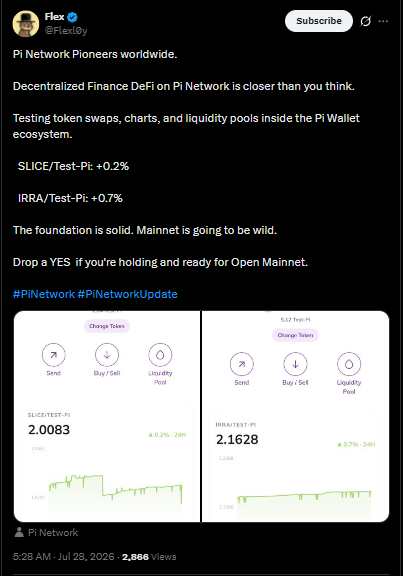
- •Community reports say the SLICE/Test-Pi pair rose about 0.2% and IRRA/Test-Pi increased about 0.7% during testnet activity.
- •The reported token movements are not real market prices because all transactions are taking place only on the Pi Testnet.
- •Pi Wallet could expand beyond storage to become a gateway for decentralized applications if the new DeFi features are integrated successfully.
- •There is no official confirmation on when these features may launch on Mainnet, but development activity remains ongoing.
The Pi Network ecosystem is once again drawing attention after reports emerged that several Decentralized Finance (DeFi) features are being actively tested within the Pi Wallet ecosystem. The developments indicate that Pi Network continues to strengthen its blockchain infrastructure by building services commonly found on leading decentralized blockchain networks.
According to updates shared by the Pi Network Pioneers community, developers are currently testing token swaps, price charts, and liquidity pools using custom tokens operating on the Pi Testnet. Many community members view the progress as another important milestone in preparing the ecosystem for future expansion.
For participants across the Crypto industry, the introduction of DeFi functionality is widely regarded as a key indicator that a blockchain is moving beyond basic infrastructure and toward real-world utility through Web3 applications.
Pi Network Expands Its DeFi Infrastructure
Decentralized Finance, or DeFi, refers to blockchain-based financial services that allow users to access financial activities without relying on traditional intermediaries.
Through DeFi protocols, users can swap digital assets, provide liquidity, earn rewards, and interact directly with decentralized financial applications powered by smart contracts.
The latest Pi Network developments indicate that several core DeFi components are now being tested inside the Pi Wallet Testnet environment.
Among the features currently under development are token swaps, live price charts, and liquidity pools, all of which are fundamental building blocks for decentralized exchanges (DEXs).
Although these features remain in the testing phase, they represent critical infrastructure that must be validated before any broader deployment and before any user-facing services can be scaled with confidence.
SLICE and IRRA Highlight Testnet Activity
Two custom tokens receiving significant attention during the testing phase are SLICE and IRRA.
Based on information shared by the Pi community, the SLICE/Test-Pi trading pair recorded an increase of approximately 0.2%, while IRRA/Test-Pi rose by around 0.7% during recent Testnet activity.
These figures should not be interpreted as actual market prices, since all transactions are occurring exclusively within the Pi Testnet environment.
Instead, the movements show that developers are actively testing pricing mechanisms, transaction execution, and liquidity management.
Such simulations are standard practice across the blockchain industry, allowing developers to validate system performance before introducing applications to a live blockchain environment.
Token Swaps Could Increase Pi Coin Utility
One of the most anticipated features currently under testing is token swapping.
Token swaps enable users to exchange one digital asset for another directly through smart contracts without relying on centralized intermediaries.
This functionality has become a cornerstone of modern DeFi ecosystems because it gives users greater flexibility and efficiency when managing digital assets.
If Pi Network eventually introduces a similar capability, Pi Coin could evolve beyond serving as a simple digital asset and become an active component within a broader decentralized economy.
Token swap functionality could also encourage developers to build additional Web3 applications that integrate Pi Coin into their services.
Liquidity Pools Remain a Core DeFi Building Block
Liquidity pools are another essential feature currently being tested.
A liquidity pool consists of digital assets supplied by users to facilitate trading on decentralized exchanges.
Unlike traditional exchanges that rely on order books, decentralized exchanges use liquidity pools to execute trades more efficiently through automated market-making mechanisms.
The larger the liquidity pool, the smoother and more efficient trading generally becomes.
The fact that Pi Network developers are testing liquidity pools suggests they are building the underlying infrastructure needed to support decentralized financial services within the ecosystem.
Source: Xpost
Pi Wallet Could Evolve Into a Web3 Gateway
Pi Wallet has traditionally served as the primary storage solution for Pi Coin holders.
However, recent developments suggest its role may expand significantly beyond functioning as a digital wallet.
By integrating token swaps, price charts, and liquidity pools, Pi Wallet could eventually become the central gateway to decentralized applications operating within the Pi Network ecosystem.
This evolution reflects broader trends across the Crypto industry, where digital wallets increasingly serve as comprehensive platforms for interacting with decentralized services rather than simply storing digital assets.
If these developments continue successfully, Pi Wallet may become one of the core pillars supporting Pi Network's future Web3 ecosystem.
Ecosystem Foundation Continues to Strengthen
According to updates from Pi Network Pioneers, the foundation of the Pi ecosystem continues to strengthen as more features enter the testing phase.
Although many services have yet to reach Mainnet, the consistent pace of development suggests that infrastructure building remains a priority.
Within the blockchain industry, extensive testing is considered essential to ensure platform security, reliability, and a positive user experience before public deployment.
The broader the testing process, the greater the likelihood that future services will operate smoothly when eventually introduced to a larger user base.
Why DeFi Matters for Pi Network
The addition of DeFi capabilities has the potential to significantly increase the utility of any blockchain network.
Instead of functioning solely as a digital currency, a coin can become part of a larger decentralized financial ecosystem supporting trading, liquidity provision, digital payments, lending, and other Web3 applications.
For this reason, the expansion of DeFi infrastructure is often viewed as one of the strongest indicators of blockchain ecosystem maturity.
For Pi Network, these developments could create new opportunities to increase Pi Coin's utility while attracting developers interested in building decentralized applications on the network.
Community Looks Ahead to Open Mainnet
As these DeFi tests continue, optimism surrounding Pi Network's Open Mainnet has grown across the global community.
Many Pioneers interpret the latest Testnet developments as evidence that the project continues preparing essential infrastructure before entering its next major phase.
While there has been no official confirmation regarding the timeline for launching these features on the Mainnet, the steady pace of development shows that work behind the scenes remains active.
That makes the current testing period notable not as a finished product, but as a step in the broader process of validating whether the ecosystem can support more advanced services when the network is ready.
This suggests that Pi Network's focus extends beyond launching Open Mainnet itself, emphasizing the importance of delivering a well-prepared ecosystem capable of supporting modern blockchain services from day one.
Looking Ahead
The ongoing testing of token swaps, liquidity pools, price charts, and custom tokens such as SLICE and IRRA highlights Pi Network's continued commitment to expanding its technological foundation.
If these developments successfully progress beyond the Testnet stage, the Pi ecosystem could eventually support a wide range of DeFi services that significantly enhance the practical use of Pi Coin across decentralized digital applications.
Although all current activity remains within the Testnet environment, these developments indicate that Pi Network is building more than just a blockchain. It is working toward a comprehensive Web3 ecosystem designed to support real utility and long-term growth.
For the broader Crypto community, this progress represents an important trend worth monitoring as Pi Network continues advancing toward a more mature and utility-driven blockchain ecosystem.

