Pi Network's Future Hinges on Everyday Adoption, Not Just Coin Price
Key Takeaways
- •Pi Network’s success is framed as dependent on everyday utility and sustained participation, not only on Pi Coin price movements.
- •The ecosystem’s potential use cases include digital payments, decentralized applications, online services, merchant adoption, and developer innovation.
- •Verified digital identity could support safer blockchain interactions, but it also requires attention to privacy and data protection.
- •AI-assisted development may allow more individuals and small teams to build applications for blockchain ecosystems.
- •Mass adoption will require practical applications, merchant participation, regulatory clarity, technical scalability, and continued community involvement.
Pi Network's Future Hinges on Everyday Adoption, Not Just Coin Price
In the cryptocurrency industry, price movements typically dominate the conversation. Market participants gravitate toward valuations, trading volumes, and speculative forecasts. Yet for blockchain projects pursuing lasting relevance, success is measured by something more fundamental than market metrics.
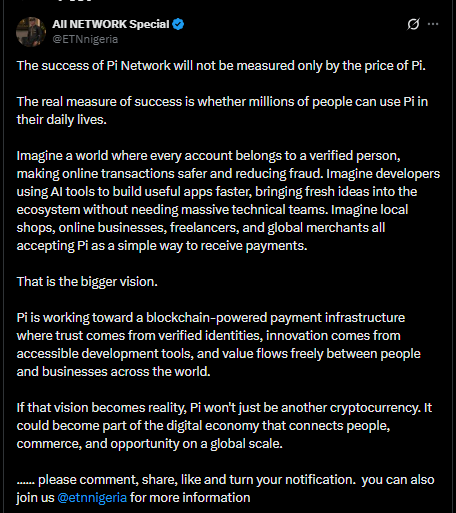
A recent discussion circulated by Pi Network community member @ETNnigeria offered an alternative framework: the true measure of Pi Network's success lies not solely in the price of Pi Coin, but in whether millions of people can integrate it into their daily routines.
This perspective speaks to one of the cryptocurrency sector's most persistent challenges — shifting digital assets from speculative instruments into practical tools that serve ordinary people. Across the industry, adoption is often evaluated not only by token activity, but also by whether networks support repeat usage, useful applications, trusted participants, and viable business interactions.
For Pi Network, the long-term vision centers on building a digital economy in which users, developers, businesses, and merchants transact and interact through blockchain technology.
Beyond Price as the Sole Benchmark
Cryptocurrency communities devote considerable attention to price movements, and for understandable reasons: market value is straightforward to track and easy to discuss. However, price alone cannot determine whether a blockchain project achieves meaningful impact.
History offers instructive parallels. The internet became indispensable not because of any single valuation metric, but because people used it to communicate, work, shop, and share information. Blockchain networks are likely to follow a similar trajectory, gaining relevance as they deliver practical solutions embedded in everyday activities.
For Pi Network, genuine adoption may prove to be one of the most telling indicators of ecosystem maturity. In practical terms, that means looking beyond attention and toward whether users have reasons to return, transact, build, and participate over time.
Everyday Utility as the Backbone of Digital Economies
A cryptocurrency ecosystem depends on users who actively engage with its underlying technology. Without real-world usage, digital assets risk remaining confined to speculation. A more resilient ecosystem takes shape when people leverage blockchain solutions for concrete purposes, including:
- Digital payments
- Online services
- Business transactions
- Decentralized applications
- Community-driven platforms
The ability to deliver simple, accessible experiences may ultimately determine whether blockchain technology reaches a broader audience. For mainstream users, ease of use, reliability, and trust often matter as much as the underlying technical design.
The Role of Verified Digital Identity
Among the concepts surfaced in the community discussion is the notion of verified users operating within a safer digital environment. Online fraud and identity-related threats remain pervasive across the internet. A system in which accounts are tied to verified individuals could open new pathways for trust-based digital interactions.
Digital identity solutions are growing in importance as online activity continues to expand. For blockchain ecosystems, verification mechanisms can bolster security while fostering more dependable environments for both users and businesses. That said, deploying identity systems demands careful attention to privacy, data protection, and user safeguards.
AI Tools Could Reshape Developer Participation
The discussion also spotlighted the potential impact of artificial intelligence on application development. AI-assisted tools are fundamentally altering how software is built. Where complex applications once required sizable engineering teams with specialized expertise, individuals and smaller collectives can now develop software with greater efficiency.
For blockchain ecosystems, this shift could meaningfully expand developer participation. A larger pool of developers may be able to build applications, services, and digital experiences without the need for extensive resources. A growing developer community, in turn, can serve as a powerful engine for ecosystem expansion.
Developer participation is especially important because users typically adopt networks through applications rather than protocols alone. Payments, marketplaces, games, social tools, and business services can translate blockchain infrastructure into experiences that ordinary users understand.
The Role of Businesses and Merchants
Real-world adoption requires buy-in from the business community. For cryptocurrencies to become woven into everyday life, merchants need compelling, practical reasons to accept them. Local shops, online retailers, freelancers, and multinational corporations could all stand to benefit from alternative digital payment systems — provided those systems deliver clear advantages in accessibility, speed, and efficiency.
A functioning blockchain payment ecosystem depends on mutual cooperation between users and businesses. Users need venues at which to spend digital assets; businesses need customers who generate demand. This interdependence forms the bedrock of any viable payment network.
For merchants, practical considerations also include transaction reliability, customer familiarity, accounting processes, and the ability to manage operational risk. These factors often determine whether digital payment options move from experimentation into routine use.
Pi Network's Vision for a Global Digital Economy
Pi Network has concentrated on building an ecosystem oriented around accessibility and broad-based participation. Unlike traditional cryptocurrency systems that often demand advanced technical knowledge, Pi Network introduced a mobile-first approach designed to lower the barriers to blockchain participation.
The project's community-driven model has drawn users from numerous regions across the globe. However, the next phase of growth hinges on a transition from participation toward practical usage. Assembling a large community represents a critical first step, but generating meaningful applications and sustained economic activity is what may ultimately determine long-term success.
Why Utility Matters More Than Speculation
Speculation can generate short-lived attention. Sustainable value, however, typically derives from usefulness. A cryptocurrency that addresses genuine problems holds a stronger prospect of maintaining relevance over time.
For Pi Network, utility could emerge across several domains:
- Payment systems
- Decentralized applications
- Digital services
- Merchant adoption
- Developer innovation
The interplay of these components may dictate whether Pi becomes embedded in a broader digital economy.
Challenges in Reaching Mass Adoption
Establishing a global blockchain ecosystem is a complex undertaking. Several hurdles must be overcome, including:
- User education
- Technical scalability
- Security safeguards
- Business integration
- Regulatory developments
- Market competition
Numerous blockchain projects have faltered by developing technology without achieving sufficient real-world adoption. A thriving ecosystem requires continuous improvement and collaboration among all participants.
Regulatory clarity is also part of the broader adoption picture. Businesses and developers often need to understand compliance obligations before integrating digital assets into payment flows, customer-facing products, or commercial services.
The Future of Web3 Adoption
Web3 aspires to create a more open, decentralized internet in which users exercise greater control over their digital assets and identities. Widespread adoption, however, depends on technology that feels intuitive and genuinely useful. Most people do not embrace technology for its technical sophistication; they adopt it because it solves problems and enhances their daily lives.
For blockchain to reach mainstream audiences, applications must become straightforward to understand and practical to use. The projects that make decentralized tools feel familiar, safe, and useful are more likely to bridge the gap between crypto-native communities and everyday consumers.
Community Participation Remains Essential
One of Pi Network's most defining strengths has been its expansive global community. Community members can contribute to ecosystem growth by:
- Supporting applications
- Encouraging responsible adoption
- Learning about blockchain technology
- Providing constructive feedback
- Helping businesses understand digital payments
Technology becomes more robust when users engage actively. A community is not merely a passive audience — it can function as an integral part of the development process.
The Long-Term Outlook for Pi Coin
The trajectory of Pi Coin will depend on more than market speculation. Its potential will be shaped by how effectively the ecosystem generates tangible, real-world value. If millions of users, developers, and businesses participate in meaningful ways, Pi Network could advance toward its vision of a more expansive digital economy.
Realizing that vision, however, will require sustained development, practical applications, and durable adoption. The indicators to watch are therefore not limited to price discussions, but also include application growth, merchant participation, user retention, and the quality of everyday use cases.
Conclusion
The success of Pi Network will ultimately be judged by criteria that extend well beyond the price of Pi Coin. The central question is whether people can use Pi in ways that genuinely matter in their everyday lives. A future in which verified users transact safely, developers build innovative applications with AI assistance, and businesses embrace digital payments reflects the broader ambition underlying blockchain adoption.
For Pi Network and the wider Web3 landscape, lasting value will stem from utility, accessibility, and the capacity to deliver solutions that benefit people worldwide.

