Pi Network Edges Higher Ahead of Protocol 27 Mainnet Upgrade Set for September 15
Key Takeaways
- •Pi Network's PI token traded near $0.0917 on August 29, up about 0.4% over 24 hours, while daily volume fell roughly 20% to $5.40 million.
- •The Protocol 27 upgrade is targeted for Mainnet deployment on September 15 and introduces more flexible and secure smart contract authentication.
- •Testnet activity, including booking escrow functions, a DEX, AMM pools, and a Launchpad, has not yet established lasting Mainnet demand.
- •Immediate resistance sits at $0.0951, with upside targets at $0.10 and $0.11, and near-term support between $0.087 and $0.088.
- •Continuing token unlock concerns and thin spot activity could absorb buying interest and amplify short-term price swings.
Key Points
- Pi Network (PI) traded near $0.0917 on August 29, up about 0.4% over 24 hours, while daily turnover fell roughly 20% to $5.40 million.
- The Protocol 27 upgrade targets Mainnet deployment on September 15, introducing stronger smart contract authentication after its Testnet rollout.
- Testnet activity includes booking escrow functions, DEX and AMM tools, but none of it demonstrates lasting Mainnet demand.
- PI must close above $0.0951 before testing $0.10 and $0.11; near-term support sits at $0.087–$0.088, then $0.085.
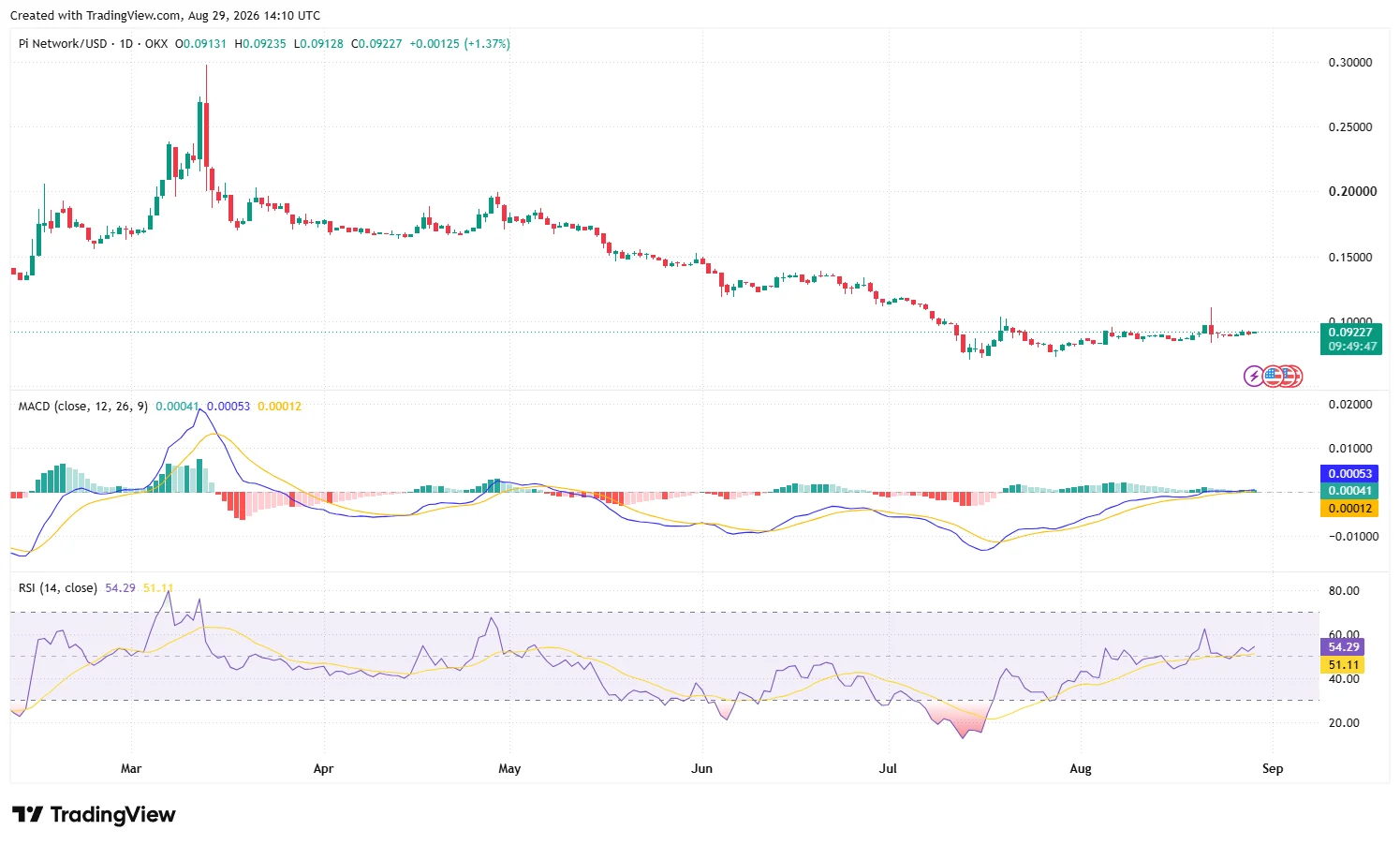
Pi Network traded near $0.0917 on August 29, adding roughly 0.4% over 24 hours. The gain came as the broader crypto market faced renewed selling, drawing attention to PI's relative strength. Market attention centers on Protocol 27, which targets a Mainnet release on September 15, although weak participation limits that narrative.
Daily turnover stood near $5.40 million, roughly 20% below the prior day. Buyers have kept PI above $0.09, but they have not delivered a convincing expansion in volume. As a result, the latest rise resembles cautious positioning ahead of a known catalyst rather than a confirmed breakout backed by broad market demand.
Pi Network Builds on Protocol 27 Expectations
Pi Network is a mobile-first crypto project that built a large user base through smartphone-based mining before opening its Mainnet, and its roadmap has progressively shifted toward on-chain utility such as payments, apps, and DeFi-style tools. Protocol upgrades like this one are the project's main vehicle for closing the gap between that user base and actual Mainnet usage.
According to the Pi Core Team, the Testnet is running Protocol 27 and the team targets September 15 for the Mainnet release. The update introduces more flexible and secure smart contract authentication, a framework that lets accounts and decentralized applications approve actions with tighter controls. That goal parallels a broader industry push toward more programmable account permissions, seen in other chains' work on flexible authorization for smart contracts and decentralized applications.
Following the successful completion of the Protocol 26 upgrade on Pi Mainnet, Pi Testnet is upgrading to Protocol 27! Protocol 27 introduces more flexible and secure smart contract authentication capabilities, enabling more advanced ways for accounts and applications to… pic.twitter.com/Qb5Id092Ln — Pi Network (@PiCoreTeam) August 21, 2026
Recent Testnet activity offers an early example of the new capabilities. Wallet records linked to the BNPi booking app showed escrow functions on August 27, including the calls server_auto_release and release_booking_escrow. These functions release Test-Pi once booking conditions are met or predefined dispute rules apply.
Pi has also tested a DEX, automated market maker pools, and a Launchpad. In July, 242,000 users committed 15.92 million Test-Pi for 10 million SLICE test tokens, with the related pool using a constant-product swap formula. These products remain on Testnet and do not establish Mainnet demand.
That distinction shapes the price case. Protocol 27 could provide developers with stronger infrastructure, but usage must follow. More applications would support transactions and liquidity; without active users, PI may remain dependent on speculation.
Pi Desktop is also widening its utility story. Node version 0.6.2 added OpenClaw and an Atlassian MCP Server to SoloHost. OpenClaw can use local or cloud-hosted models while storing memory locally, and the second tool connects compatible AI clients with Jira. Pi says SoloHost can reach more than 420,000 node runners, though it remains in beta.
Technical Levels Keep a $0.10 Breakout in Focus
The 50-day average at $0.0951 marks immediate resistance. A daily close above it could open the door to a test of $0.10, with the next supply area around $0.11, where previous buyers may look to exit. Clearing both levels would require stronger turnover than the latest session produced.
Momentum readings do not confirm such a move. The four-hour relative strength index stood near 44, below its neutral midpoint, while MACD at 0.00020 trailed its 0.00022 signal line. The negative histogram showed upward momentum fading even though both lines remained above zero.
Near-term support sits between $0.087 and $0.088. A deeper pullback could expose $0.085, followed by $0.080, and the broader base near $0.075 would come into play if sellers break those zones. Holding $0.09 would keep PI close to its first resistance test.
Liquidity remains a central weakness. CoinGecko tracked about $5.40 million in 24-hour volume, down roughly 20% from the previous day, while the token's market value stood near $1.02 billion, supported by 11 billion circulating PI. Those figures show scale, but low turnover can amplify short-term price swings.
The September event also competes with continuing token unlock concerns. New supply can absorb buying interest, especially when spot activity is thin. PI therefore needs stronger volume before any move above $0.0951 looks durable; a breakout backed by rising turnover would strengthen the case for $0.10 and $0.11.
PI currently sits between improving development and restrained participation. Protocol 27 gives the project a dated catalyst, while smart contracts, DEX tools, and AI applications broaden its utility. Price confirmation still depends on buyers firmly defending $0.09 and converting the $0.0951 ceiling into support. Beyond the September 15 deployment, the metrics to watch are Mainnet transaction activity and whether Testnet applications migrate to production use.
Source: Blockonomi
