Pi Network Debate: Can Exchange Price Reflect Real Utility?
Key Takeaways
- •The debate was triggered by a post from @L10850243 that strongly criticized community members who judge Pi Network's long-term prospects almost exclusively by its exchange price.
- •Pi Network launched in 2019 and moved to its Open Network on 20 February 2025, after which exchanges including OKX, Bitget, Gate.io and MEXC opened trading in the token.
- •The project caps total supply at 100 billion PI, and only part of the mined balances has migrated to the Open Mainnet through a KYC-based process, so tradable supply remains a fraction of the eventual total.
- •The community recently highlighted 82 operational Mainnet applications, with the ecosystem approaching a possible 100-app milestone.
- •The project's 2026 Pi2Day announcements included Pi Sign-In and PiVerify, initiatives aimed at expanding Pi's role in application access and identity verification.
Pi Network Debate: Can Exchange Price Reflect Real Utility?
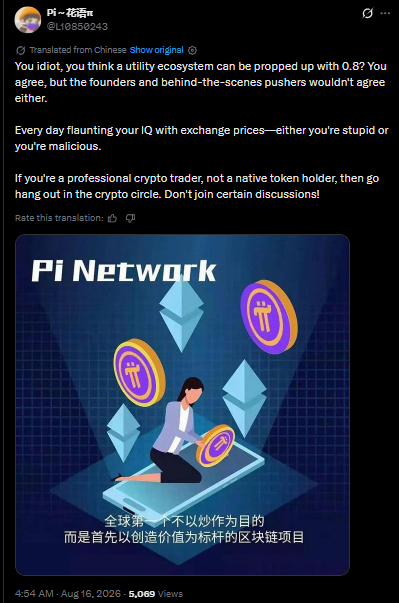
A heated discussion within the Pi Network community is drawing attention to a fundamental question facing the project: should the value of Pi be judged primarily by its exchange price, or should greater attention be given to the utility being developed around the ecosystem? The debate was thrust into the spotlight by a post from @L10850243, which strongly criticized community members who focus heavily on exchange prices when discussing Pi Network's long-term prospects.
Behind the emotional language of the original discussion lies a broader issue that affects nearly every crypto project. Price and utility are related, but they are not the same thing. A token can experience significant price movements without a corresponding change in its underlying technology or ecosystem. Likewise, a blockchain can continue developing applications and infrastructure while its native coin suffers weak market performance. For Pi Network, the distinction has become increasingly important as the project attempts to move the conversation beyond mining and speculation toward applications, payments, identity, and Web3 utility.
The debate also reflects the particular path Pi Network has taken to reach this point. Launched in 2019 by a founding team that includes Stanford PhDs Nicolas Kokkalis and Chengdiao Fan, the project built an audience measured in the tens of millions through a mobile app that let users "mine" Pi with a daily tap instead of power-hungry hardware. For years the network ran in an Enclosed Mainnet phase in which balances could not move externally; the Open Network launch on 20 February 2025 connected Pi to the outside world, and exchanges including OKX, Bitget, Gate.io and MEXC opened trading — the point at which a public exchange price entered the community's daily conversation.
The Debate Around Pi's Exchange Price
The central criticism in the community discussion is directed at users who appear to judge Pi Network almost exclusively through its exchange price. From that perspective, a low or declining price is treated as evidence that the broader project is failing. That approach, however, can overlook the complexity of blockchain ecosystems.
The price displayed on an exchange reflects the market's current willingness to buy and sell an asset under specific market conditions. It can be influenced by liquidity, supply, demand, sentiment, trading activity, broader market conditions, and investor expectations. It does not necessarily provide a complete picture of the technological development taking place behind the token.
Pi's own supply mechanics make that nuance concrete. The project caps total supply at 100 billion PI, and since the Open Network launch a large share of mined balances has been migrating to the Open Mainnet through the project's KYC-based migration process. The amount of Pi tradable on exchanges is therefore only part of the eventual total, a supply situation that differs from many older cryptocurrencies whose issuance schedules are further along.
This does not mean price is irrelevant. On the contrary, price remains an important metric for token holders and investors. The more accurate argument is that price should be considered alongside other indicators. For Pi Network, those indicators include application development, Mainnet activity, merchant adoption, developer participation, network infrastructure, and real-world use cases.
Utility and Market Price Are Two Different Measurements
The difference between utility and price can be illustrated through a simple example. Imagine a blockchain that is adding new applications, improving its infrastructure, and attracting developers, while at the same time the broader cryptocurrency market is experiencing a downturn. The blockchain's token could decline in value even as development continues. Conversely, a token could rise sharply because of speculation despite limited practical utility.
This is one of the reasons experienced crypto analysts often separate fundamental development from short-term market movements. For Pi Network, the distinction is particularly relevant because the project has spent significant effort developing an ecosystem around the Pi coin. The official Pi Network developer platform provides tools such as the Pi SDK and APIs for developers building applications that integrate with Pi. That development activity cannot be fully represented by looking at a single exchange price.
Why Exchange Prices Still Matter
Dismissing exchange prices entirely, however, would also be a mistake. Market price provides information about current demand and sentiment. If a token consistently loses value, that can indicate that investors have concerns about its future prospects, liquidity, supply, adoption, or other factors. For Pi Network, market performance therefore remains an important part of the overall picture.
The issue is how the information is interpreted. A falling price does not automatically prove that the ecosystem has no utility. Likewise, a rising price does not automatically prove that an ecosystem is fundamentally strong. The most useful analysis combines market data with fundamental developments — an approach that can provide a more balanced view of where a project actually stands.
Pi Network Is Building Beyond the Token
The debate is becoming more relevant as Pi Network continues to position itself as an ecosystem rather than simply a digital coin. Pi Network's official materials describe an environment involving applications, developers, users, identity verification, payments, and other Web3 components. The Pi Browser, for example, provides access to Pi applications, while the developer platform is intended to help builders integrate Pi into their products.
This creates a broader definition of utility. A cryptocurrency can be useful as a payment asset, but its ecosystem can potentially become more valuable when users can access multiple services through the same infrastructure. That is the direction Pi Network supporters are emphasizing when they argue that exchange prices alone do not tell the entire story.
The Importance of Mainnet Applications
One of the clearest ways to evaluate a utility ecosystem is to look at the applications being built within it. Applications create practical reasons for users to interact with a blockchain — and Pi begins with an unusually large potential audience, as the project itself describes a user base of tens of millions of registered "Pioneers". Pi Network has been expanding its Mainnet application ecosystem, with the community recently highlighting 82 operational Mainnet applications and the possibility of reaching the 100-app milestone.
The number itself is not enough to prove success. The more important questions are whether those applications attract users, whether they provide useful services, and whether they generate genuine economic activity. If an application has thousands of users who regularly transact with Pi, that could represent meaningful utility. If an application exists but receives almost no activity, its contribution is considerably smaller. The quality and usage of Pi applications should therefore arguably receive as much attention as the number of applications available.
The Founder and Community Debate
The original post also raises a more controversial issue by suggesting that the people behind Pi Network may view the ecosystem differently from traders focused primarily on exchange prices. It is important to separate community opinion from verified statements by the Pi Network Core Team. There is no basis for assuming that every Pi Network founder, developer, or contributor shares a particular view simply because members of the community believe they do.
The underlying disagreement between traders and ecosystem-focused users, however, is real across the wider cryptocurrency industry. Traders typically concentrate on price movements, liquidity, technical indicators, market structure, and short-term opportunities. Long-term ecosystem participants may focus more heavily on adoption, applications, network growth, and utility. Neither perspective is automatically correct in every situation; they simply measure different things.
Traders and Long-Term Users Have Different Goals
A professional crypto trader does not necessarily need to believe in the long-term success of a blockchain to trade its token. Traders can potentially profit from price movements in either direction depending on their strategy and market position. A long-term Pi holder may have a completely different objective — caring about whether Pi becomes widely used, whether applications continue to develop, and whether the ecosystem can create sustainable demand.
This difference can create friction within online communities. A trader may see a declining price and consider it the most important fact. A long-term ecosystem participant may see the same decline while focusing on development activity. Both observations can be true simultaneously, and the challenge is avoiding the assumption that one metric explains everything.
What Does Real Utility Actually Mean?
The word "utility" is frequently used in Web3 discussions, but it can mean different things. For a cryptocurrency, utility could involve payments. It could involve access to applications. It could support digital identity. It could enable transactions between users. It could also become part of decentralized computing, marketplaces, games, or other digital services.
Pi Network has continued experimenting with several of these areas. Its ecosystem has included identity-related initiatives, developer tools, Mainnet applications, and other infrastructure intended to expand how Pi can be used. The project's 2026 Pi2Day announcements, for example, included Pi Sign-In and PiVerify, initiatives aimed at expanding Pi's role in application access and identity verification. These developments demonstrate why utility cannot be reduced to a single exchange price.
Source: X post
The Problem With Ignoring Market Signals
At the same time, supporters should be careful not to use "utility" as an excuse to ignore market signals. If users are not adopting applications, if businesses are not accepting Pi, or if economic activity remains limited, the existence of infrastructure alone may not create sustainable value. Utility needs users. Users need reasons to participate. Businesses need customers. Developers need incentives to continue building. This creates a network effect that Pi Network must continue developing. The ultimate test will be whether technical infrastructure translates into measurable activity.
Price Could Eventually Follow Utility
One argument made by long-term Pi supporters is that utility could eventually influence market value. The theory is relatively simple: if more people need Pi to access goods, services, applications, or other economic activities, demand for the coin could potentially increase. If demand grows faster than available supply, market conditions could potentially change.
That outcome, however, is not guaranteed. The relationship between utility and price is affected by many other variables. Users may hold Pi without spending it. Businesses may accept Pi but immediately convert it. Applications may have users without generating significant economic volume. Supply dynamics may also affect price. Utility can therefore create potential demand, but it does not automatically guarantee price appreciation.
The Real Question Is Economic Activity
Rather than asking whether Pi's exchange price is high or low, a more useful long-term question may be how much real economic activity is taking place within the Pi ecosystem. That question can be measured through several indicators: how many people are actively using Pi applications, how many transactions occur, how many merchants accept Pi, how many developers continue building, how many services depend on Pi, and how frequently users return to those applications.
These metrics could provide a much deeper understanding of ecosystem health than price alone. They also mirror the fundamentals analysts already publish for major networks such as Ethereum and Solana — daily active addresses, transaction counts, fees, and developer activity — where separating market data from on-chain usage is standard practice rather than a Pi-specific idea. The exchange rate would still matter, but it would become one component of a larger picture.
Pi Network Needs Both Utility and Market Confidence
Ultimately, Pi Network cannot choose between utility and market value — it needs both. A strong ecosystem without sufficient market confidence can struggle to attract investment and liquidity. A strong market price without meaningful utility can be difficult to sustain over the long term. The two sides therefore need to develop together.
For Pi Network, the challenge is to demonstrate that the infrastructure being built can produce genuine economic activity. If that happens, market participants may eventually place greater emphasis on fundamental ecosystem metrics. If it does not, critics will continue pointing to price as evidence that the project's ambitions have not yet translated into sufficient demand.
A More Balanced Way to Evaluate Pi
The current debate suggests that Pi Network users may benefit from taking a more balanced approach. Instead of focusing exclusively on whether Pi is rising or falling, they can monitor several categories of information:
- Market performance: Price, liquidity, trading volume, and market capitalization remain relevant.
- Development: New releases, network upgrades, developer tools, and infrastructure can show whether the project is continuing to evolve.
- Utility: Applications, merchants, services, and actual transactions can demonstrate whether users have practical reasons to interact with Pi.
- Adoption: A technically impressive ecosystem has limited value if users do not actually use it.
Combining these factors provides a more complete framework for understanding Pi Network.
Conclusion
The latest debate surrounding Pi Network highlights a question that extends far beyond Pi coin itself: can the value of a blockchain ecosystem be judged by its exchange price alone? The answer is no — but price cannot simply be ignored either. Exchange markets provide important information about current demand, sentiment, liquidity, and expectations. At the same time, they do not fully capture application development, infrastructure improvements, developer activity, or emerging real-world utility.
For Pi Network, this distinction is becoming increasingly important. The project is attempting to build an ecosystem around its coin through applications, developer tools, identity systems, payments, and Web3 infrastructure. The success of that strategy will ultimately depend on whether users and businesses transform those tools into genuine economic activity.
The criticism from @L10850243 may have been expressed in unusually strong language, but it reflects a debate that deserves more measured discussion. Traders can focus on price. Long-term users can focus on utility. Developers can focus on infrastructure. Businesses can focus on customers. All of these perspectives have a place within a functioning cryptocurrency ecosystem.
The real test for Pi Network will be whether these different elements eventually converge into a sustainable digital economy. The checkpoints along the way are concrete: progress toward the 100-application milestone, the pace of remaining Mainnet migrations, and whether initiatives such as Pi Sign-In and PiVerify generate measurable usage. If that convergence happens, exchange price may become only one part of the Pi story. If it does not, market participants will continue to judge the project primarily through the value of its token. For now, the most reasonable approach is neither blind optimism nor excessive pessimism: Pi Network should be evaluated on both sides of the equation — what the market says about Pi today, and what the ecosystem is building for tomorrow.

