Pi Network’s PI Trades Near $0.08 as Token Unlocks and Demand Concerns Weigh on Holders
Key Takeaways
- •PI is trading around $0.0827 after falling below the $0.10 level that had served as a psychological support area.
- •Pi Network has about 103.7 million PI scheduled to unlock in July 2026, with some reports estimating up to 127.5 million PI could enter the market in coming weeks.
- •Recent Pi2Day product releases, including Pi Sign-in and PiVerify, have not yet produced a strong market reaction or broad utility-driven demand.
- •Community frustration has increased over issues including exchange listings, mainnet functionality, KYC problems, migrations, wallet issues, and limited support.
- •The $0.0800 to $0.0805 range is the main near-term support zone, while resistance is seen around $0.0840 to $0.0850 and higher levels near $0.0870 to $0.090.
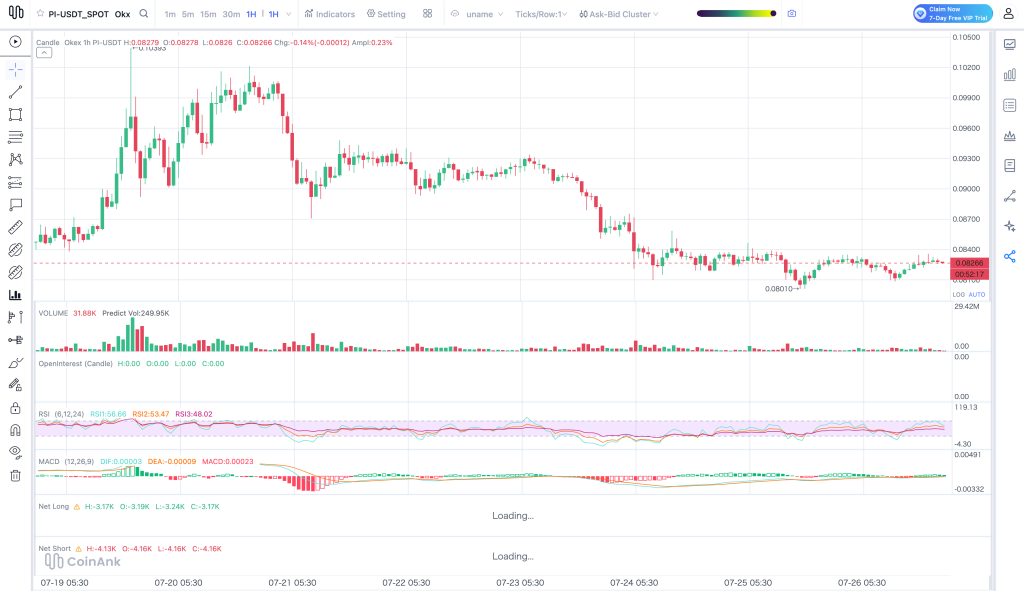
Pi Network holders are facing a difficult July, with PI trading around $0.08 after years in which some community discussions on Telegram and X promoted expectations of much higher prices, including $100 PI.
Many Pioneers who participated in the project’s mobile mining model by tapping the mining button daily are now watching the token trade far below those earlier hopes while broader parts of the crypto market continue to advance. Several factors are contributing to pressure on PI, including scheduled token unlocks, weak price action, fading market attention, community frustration, and limited real demand for the token.
Heavy token unlocks are adding supply pressure
Pi Network is dealing with a large increase in potential circulating supply. The project has about 103.7 million PI scheduled to unlock in July 2026, while some reports suggest as much as 127.5 million PI could enter the market in the coming weeks.
That supply is becoming sellable in a market that has shown limited ability to absorb it. Each unlock event can bring more tokens to exchanges, increasing the number of potential sellers and adding downward pressure on price. Unlocks do not automatically mean every holder will sell, but they do increase the amount of PI that can be traded, making actual demand more important.
$PI is possibly one of the easiest shorts on the market right now ( if they stick to their word and give people their earned tokens ). Between now and June 2029, $505 million dollars unlocks ( current market cap is only 900M ) Price goes up? So does that unlock value. $141… pic.twitter.com/nhxvuuxxMp — Travladd 𐤊 (@travladd) July 25, 2026
$PI is possibly one of the easiest shorts on the market right now ( if they stick to their word and give people their earned tokens ). Between now and June 2029, $505 million dollars unlocks ( current market cap is only 900M ) Price goes up? So does that unlock value. $141… pic.twitter.com/nhxvuuxxMp
The scheduled nature of the unlocks also matters. Holders know when new supply is expected to arrive, which can create pressure from traders and investors trying to sell before later waves of supply reach the market. That dynamic can reinforce a negative price trend.
Pi Network has attempted to counter the supply issue with product releases around Pi2Day, including Pi Sign-in and PiVerify. The goal is to build practical utility that can support demand for PI. However, the market reaction has been limited so far, and while utility development takes time, token unlocks are occurring immediately.
PI price action remains weak
PI is trading near $0.0827, down from the $0.10 area that had acted as a psychological support level. The current market structure is described as bearish, with lower highs and lower lows shaping the trend.
Near-term support is concentrated around the $0.0800 to $0.0805 zone. If that level breaks, the next support area is around $0.0780. A deeper move toward $0.0750 could trigger stop losses and increase selling pressure.
Resistance levels remain overhead. Sellers have appeared around $0.0840 to $0.0850, while stronger resistance is seen at $0.0870 to $0.0880. The $0.090 to $0.093 range is viewed as a more significant resistance zone that buyers have not yet overcome.
Technical indicators offer limited confirmation of a recovery. RSI is hovering in the mid-50s, indicating neutral momentum. MACD is flattening near zero without a clear crossover signal. Trading volume has also declined, suggesting that a breakdown or breakout could occur suddenly.
One constructive point is that the decline from $0.10 to about $0.082 has slowed. Consolidation can often precede a larger move, but the current chart structure continues to favor sellers.
Pi Network has lost ground in the main crypto narratives
Crypto markets often move around narratives. In 2024 and 2025, meme coins were a major focus. In 2026, AI tokens and real-world assets have taken a larger share of market attention.
Pi Network does not fit neatly into either of those leading narratives. The project gained attention during the pandemic because it offered free tokens and allowed users to mine on their phones without specialized hardware or electricity costs. That made it one of the lowest-barrier ways for new users to engage with crypto.
That early novelty has weakened. Newer projects with more visible technology narratives and stronger marketing have moved into the spotlight. As the social media excitement around Pi Network has faded, demand for the token has also appeared limited.
The Pi Network team is continuing to push Protocol v25 and is preparing for Protocol v26. Its stated areas of work include privacy tools, network improvements, and developer tooling. These developments may be important for long-term viability, but they have not generated the kind of short-term market hype that tends to attract new buyers.
Pioneer frustration is increasing
Some long-time supporters are showing signs of frustration after years of defending the project through delays. Questions from the community now include exchange listings, the status of mainnet functionality, and why PI is trading around $0.08 when many users had expected much higher valuations.
Community sentiment has shifted from optimism toward frustration in some channels. Telegram groups have seen more complaints, and some long-term supporters have sold their positions. This is significant because Pi Network’s model depends heavily on the engagement of its community and on users continuing to participate regularly.
Hard to stay bullish on $Pi lately. Years of mining and promises, yet users are stuck with failed KYC, missing balances, broken migrations, wallet issues and zero real support. Pi CT barely communicates, everything still feels heavily centralized, scams keep popping up,… pic.twitter.com/4UES2oniz7 — pinetworkmembers (@pinetworkmember) January 1, 2026
Hard to stay bullish on $Pi lately. Years of mining and promises, yet users are stuck with failed KYC, missing balances, broken migrations, wallet issues and zero real support. Pi CT barely communicates, everything still feels heavily centralized, scams keep popping up,… pic.twitter.com/4UES2oniz7
Pi Network’s mining system has relied on people opening the app and clicking the button daily. If those users lose confidence, the network risks losing part of the community foundation that helped drive its early growth.
The team’s recent product push has not yet restored broad confidence among holders. New tools may help the ecosystem, but many holders are looking for liquidity, price appreciation, and a clearer path to real value. For a community-driven network, confidence is not only a sentiment issue; it affects whether users keep participating, testing apps, completing migrations, and supporting merchant or developer activity.
Utility and real demand remain limited
A central challenge for Pi Network is that there are still few compelling reasons for new users to buy PI. Earlier price increases were driven largely by speculation, with buyers expecting future demand from other market participants.
For sustainable value, a token generally needs practical utility. Users must need the token to access services, make purchases, pay fees, or participate in meaningful ecosystem activity. At present, demand for PI appears thin.
The products launched around Pi2Day represent a step toward broader utility, but they remain in testing phases and have not yet reached critical adoption. Many average holders still have limited ways to use PI beyond holding it and waiting for future ecosystem growth.
That puts Pi Network behind larger networks such as Ethereum, where users pay gas fees for transactions, and Solana, where decentralized finance applications generate steady on-chain activity. Pi Network has not yet reached that level of ecosystem usage, and the gap is becoming more visible. In practice, the next test for Pi is whether its tools translate into repeat usage by developers, merchants, and ordinary users rather than only announcements.
Without stronger real demand, PI remains heavily dependent on speculation. When speculative interest fades, prices tend to weaken, which is what has been happening with PI.
What remains for PI holders
Pi Network is still developing its ecosystem. Protocol v25 is live, Protocol v26 is planned, and the team is working on developer tools, identity-based use cases, and third-party integrations. These efforts take time to mature.
The technical chart also shows some signs of stabilization. PI has held above $0.080 for the past few days, and volume is contracting, which can indicate that sellers are becoming exhausted. If buyers can push the price above $0.085, the next levels to watch are $0.087 to $0.088 and then $0.090.
A move above $0.090 could shift the short-term trend, while a move above $0.100 would be a more significant signal. However, the unlock schedule remains the major challenge. Until Pi Network creates enough demand to absorb newly unlocked tokens, the price may continue to struggle.
The community is looking for real adoption, practical use cases, and clearer reasons to hold PI. The coming months will be important because additional unlock waves could increase pressure if utility does not grow quickly enough.
If the team delivers meaningful utility before the next supply wave, PI may stabilize. If not, the token could continue sliding toward $0.075 or lower. The $0.080 level remains an important support area between current prices and a deeper correction.
Frequently asked questions
A $1,000 PI price is possible only under extraordinary adoption, sustained demand, and favorable market conditions. There is no guarantee that Pi Network will reach that level.
No one can predict PI’s 2030 price with certainty. Its future value will depend on adoption, ecosystem growth, exchange availability, regulation, and broader market conditions.
PI’s price could increase in 2026 if adoption grows, more utility is added to the ecosystem, and market conditions remain favorable. There is no certainty that its price will rise.

