Pi Network (PI) Holds Below $0.0800 as Stablecoin Integration Plans Emerge, Downside Risks Persist
Key Takeaways
- •PI traded near $0.07956 on Wednesday after slipping below $0.0800, giving back the previous session's 2% gain.
- •The Pi Core Team said on October 13 that stablecoins could expand utility across the Pi ecosystem where price stability matters, but emphasized that design and initial introduction are decisive.
- •The stablecoin exploration follows Pi Network's partnership with Open Standard, the OUSD issuer backed by companies including Visa and Stripe, covering potential integration and planned OUSD rewards initiatives for Pioneers.
- •PI remains below its 50-day EMA at $0.0882 and 200-day EMA at $0.1256, with an RSI near 37 and a slightly negative MACD, indicating a bearish technical picture.
- •A sustained break below $0.0774 support could expose the $0.0704 swing low, while reclaiming $0.0827 and then the 50-day EMA would strengthen the case for recovery.
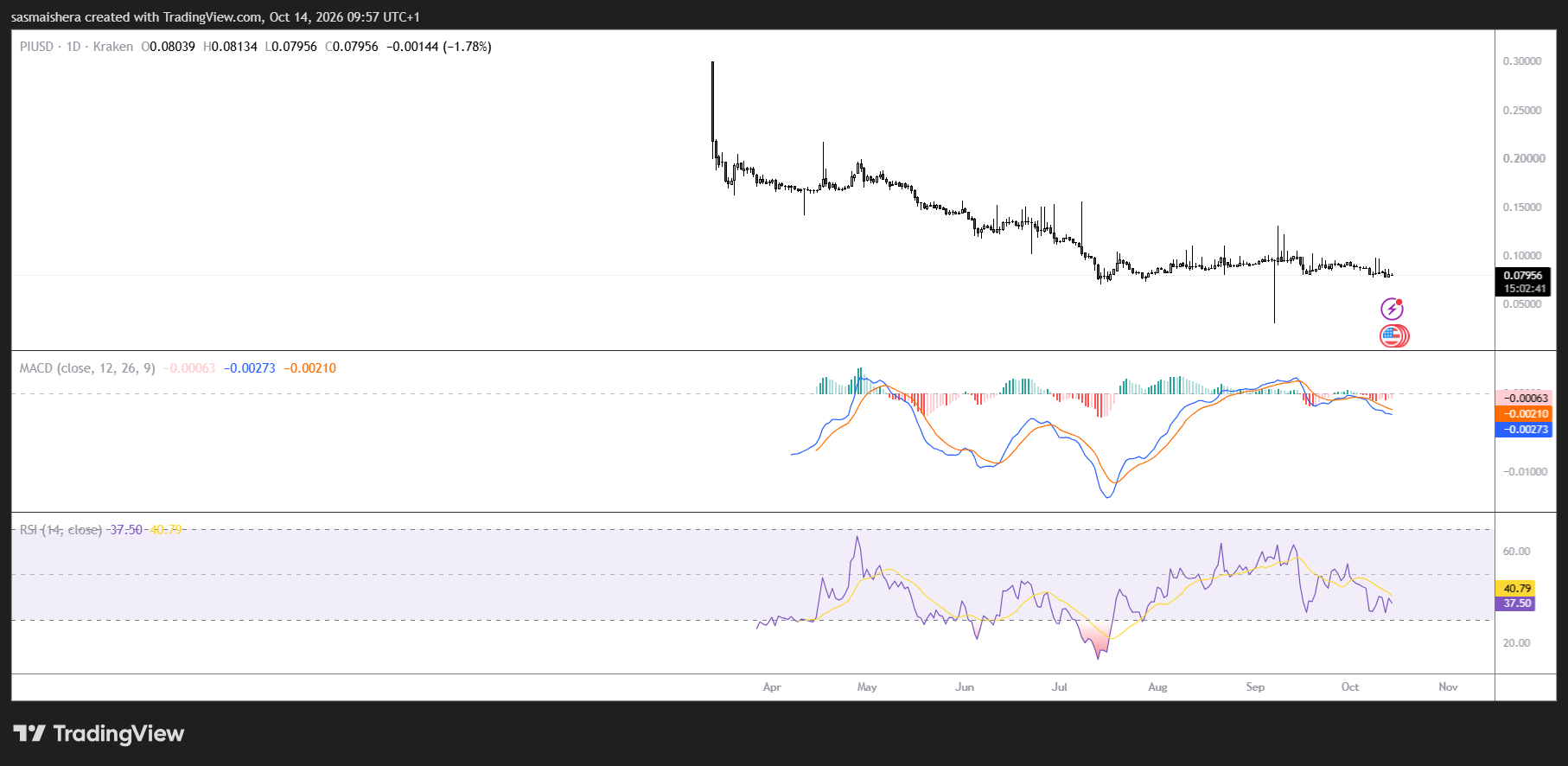
Pi Network's native token, PI, slipped below the $0.0800 level on Wednesday, trading near $0.07956 and giving back the previous session's 2% gain. The modest rebound had helped the token avoid extending losses beneath last week's low. Even so, PI remains below both its 50-day and 200-day exponential moving averages, keeping the near-term outlook bearish and leaving the price vulnerable if support at $0.0774 fails.
The move came as the Pi Core Team reiterated its exploration of stablecoin integration as a way to broaden across the ecosystem, an initiative the team says is intended to complement the token's existing utility.
Pi Core Team Weighs Stablecoin Integration
Stablecoins are cryptocurrencies designed to hold a steady value, typically pegged to a fiat currency, and are widely used across the industry wherever volatility would complicate payments or pricing. Against that backdrop, the Pi Core Team is considering how stablecoins could support additional ecosystem uses while preserving PI's role as the network's native cryptocurrency. In a post shared on X on October 13, the team said stablecoins can play an important role in expanding certain utility across the Pi ecosystem, particularly in use cases where predictable price stability is important. It cautioned, however, that introducing a stablecoin requires a deliberate and unique approach, and that how the two function alongside each other depends on how stablecoins are integrated, making the design and initial introduction especially important.
The team's full statement reads:
Stablecoins can play an important role in expanding certain utility across the Pi ecosystem, particularly in use cases where predictable price stability is important. The introduction of stablecoins requires a deliberate, unique approach, and must be aligned with Pi Network's ecosystem and principles.
– Simply adding a stablecoin does not guarantee that it will naturally complement Pi.
– How the two function alongside each other depends on how stablecoins are integrated into the Pi ecosystem. This makes the design and initial introduction especially important.
Stablecoin functionality should be directed toward circumstances where price stability is needed while preserving the utility of the Pi cryptocurrency across the broader ecosystem. Learn more
— Pi Network (@PiCoreTeam) October 13, 2026
Source: Pi Network (@PiCoreTeam) on X, October 13, 2026
The exploration follows Pi Network's partnership with Open Standard, the issuer of the OUSD stablecoin. According to the announcement, Open Standard is backed by companies including Visa and Stripe. The collaboration focuses on potential stablecoin integration and planned OUSD rewards initiatives designed to encourage broader ecosystem participation among Pi users, known as Pioneers.
The integration remains exploratory, with the team emphasizing that stablecoin functionality should complement PI's utility across the broader ecosystem. No timeline or technical specifications for such an integration have been announced.
PI Rebounds but Remains Below Key Moving Averages
PI's rebound has provided some relief after recent selling pressure, but the broader technical picture remains weak. The token trades below the 50-day exponential moving average at $0.0882 and the 200-day EMA at $0.1256, both of which stand as overhead barriers to a sustained recovery.
In the near term, PI is trading between support at $0.0774 and resistance around $0.0827, the latter corresponding to the 23.6% Fibonacci retracement identified in the analysis. Until buyers can overcome that upper boundary, the latest gain remains a rebound within a bearish structure.
Momentum readings reinforce the cautious outlook. The Relative Strength Index is near 37, below its neutral midpoint and consistent with continued selling pressure. The Moving Average Convergence Divergence indicator remains slightly negative and below its signal line. These readings suggest the rebound has yet to produce a convincing shift in momentum.
Holding above $0.0800 offers short-term stability, but buyers still need to clear nearby resistance. On the downside, a sustained break below $0.0774 could expose the $0.0704 swing low.
On the upside, PI first needs to reclaim $0.0827 before challenging the 50-day EMA at $0.0882. Moving above both levels would strengthen the case for a more durable recovery. A sustained advance beyond $0.0882 could then bring the 50% Fibonacci retracement near $0.0990 into focus.
For now, the ability to defend $0.0774 and overcome $0.0827 will help determine whether the rebound develops into a recovery or gives way to renewed losses. Beyond the charts, any further detail from the Pi Core Team on the design and initial introduction of a stablecoin — the factors it flagged as decisive — would be the next tangible signal of how the integration takes shape.

