Pi Network Announces Q1 2027 DEX and AMM Launch, 20 Million Pi App Growth Fund at Inaugural Ecosystem Summit
Key Takeaways
- •Pi Network's token traded at $0.0608 on Wednesday, hovering slightly above its all-time low of $0.055 despite improving sentiment across the broader crypto market.
- •The project's decentralized exchange and automated market maker, which have spent months in testnet, are scheduled to go live in the first quarter of 2027, with the mainnet migration serving as the key milestone.
- •A new App Growth Initiative begins with a budget of 20 million Pi tokens, worth more than $1.2 million, allowing developers to reward KYC-verified users based on their applications' merit and performance.
- •Developers also introduced a web console, AI-assisted building tools, on-chain smart contracts in testnet, and x402 machine-to-machine payment plans, following an earlier partnership with the stablecoin OUSD.
- •Technically, the token has fallen below the $0.07047 support from July 14 and the lower boundary of a descending triangle, pointing toward $0.050 unless a move above $0.070 invalidates the bearish setup.
Pi Network's token remained under pressure on Wednesday, trading at $0.0608 and hovering a few points above its all-time low of $0.055, even as broader sentiment in the crypto industry gained momentum. The continued decline came despite a series of major announcements from the network and its developers at the project's inaugural ecosystem summit.
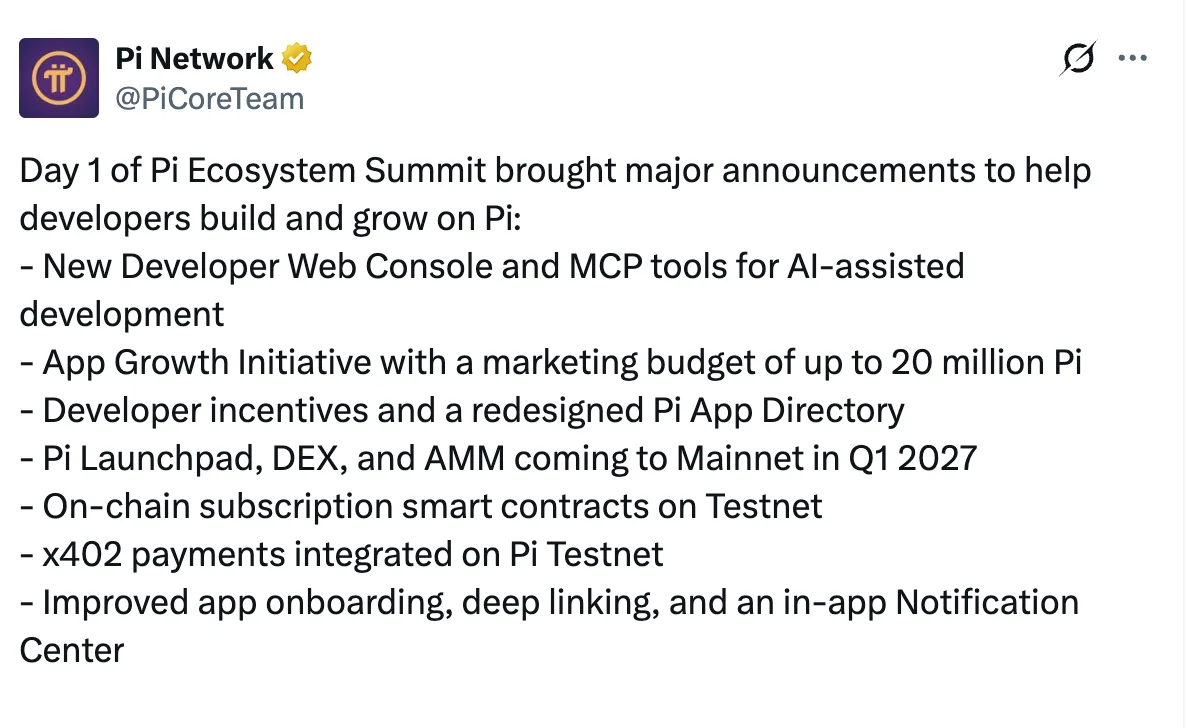
The announcements, disclosed in an X post by the network during the event, include a first-quarter launch window for the Pi decentralized exchange (DEX) and automated market maker (AMM), a new App Growth Initiative backed by 20 million Pi tokens, and several developer tools now being tested. The network described the measures as changes that will have a substantial impact on the ecosystem over the long term.
DEX, AMM and Launchpad Slated for Q1 2027
Pi Network is hosting its inaugural ecosystem summit this week. Among the most consequential announcements was the launch timeline for the project's decentralized exchange and automated market maker tools. The two platforms, which have spent several months in testnet, are scheduled to go live in the first quarter of 2027. Testnet deployments run in a sandboxed environment with no real funds at stake, so the migration of these tools to Pi's mainnet will be the milestone that shows whether the launch window holds.
Pi DEX is designed to let users trade cryptocurrencies and will initially list tokens built on the Pi network, which the developers aim to make utility-bearing. In form, the exchange will resemble popular decentralized platforms such as Uniswap and PancakeSwap, which execute trades through smart contracts against liquidity pools funded by users rather than through a centralized order book.
In line with the DEX rollout, the network will also launch its automated market maker and launchpad. The AMM is intended to provide liquidity to the network, allowing users to enter and exit trades through a simple process.
Still, the products face significant risks. The Pi Launchpad has yet to produce a major successful project, and it remains unclear whether users will embrace the new DEX. Many traders currently favor established venues such as Uniswap, Raydium and PancakeSwap, along with newer platforms like Hyperliquid and Grvt.
App Growth Initiative Backed by 20 Million Pi
The price also wavered after the developers announced the App Growth Initiative, a program aimed at raising the ecosystem's profile. The initiative will begin with an initial marketing budget of 20 million Pi tokens, currently worth more than $1.2 million.
Eligible developers will be able to access the funds based on the merits and performance of their applications. The structure lets teams target KYC-verified users with rewards without having to fund the incentives themselves. The goal is to help developers succeed and, in turn, drive more activity across the Pi Network ecosystem. The design leans on Pi's defining feature: a user base assembled through mobile-phone mining and verified through KYC, which the project has long presented as a ready-made audience for new applications.
More Announcements From the Summit
The developers made additional announcements at the event. They introduced a new developer web console and AI-assisted tools to help developers build new applications, and they unveiled on-chain smart contracts running on the testnet.
The network is also working on x402 payments on Pi, a move the project expects to generate more demand activity in the ecosystem. x402 is an open protocol that repurposes the web's long-unused HTTP "402 Payment Required" status code to let applications and machines pay one another programmatically, typically in stablecoins. That effort follows an earlier partnership with OUSD, a top stablecoin.
Despite the flurry of announcements, Pi Network's price has changed little, likely because investors are skeptical about whether the initiatives will succeed. Many of the pioneers the project frequently cites have long abandoned the ecosystem as the token's price has fallen.
Pi Network Technical Picture
The daily chart shows Pi Network's price has been in a strong sell-off in recent months and is now hovering around its all-time low. The token has slumped below the important support level of $0.07047, its low from July 14, and has dropped below the lower side of a descending triangle pattern.
That leaves the token's path of least resistance pointing downward, with the psychological level of $0.050 the next key target to watch. A move above the resistance at $0.070 would invalidate the bearish outlook.
This article provides cryptocurrency market information, not investment advice. Cryptocurrency prices remain volatile, and technical forecasts and planned product launches do not guarantee future returns.

