Pi2Day 2026 Community Analysis: Beyond Pi Coin Toward Broader Digital Infrastructure
Key Takeaways
- •Pi Network introduced three new features during its annual Pi2Day event on June 28, 2026, though a widely discussed community post argues the broader infrastructure strategy matters more than individual feature releases.
- •Pi Network, founded in 2019 by Stanford graduates, claims over 60 million engaged members worldwide and is distinctive for allowing mobile-based mining without energy-intensive hardware.
- •The project remains in transition from its enclosed mainnet, launched in December 2021, toward an open mainnet that depends on KYC verification progress, ecosystem readiness, and favorable external market conditions.
- •The community analysis suggests Pi Network is increasingly prioritizing foundational infrastructure for developers, businesses, and potential AI-driven services over encouraging speculative interest.
- •The interpretation shared by @PicoinWhales represents community opinion rather than official Pi Core Team guidance, and users are advised to follow official announcements for verified project updates.
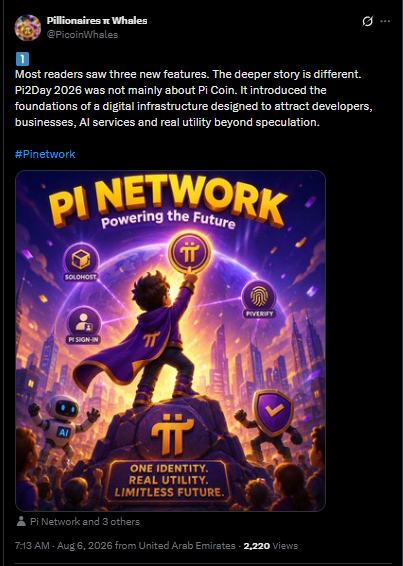
Pi Network has returned to the center of community discussions following a post shared by @PicoinWhales on X (source post). While many users initially focused on the three new features introduced during Pi2Day 2026, the post argues that the real significance of the event extends well beyond those announcements.
Pi Network, launched in 2019 by a team of Stanford graduates, is distinctive among blockchain projects for its mobile-first approach that allows users to mine Pi coins via a smartphone app without energy-intensive hardware. The project claims over 60 million engaged members, referred to as "Pioneers," spanning countries worldwide. Pi2Day, held annually on June 28 (6/28, a nod to the mathematical constant 2π), has become the project's signature event for ecosystem-wide updates.
According to the post, Pi2Day 2026 was not primarily about Pi Coin itself. Instead, it represented the beginning of a broader digital infrastructure designed to support developers, businesses, artificial intelligence services, and practical Web3 applications that move beyond speculation. The perspective has sparked fresh conversations across the Pi Network community, with many users viewing Pi2Day as an important milestone in the project's long-term ecosystem strategy rather than simply another product update.
The broader context for these discussions is Pi Network's transition from its enclosed mainnet phase, launched in December 2021, toward an open mainnet environment that would enable external connectivity and broader exchange of value. The Core Team has stated that the open mainnet launch depends on milestones including KYC verification progress, ecosystem readiness, and favorable external market conditions. Within this framework, each Pi2Day takes on heightened significance as an indicator of how close the project is to meeting those benchmarks.
It is important to note that this interpretation reflects community analysis and should not be viewed as an official statement from the Pi Core Team.
Pi2Day as a Major Ecosystem Event
Each year, Pi2Day serves as one of Pi Network's major annual milestones. The event has traditionally been used to showcase ecosystem progress, introduce new tools, and provide updates regarding the project's long-term roadmap. As a result, every Pi2Day announcement receives close attention from millions of Pioneer users worldwide.
This year's event was no exception. Although many discussions centered on the newly introduced features, some community members believe the broader strategic direction deserves even greater attention.
Looking Beyond the New Features
According to @PicoinWhales, many readers concentrated primarily on the visible product updates announced during Pi2Day 2026. However, the post suggests that the true significance lies beneath the surface. Rather than viewing the event simply as another software update, the community analysis describes Pi2Day as the beginning of infrastructure capable of supporting future digital services across the Pi ecosystem.
This shift in perspective places greater emphasis on long-term ecosystem development rather than individual feature releases.
Building Infrastructure Instead of Chasing Speculation
One of the central messages in the post is that Pi Network appears increasingly focused on creating infrastructure rather than encouraging speculative interest. Across the blockchain industry, successful ecosystems are typically built on practical tools that developers, businesses, and users can rely upon. Infrastructure often includes developer platforms, digital identity systems, payment technology, decentralized applications, and services capable of supporting large-scale economic activity. By prioritizing these foundational elements, blockchain projects may improve their long-term sustainability and practical usefulness.
The Role of Developers
Developers play a critical role in the success of every major blockchain ecosystem. Without applications, services, and software built by independent creators, even the most advanced blockchain networks struggle to achieve widespread adoption. The community interpretation of Pi2Day 2026 suggests that Pi Network continues working toward creating an environment where developers can build useful applications that leverage the ecosystem's growing infrastructure. A healthy developer ecosystem often leads to greater innovation, broader user engagement, and expanded commercial opportunities.
Business Adoption as a Key Component
The post also highlights businesses as another essential component of Pi Network's long-term vision. For any cryptocurrency ecosystem to achieve mainstream adoption, merchants, service providers, and companies must be able to integrate blockchain technology into real commercial activities. If businesses begin adopting Pi-powered infrastructure, the ecosystem could expand beyond individual users into broader economic participation. Although the pace of adoption will depend on numerous technological and market factors, commercial engagement remains an important objective for many blockchain projects.
AI Services as a Growing Opportunity
Artificial intelligence has become one of the fastest-growing sectors in technology. Blockchain developers worldwide are increasingly exploring ways to combine decentralized networks with AI-powered applications. According to the community perspective shared by @PicoinWhales, Pi Network's long-term infrastructure may eventually support AI-driven services alongside traditional decentralized applications. Such integration could enable new forms of automation, digital commerce, intelligent services, and user interaction. However, there has been no official announcement detailing specific AI products or implementation timelines within the Pi ecosystem.
Source: X post
Utility Beyond Speculation
Perhaps the most important theme in the post is the emphasis on real utility. The cryptocurrency market has historically been dominated by price speculation. Increasingly, however, successful blockchain ecosystems are measured by the practical value they deliver to users. Payment systems, decentralized applications, digital identity, developer tools, online marketplaces, and business services all contribute to sustainable ecosystem growth. The community believes Pi2Day 2026 signals that Pi Network is continuing its transition toward becoming a platform where real economic activity can take place.
Why Infrastructure Matters More Than Short-Term Headlines
Major technology platforms are rarely built through a single product launch. Instead, they grow gradually by introducing the infrastructure needed to support future innovation. This includes software development tools, payment systems, security frameworks, identity solutions, APIs, and services that encourage external developers and businesses to participate. Many members of the Pi Network community believe Pi2Day 2026 represents another important step in constructing that foundation. Whether those expectations are realized will ultimately depend on continued ecosystem development and adoption.
Rising Community Expectations
As Pi Network expands its ecosystem, expectations from the global Pioneer community continue to increase. Users are looking beyond mining activities and are increasingly interested in applications, digital commerce, Web3 services, artificial intelligence, and broader real-world utility. This evolution reflects a wider trend throughout the blockchain industry, where long-term success depends on creating value through practical usage rather than market speculation alone. Community discussions following Pi2Day demonstrate how closely users are monitoring the project's strategic direction.
Users Should Continue Following Official Updates
Although the analysis shared by @PicoinWhales has generated considerable interest, it represents a community interpretation rather than official confirmation of Pi Network's future roadmap. Users should continue following announcements from the Pi Core Team for verified information regarding new products, developer tools, AI initiatives, business integrations, and ecosystem expansion. Official communication remains the most reliable source for understanding the project's future development plans.
Conclusion
The recent X post from @PicoinWhales has encouraged the Pi Network community to view Pi2Day 2026 from a broader perspective. Rather than focusing solely on the three newly introduced features, the discussion suggests that the event highlighted the construction of digital infrastructure capable of supporting developers, businesses, AI-powered services, and meaningful Web3 adoption. While these interpretations remain community opinions rather than official statements, they reflect growing optimism that Pi Network is steadily evolving beyond a cryptocurrency project into a broader digital ecosystem built around practical utility, technological innovation, and long-term global adoption.

