Pi Network Price Holds Near $0.095 Ahead of Targeted Protocol 27 Upgrade
Key Takeaways
- •Protocol 27 is scheduled to introduce developer features intended to support decentralized finance, stablecoins and applications beyond Pi Network’s mobile-mining origins.
- •PI has traded between approximately $0.0715 and $0.1200 for two months and remains below its 100-day exponential moving average.
- •CoinMarketCap data cited in the article showed about $6 million in 24-hour trading volume, with most activity occurring on OKX and less than $700 on Kraken.
- •Pi Network has 11.1 billion tokens in circulation against a maximum supply of 100 billion, leaving more than 88 billion tokens expected to unlock in coming years.
- •The network continues to face centralization concerns, while Binance and Coinbase have not listed PI.
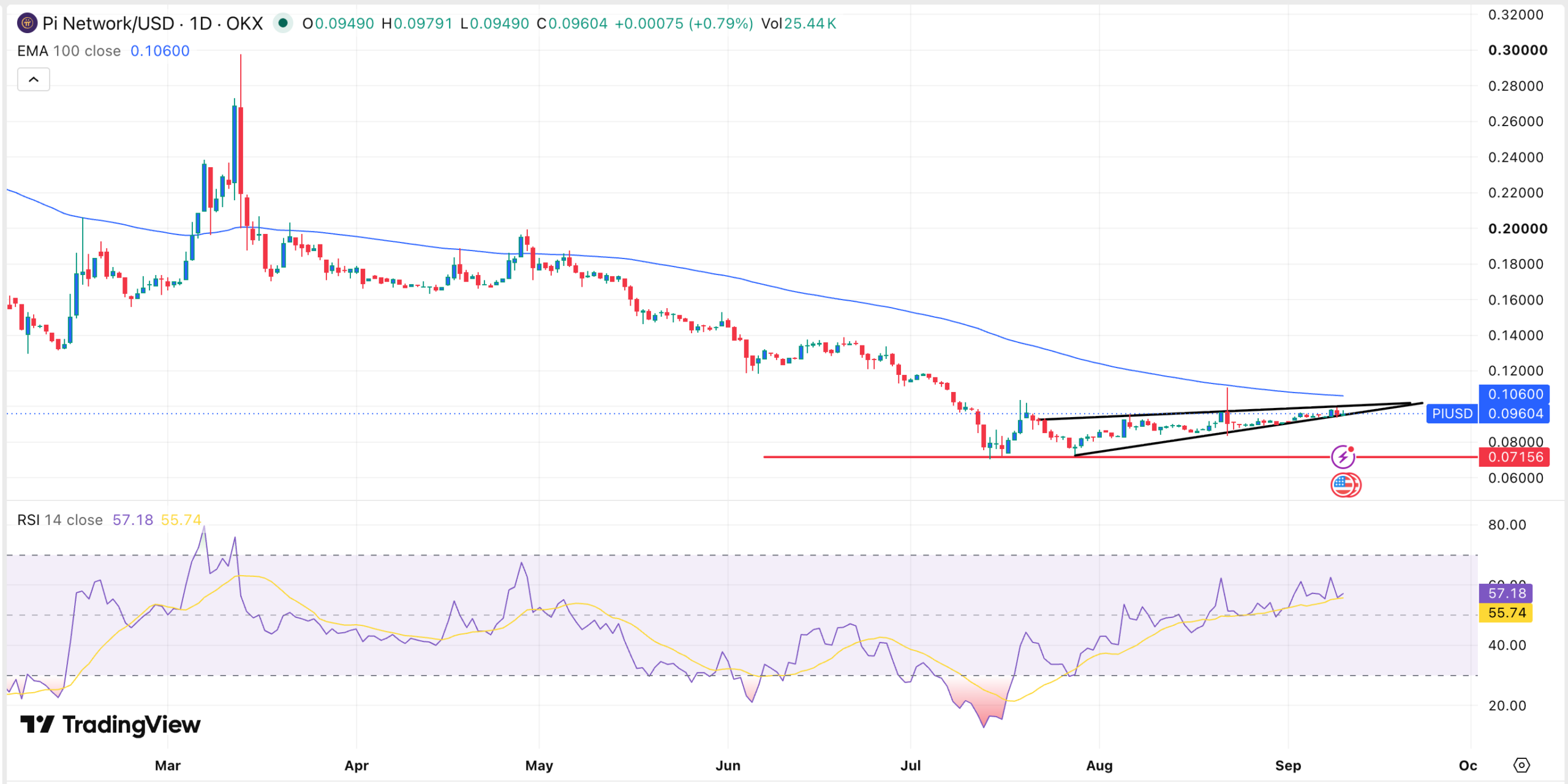
Pi Network’s PI token remained near $0.095 on Sept. 10 after spending several weeks in a narrow trading range. The token has not fully participated in the broader cryptocurrency recovery and remains substantially below its 2025 peak. Market attention is now focused on the targeted Sept. 15 launch of the Protocol 27 Mainnet upgrade.
PI has a market capitalization of around $1.07 billion, while daily trading volume is approximately $6 million to $7 million. The token remains roughly 97% below its February 2025 record near $2.99. Protocol 27 is expected to provide the network’s next measurable technical catalyst.
Protocol 27 to Add Network Features
PI’s price has fallen by more than 90% from its all-time high, and its market capitalization has declined to about $1 billion from a record high of nearly $20 billion last year.
The upcoming Protocol 27 launch will conclude a lengthy development process that began late last year. The upgrade is set to introduce additional network capabilities, including smart contract authentication, automated market maker tools, and decentralized exchange (DEX) features.
The stated goal is to move Pi Network beyond mobile mining and toward broader utility, including potential applications in decentralized finance (DeFi) and stablecoins. These capabilities are intended to allow developers to build applications on the network and compete with established chains such as Ethereum, XRP Ledger, and Solana.
The upgrade is also presented as part of an effort to transform Pi Network from what critics describe as a ghost chain into a utility network. During this transition, developers have introduced local storage support, a staking data API, file and video sharing, and improved documentation for developers.
The Sept. 15 target therefore gives the market a specific near-term event to monitor. Beyond the launch itself, the article’s focus on developer tools means that implementation of the new capabilities and evidence of their use will be relevant to assessing whether the upgrade expands Pi Network’s utility.
However, the transition could prove difficult. Other networks that have attempted to compete with Ethereum, including IOTA, Berachain, Unichain, EOS, Algorand, and Scroll, have not succeeded in doing so, according to the article.
Demand, Unlocks, and Centralization Concerns
Pi Network faces several challenges. One is the possibility that many people who were previously interested in the project have moved on. The article says that many early participants, known as pioneers, were primarily attracted by the prospect of making a fortune if the token’s price rose sharply.
Demand for PI has also remained low in recent months. CoinMarketCap data cited in the article showed approximately $6 million in trading volume over the previous 24 hours. Most of that volume was recorded on OKX, while Kraken accounted for less than $700.
Weak demand has coincided with continuing token unlocks. Pi Network has a maximum supply of 100 billion tokens and a circulating supply of 11.1 billion. Based on those figures, more than 88 billion tokens are expected to be unlocked in the coming years.
The network has also continued to face concerns about centralization. The article links those concerns to the decisions by notable exchanges, including Binance and Coinbase, not to list PI. Unlike some other cryptocurrency projects, Pi Network is described as giving insiders most of the control and lacking community voting.
Technical Outlook for PI
On the daily chart, PI has traded within a narrow range for the past two months. The token has remained between support at $0.0715 and resistance at $0.1200 during that period.
The chart also shows a rising wedge, a pattern formed by two ascending and converging trendlines. Those trendlines are approaching their convergence point, which could precede a bearish breakout.
PI has remained below its 100-day Exponential Moving Average (EMA). A move above that average would be needed to confirm a bullish breakout, according to the technical analysis presented in the article.
If the token declines further in the near term, the next key level identified is $0.07156, which was its lowest level in July this year. Conversely, a move above the $0.1200 resistance level would indicate additional gains.
This article is for informational purposes only and should not be considered financial or investment advice. Cryptocurrency markets remain highly volatile. Readers should conduct independent research before making investment decisions.
Source: The Market Periodical.
