Pi Network's V27 Upgrade Reaches Final Testnet Stage as PI Coin Extends Recovery
Key Takeaways
- •Pi Network has moved its Protocol V27 upgrade to Testnet 2, the final stage of testnet testing, where the protocol has stabilized at roughly 250 transactions per block with no recorded failures.
- •Mainnet node operators are required to upgrade to version 27, with Pi Node Docker V27.1.0 images already available for Docker-based server nodes.
- •PI rose about 5.7% to near $0.0894 on September 21, extending a two-day recovery alongside a broader crypto-market rebound that saw Bitcoin trade above $85,000.
- •Approximately $688 million in total crypto liquidations occurred over 24 hours, including about $598 million in short positions, while the Fear and Greed Index climbed to 77.
- •PI still trades below its 50-, 100-, and 200-day exponential moving averages, with the 50-day EMA near $0.0924 as the nearest resistance and $0.0827 as the first nearby support.
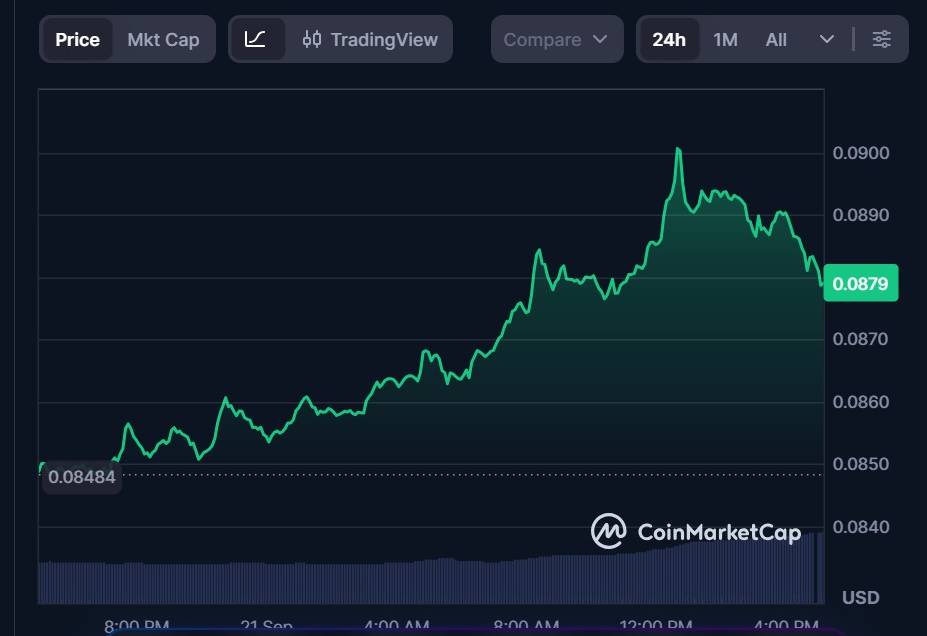
Pi Network's PI token extended a two-day recovery on Monday, September 21, rising as the broader cryptocurrency market strengthened and the project advanced the rollout of its Protocol V27 upgrade to the final stage of testnet testing. PI traded near $0.0894 during the latest session up about 5.7% over the past 24 hours, according to market data. Pi Network separately confirmed that its Mainnet blockchain protocol upgrade is underway and that Mainnet node operators need to move to version 27.
The rebound came alongside a wider crypto-market recovery. However, PI remains below several longer-term moving averages, leaving the broader technical trend weaker than the latest daily move suggests.
V27 Rollout Reaches Final Testnet Stage
Pi Network has moved Protocol V27 to Testnet 2 following earlier testing on Testnet 1, placing the upgrade in the final stage of its testnet rollout. The protocol has stabilized at around 250 transactions per block, with no recorded failures reported during the test period. That performance gives developers another measure of network stability before wider deployment. Staged testnet validation of this kind is standard practice in blockchain development, letting teams surface defects before changes reach live nodes.
The progression followed the completion of the Protocol 26 upgrade on Mainnet. The project then shifted its Testnet toward Protocol 27 before beginning Testnet 2 testing, a sequence that separates protocol validation from the node migration now taking place across the Mainnet.
The network is using Pi Node Docker V27.1.0 during this stage. Pi Network's official Node page also states that the Mainnet blockchain protocol upgrade is in progress and requires every Mainnet node to upgrade to V27, indicating that the transition has already reached network operators. That requirement sits at the center of the upgrade's progress, since nodes need compatible software to keep processing transactions under the network's updated rules.
Protocol V27 focuses on stronger transaction authorization and infrastructure for future applications. The upgrade also gives developers more flexibility when building services that depend on authenticated transactions. Reports have linked the update with future decentralized exchange tools, though Pi Network has not announced a DEX launch date, leaving any deployment window or DEX timeline among the rollout's open items to watch.
PI Recovers With the Broader Crypto Market
PI traded near $0.089 on September 21 after gaining more than 4% during the day, extending the token's rebound from the previous session. Bitcoin also traded above $85,000 during the same period, while broad crypto sentiment improved.
Market data showed heavy short liquidations as Bitcoin moved higher. About $688 million in total crypto liquidations occurred over 24 hours, including roughly $598 million in short positions. Short liquidations occur when rising prices force bearish, leveraged positions to close, with the resulting buy orders adding further upward pressure. The Fear and Greed Index also rose to 77 on its 0-to-100 scale, where readings above 50 indicate greed, reflecting stronger risk appetite across the market.
Despite the rebound, PI still trades below its 50-, 100-, and 200-day exponential moving averages. These averages weight recent prices more heavily and are widely used as trend reference points, so trading beneath all three keeps the wider trend under pressure even as short-term demand improves.
Key Technical Levels in Focus
The token's near-term technical structure now centers on the 50-day exponential moving average near $0.0924, which stands as the nearest resistance. A daily break above that level could place $0.0990 back in focus, an area that marks the 50% Fibonacci retracement between the $0.1394 high and the $0.0704 low. Retracement levels of this kind are drawn from the distance between a prior swing high and low and are commonly used as reference zones for market reactions.
If PI fails to clear $0.0924, the first nearby support sits at $0.0827, a level matching the 23.6% Fibonacci retracement. A deeper decline would shift attention toward the $0.0704 structural low.
Node operators face a separate requirement alongside the price action. Mainnet node operators need to upgrade to V27 as Pi Network continues the protocol rollout. V27.1.0 images are already available for Docker-based server nodes, and operators should use the official instructions that match their node setup.
With testnet validation in its final stage and the Mainnet node migration underway, the completion of both tracks — and any official word on wider deployment — stand out as milestones to monitor alongside PI's chart levels.
This article is for informational purposes only and does not constitute financial or investment advice. Cryptocurrency investments involve risk, and past performance does not guarantee future results.

