Pi Network Gets Payment Spotlight as OpenPay Adds Pi Support
Key Takeaways
- •OpenPay is reported to support Pi Network among several payment methods for users to top up balances.
- •Pi Network launched in 2019 and has tens of millions of users, but its coins are not listed on major cryptocurrency exchanges.
- •Since the enclosed mainnet began in December 2021, Pi has restricted external transfers, making in-ecosystem applications a key use case.
- •The article says the OpenPay integration does not prove Pi has become a major global payments network.
- •The broader significance depends on whether more merchants, platforms, and users adopt Pi for actual transactions.
Pi Network is drawing fresh attention as its ecosystem continues to move toward practical payment use cases.
Launched in 2019 by a team of Stanford graduates, Pi Network set out to make cryptocurrency accessible to everyday users through a mobile-first mining model. Instead of relying on energy-intensive proof-of-work consensus, Pi uses a security-circle-based approach derived from the Stellar Consensus Protocol, allowing users to contribute to network security simply by tapping a button on their phones daily. The project reports tens of millions of engaged users, known as Pioneers, though Pi coins have not yet been listed on major cryptocurrency exchanges.
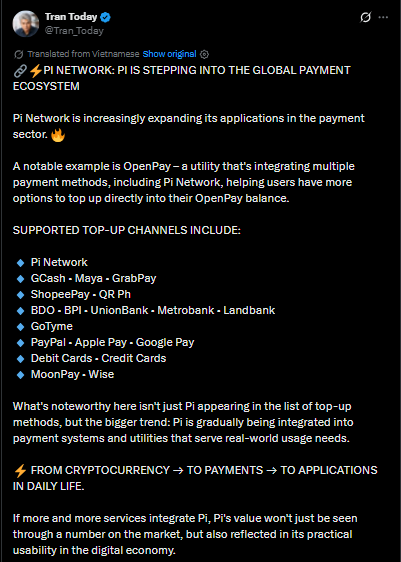
A recent post shared by X account @Tran_Today highlighted OpenPay as an example of Pi Network's growing connection to the payments sector. According to the information shared, OpenPay is integrating multiple payment methods, including Pi Network, and is giving users additional options to top up their OpenPay balances.
The development matters because payment utility has long been one of the most closely watched parts of the Pi Network ecosystem. Since launching its enclosed mainnet in December 2021, Pi Network has operated within a firewall that restricts external transfers, making in-ecosystem applications one of the primary ways users can interact with the coin.
While many blockchain projects focus heavily on trading, speculation, or decentralized finance, Pi Network has consistently emphasized building an ecosystem in which its digital asset can be used by ordinary users.
Payment-oriented applications could therefore become an important part of that strategy.
However, the latest development should be interpreted carefully. The available information indicates that OpenPay supports Pi as part of its payment infrastructure, but it does not by itself show that Pi has entered the global payments industry at a scale comparable with traditional payment networks.
Instead, the development represents another potential building block in Pi's broader utility ecosystem.
OpenPay Brings Pi Into the Payment Conversation
OpenPay is notable because it focuses on payment functionality rather than simply offering another venue for trading digital assets.
According to the information shared by @Tran_Today, OpenPay allows users to top up balances through multiple payment methods, with Pi Network included among the supported options.
For users, the idea is straightforward.
Instead of treating Pi only as a digital asset held in a wallet, an integration like this creates a possible pathway for Pi to become part of a broader payment experience.
That distinction matters.
A blockchain ecosystem becomes more useful when its native coin can interact with real applications.
Payment services can potentially provide one of those practical use cases.
The more applications that integrate Pi, the more situations in which users may be able to interact with the asset.
Why Payments Matter for Pi Network
The payments sector is one of the most natural areas for blockchain technology.
Digital assets were originally developed around the idea of transferring value without relying entirely on traditional intermediaries. In the broader crypto industry, payment solutions such as the Bitcoin Lightning Network, stablecoin-based remittance platforms, and services like BitPay and Coinbase Commerce have each attempted to bridge the gap between digital assets and everyday transactions, with varying degrees of adoption.
However, blockchain payments have historically faced several challenges, including usability, transaction speed, regulatory requirements, liquidity, and the complexity of using wallets.
A successful payment ecosystem needs to make the experience simple.
Users should be able to understand how to add funds, send value, receive payments, and complete transactions without needing extensive technical knowledge.
This is where applications such as OpenPay could become relevant.
If the platform can provide a straightforward interface while connecting multiple payment methods, it could potentially reduce some of the barriers between traditional digital payments and blockchain-based assets.
Pi Coin Utility Becomes the Bigger Story
For the Pi Network community, the key question is not simply whether another platform supports Pi.
The more important question is what users can actually do with Pi after an integration is added.
Utility is a central theme in the development of any blockchain ecosystem.
A coin can have a large community, strong market attention, and active trading activity, but long-term sustainability also depends on whether people have practical reasons to use it.
Pi Network has been developing applications and infrastructure intended to increase Pi's utility.
The network's official roadmap describes Pi as an ecosystem involving applications, Pi Browser, Pi Wallet, and other components designed to support its Web3 environment.
OpenPay's payment functionality can therefore be viewed within that broader picture.
Multiple Payment Methods Could Matter
One of the most notable details in the latest information is that OpenPay is not relying on a single payment method.
Instead, the platform is described as integrating multiple payment options.
That matters because users in different regions have different preferences and access to financial infrastructure.
Some users may prefer bank transfers.
Others may use digital payment services, cards, or cryptocurrency.
By supporting multiple payment rails, a platform can potentially make its services accessible to a broader audience.
The addition of Pi Network could give Pioneers another way to interact with the platform.
At the same time, it could expose users who are already familiar with traditional payment methods to another blockchain-based payment option.
That kind of interaction is important for the wider Web3 industry.
Is Pi Entering the Global Payments Ecosystem?
The phrase "global payment ecosystem" is strong, but it needs careful interpretation.
Pi Network participating in a payment application does not mean Pi has suddenly replaced traditional payment networks.
Global payment infrastructure involves banks, card networks, payment processors, regulators, fintech companies, merchants, and many other institutions.
An individual integration represents only one part of that much larger system.
Nevertheless, integrations can accumulate.
If more applications begin supporting Pi, and if more merchants and users adopt those applications, the network's role in digital payments could gradually become more meaningful.
That is why OpenPay deserves attention.
The importance may not come from one application alone, but from what similar integrations could represent over time.
OpenPay as a Possible Bridge Between Crypto and Everyday Payments
One of the biggest challenges facing crypto adoption is the gap between blockchain technology and everyday financial activity.
Many people already know how to use traditional payment applications.
They can transfer money, pay bills, purchase products, or top up balances without thinking about the technical infrastructure underneath.
Crypto applications often require additional steps.
Users may need to understand wallets, blockchain networks, addresses, transaction fees, and other concepts.
Payment platforms can potentially simplify that experience.
If OpenPay successfully integrates Pi while maintaining an easy user experience, it could help show how Pi might fit into more familiar payment environments.
That would be important for Web3 adoption.
What This Means for Pioneers
For Pioneers, the development could add another potential use case for Pi.
Instead of viewing Pi solely as a coin whose future depends on market trading, users can increasingly look at whether Pi is being integrated into actual applications.
This does not mean every integration will be successful.
Some applications may remain small.
Others may change their business models.
Some may eventually discontinue support.
For that reason, Pioneers should focus on measurable adoption rather than simply counting announcements.
Important indicators include active users, transaction volume, merchant participation, available payment options, and the number of services that actually use Pi.
These factors can provide a better picture of ecosystem growth.
Payment Utility Does Not Automatically Mean Price Growth
The development also needs to be separated from speculation about the price of Pi Coin.
A new payment integration does not automatically guarantee a price increase.
Crypto markets are influenced by supply and demand, liquidity, market sentiment, exchange availability, macroeconomic conditions, regulation, and investor expectations.
An increase in utility can potentially strengthen the fundamental case for an asset, but the market may react differently depending on broader conditions.
Pioneers should therefore avoid reading every payment integration as a direct price signal.
The stronger argument is that greater utility could potentially create more reasons for users to hold and spend Pi.
That is a long-term ecosystem question rather than a short-term trading prediction.
Source: Xpost
The Web3 Connection
The OpenPay development also fits into the broader evolution of Web3.
Web3 is increasingly moving beyond the idea of simply owning blockchain assets.
The next phase involves connecting decentralized technology with applications people can use in everyday life.
Payments are an obvious part of that transition.
If blockchain-based assets can be integrated into familiar financial applications, the technology becomes easier to access for mainstream users.
Pi Network has been trying to build an ecosystem around that concept.
The project's Open Network transition was described by Pi Network as a major step toward connecting its blockchain, identity-verified community, and Web3 ecosystem with the external world.
Payment integrations can potentially become part of that external connectivity.
Developers Could Play a Major Role
The long-term success of Pi's payment ecosystem will not depend only on the Pi Core Team.
Developers will have an important role.
Developers create the applications that allow users to interact with blockchain networks.
If Pi's technical infrastructure continues to improve, developers could potentially build more sophisticated payment applications around the network.
Pi Network has already introduced infrastructure designed to support smart contract development.
In April 2026, the project announced an RPC server on Testnet intended to help developers build and test applications that communicate with the Pi blockchain.
That infrastructure could eventually support a broader range of applications, including payment-related services.
What Could Happen Next?
The next stage will depend on whether integrations like OpenPay expand beyond basic support.
A simple payment integration is useful, but a broader ecosystem could include merchants, marketplaces, subscription services, digital products, remittances, and other payment use cases.
If developers can build applications that allow Pi to move easily between different services, the potential utility becomes much greater.
Interoperability will also matter.
Users will want to move assets between wallets and applications without unnecessary complexity.
The more connected the ecosystem becomes, the more valuable individual integrations could potentially become.
What Pioneers Should Watch
The Pi community should monitor several developments.
First, whether OpenPay expands the number of payment methods supporting Pi.
Second, whether more merchants begin accepting Pi through payment applications.
Third, whether additional Web3 platforms integrate Pi.
Fourth, whether transaction activity grows alongside the number of integrations.
Finally, official documentation should be checked to confirm which features are actually live.
Community posts can help identify emerging developments, but official announcements remain the best source for confirming technical capabilities and availability.
This distinction is especially important in the crypto industry, where rumors can spread quickly.
Why Utility May Matter More Than Hype
Pi Network has attracted substantial attention since its early development.
But the long-term question is increasingly shifting away from how much attention Pi receives and toward what users can actually do with it.
That is where utility becomes critical.
A payment ecosystem built around Pi could potentially create a stronger connection between the coin and everyday economic activity.
OpenPay is one example of that direction.
If similar integrations continue appearing, Pi could gradually become part of a broader digital payment environment.
The process is unlikely to happen overnight.
Building payment infrastructure requires technology, compliance, security, liquidity, and user trust.
But each successful integration can potentially add another piece to the larger ecosystem.
Security and User Awareness Remain Important
As payment integrations increase, security becomes even more important.
Users should verify that they are interacting with legitimate applications and official services.
They should also carefully review wallet addresses, transaction details, network information, and authorization requests before confirming transactions.
The growing popularity of a coin can attract malicious actors trying to exploit users through fake applications or phishing websites.
Pioneers should therefore avoid relying only on social media screenshots or unofficial claims.
A legitimate integration should be verifiable through the relevant platform's official channels or documentation.
Conclusion
Pi Network's growing presence in payment-focused applications is becoming an increasingly notable part of the project's broader development.
The latest information shared by @Tran_Today highlights OpenPay as one example, with the platform integrating multiple payment methods and including Pi Network as an option for users to top up their OpenPay balances.
The development does not mean Pi has suddenly become a dominant global payment network.
Instead, it represents a potential step toward greater utility and broader integration.
For Pi Coin, that distinction is important.
The long-term value of a blockchain ecosystem depends not only on market speculation but also on whether people can use its technology for practical purposes.
Payment applications could become one of the most important areas for that utility.
As Pi Network continues developing its Web3 infrastructure, smart contract capabilities, applications, and external connectivity, integrations such as OpenPay could help demonstrate how Pi might fit into real-world digital payments.
The next stage will be determined by adoption.
If more users, merchants, developers, and payment platforms begin using Pi for actual transactions, the network's role in the digital economy could become increasingly significant.
For now, OpenPay is an interesting development worth watching.
The bigger story, however, is whether this becomes the beginning of a much larger trend in which Pi Coin moves from being primarily a blockchain asset into a more widely used component of the global Web3 payment ecosystem.

