Pi Network Price Crashes Toward Record Low Despite Protocol 27 Upgrade
Key Takeaways
- •PI traded around $0.082 on Sept. 17, leaving the token close to its all-time low of $0.0715, with a potential further decline toward $0.048 if that support breaks.
- •The US Senate failed to advance the CLARITY Act after many Democrats voted against cloture, citing loopholes that could allow politicians such as President Donald Trump to issue their own tokens.
- •Pi Network completed the Protocol 27 upgrade, intended to improve smart-contract authentication capabilities, but the milestone did not lift the token's price.
- •Technical signals, including a rising wedge breakdown, a price below the 50-day EMA, an RSI under 50, and a rising ADX, indicate the downtrend is gaining momentum.
- •PI's 24-hour trading volume stood at about16 million while more than 1.7 billion tokens, roughly 15% of circulating supply, are estimated to unlock over the next 12 months.
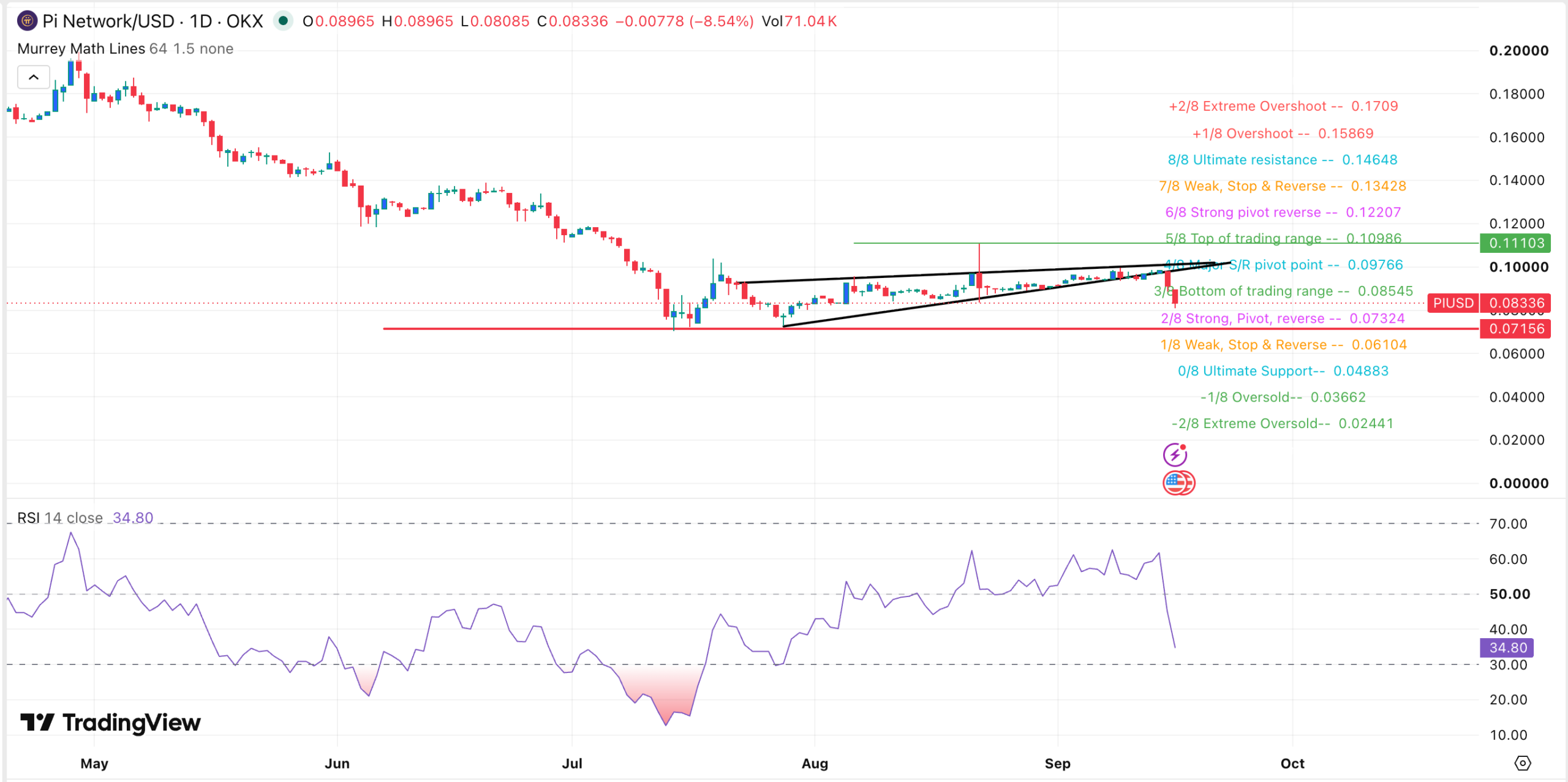
Pi Network's PI token extended its decline this week, edging closer to its all-time low as a broad cryptocurrency market downturn and a stalled US crypto bill outweighed the completion of the network's latest protocol upgrade. The episode underscores a recurring dynamic in crypto markets, where network milestones can be overshadowed by macro conditions and policy developments.
PI changed hands around $0.082 on Sept. 17 after sliding to roughly $0.081 during the previous session, leaving the token within reach of its record low. The retreat coincided with weakness across the crypto market following the failed cloture vote on the CLARITY Act in the US Senate. At the same time, the Pi Network development team concluded the Protocol 27 upgrade this week, an update intended to the network's smart-contract authentication capabilities.
Rising Wedge Breakdown Signals Further Weakness
The daily chart explains why the Pi token produced a strong bearish breakout this week. The token had traced a rising wedge pattern, a formation built from two ascending, converging trendlines, and the breakdown occurred as the two lines approached their confluence point.
PI has since moved below the Major S/R Pivot Point of the Murrey Math Lines tool — a framework that maps price action onto a grid of evenly spaced support and resistance levels — and remains beneath its 50-day Exponential Moving Average (EMA), a trend gauge that smooths the past 50 days of price data, a sign that sellers have prevailed. The Relative Strength Index (RSI) has continued its downward trend and crossed below the neutral level of 50, while the Average Directional Index (ADX) has jumped, indicating that the downtrend is gaining momentum.
The chart therefore suggests that the token has more downside to go. The next level to watch is $0.0715, its all-time low. A drop below that level would point to further declines, potentially toward the ultimate support of the Murrey Math Lines at $0.048.
CLARITY Stalls in the Senate
The ongoing Pi crash is playing out against a backdrop of broader crypto market weakness. Bitcoin, the largest cryptocurrency, slipped to $75,000 from its monthly high of more than $80,000, and the market capitalization of all tokens fell by more than 1.12% to $2.58 trillion.
The retreat came as investors reacted to the US Senate's failure to pass the CLARITY Act, a market-structure bill intended to clarify which US regulators oversee digital assets. Many Democrats voted against the procedural step — cloture, the motion required to end debate and move legislation toward a final vote — arguing that the concessions made by Republicans did not go far enough. Their concern was that the bill left loopholes that would allow politicians such as President Donald Trump to issue their own tokens.
The CLARITY Act would have been the biggest crypto-focused bill the United States has passed since the GENIUS Act, the stablecoin-focused legislation signed into law in July 2025. As a result, the odds of the CLARITY Act becoming law now appear substantially lower, and whether Senate leaders bring a revised version back to the floor remains one of the sector's open questions.
Protocol 27 Upgrade Fails to Lift the Token
The token also declined as investors assessed the impact of the Protocol 27 upgrade, the final upgrade in a process that began late last year. Its goal was to deliver improvements to the network's smart contract features. Smart-contract capability is a baseline requirement for most decentralized applications, which is why upgrades of this kind are typically judged by whether they attract developer activity. Traders likely believe the upgrade will not have a major impact on the network's ability to attract developers and investors.
Beyond the upgrade, there are signs that many people who were interested in Pi Network during its pre-listing period — when the project drew a following through its smartphone-based mining app — have abandoned the project. The project has not achieved the goals its developers set out, including becoming a popular player in the payments industry.
Daily trading volume offers an example of the waning engagement. Data compiled by CoinMarketCap shows that PI's volume stood at just $16 million over the last 24 hours. While that represented a 108% increase, it is significantly lower than volumes for other popular coins, including XRP and Bitcoin, which routinely record billions of dollars in daily turnover.
Most notably, the low volume has coincided with growing token unlocks. The network is estimated to unlock more than 1.7 billion tokens over the next 12 months — an amount equivalent to roughly 15% of the current circulating supply — and the releases will continue for the foreseeable future given that 11.2 billion tokens, about 11% of the total, are in circulation against a maximum supply of 100 billion. Token unlocks normally lead to higher supply, adding to the number of tokens available to trade; scheduled releases of this kind are commonly tracked by market observers as known supply events.
This article is for informational purposes only and does not constitute financial or investment advice. Cryptocurrency investments involve risk, and technical indicators or network upgrades do not guarantee future price performance.
This article is based on a report originally published by The Market Periodical.

