Pi Network Releases Pi Launchpad on Testnet for Ecosystem Token Exploration
Key Takeaways
- •Pi Network has released Pi Launchpad on Testnet, allowing users and developers to explore how ecosystem tokens could be created, distributed, and utilized within a decentralized environment.
- •The Testnet phase serves both technical evaluation and community education purposes, enabling Pioneers to familiarize themselves with token mechanisms and decentralized finance concepts while providing feedback.
- •Pi Network has been operating in an enclosed Mainnet phase since December 2021, meaning Pi Coins can be transferred internally but are not yet freely tradable on external exchanges.
- •The Pi Launchpad Testnet release does not confirm immediate Mainnet implementation but represents ongoing infrastructure development ahead of any potential open Mainnet transition.
- •The token issuance mechanism could create new opportunities for developers to build specialized applications and services within the Pi Network ecosystem, potentially supporting broader ecosystem growth.
Pi Network Releases Pi Launchpad on Ecosystem Token Exploration
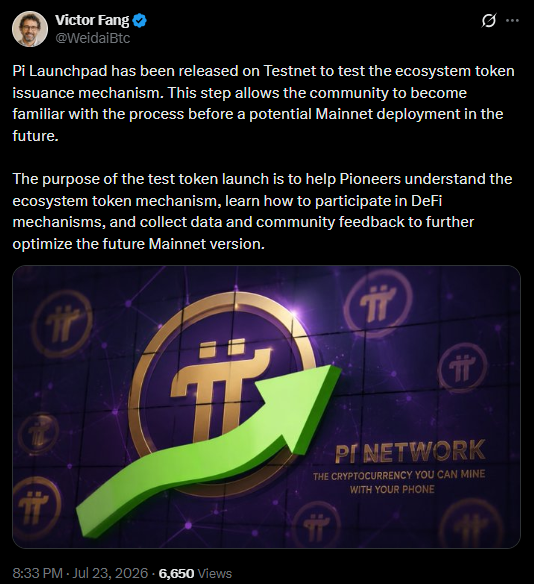
Pi Network continues to expand its blockchain infrastructure with the release of Pi Launchpad on Testnet, a new development that enables the community to explore and test an ecosystem token issuance mechanism. The update has drawn significant attention among Pioneers, as it introduces a concept previously unseen within the Pi Network ecosystem: the ability for users and developers to experience firsthand how ecosystem tokens could be created, distributed, and utilized in a decentralized environment.
Pi Network, launched in 2019 by Stanford graduates with the goal of making cryptocurrency accessible via mobile devices, has amassed tens of millions of users who mine Pi Coin through a lightweight smartphone app. The project has been operating in an enclosed Mainnet phase since December 2021, meaning Pi Coins can be transferred within the network but are not yet freely tradable on external exchanges. Features like Pi Launchpad are part of the project's broader effort to build utility and ecosystem activity ahead of any potential open Mainnet transition.
According to a discussion shared by community member @WeidaiBtc on X, the Pi Launchpad Testnet release is designed as a preparation stage before any potential future Mainnet deployment. The testing phase serves a dual purpose: technical evaluation and community education. It allows Pioneers to familiarize themselves with token mechanisms, understand decentralized finance concepts, and provide feedback that could help shape future iterations.
The Testnet release does not confirm immediate Mainnet implementation, but it represents another significant step in Pi Network's exploration of how it could broaden its Web3 ecosystem.
Understanding Pi Launchpad and Its Purpose
In the blockchain industry, a launchpad generally refers to a platform that helps introduce new digital assets or ecosystem projects. Many blockchain networks rely on launchpads to support developers seeking to create new tokens, applications, or decentralized services. Established platforms such as Binance Launchpad, Polkastarter, and DAO Maker have demonstrated how launchpad mechanisms can connect projects with communities, though outcomes across the industry have varied widely.
The introduction of Pi Launchpad on Testnet signals that Pi Network is exploring infrastructure capable of supporting ecosystem growth beyond its native Pi Coin. By testing token issuance mechanisms, developers and users can gain a clearer understanding of how new assets might interact within the network.
This kind of preparation is standard practice in blockchain development, as complex systems require thorough testing before live deployment.
Why Testnet Development Matters
Before launching major features on a Mainnet, blockchain projects typically use Testnet environments. A Testnet enables developers to experiment with new systems without risking real assets or disrupting live network operations. During this phase, developers can identify potential issues, refine user experience, and gather valuable feedback.
For Pi Network, the Pi Launchpad Testnet offers an opportunity to study how users interact with token creation and decentralized finance mechanisms. The insights gathered during this phase could inform the optimization of future ecosystem features.
Helping Pioneers Understand Ecosystem Tokens
Education is one of the primary objectives of the Pi Launchpad Testnet. Blockchain technology can be complex, particularly for users new to decentralized finance and digital assets.
By allowing Pioneers to experience ecosystem token mechanisms directly, Pi Network can help users better understand how decentralized economies function. This learning process may grow increasingly important as Web3 applications continue to develop. Understanding concepts such as token utility, liquidity, decentralized applications, and digital ownership can enable users to participate more effectively in blockchain ecosystems.
Exploring DeFi Mechanisms Within Pi Network
Decentralized finance, commonly known as DeFi, has emerged as one of the most significant developments in blockchain technology. DeFi enables users to access financial services through decentralized platforms rather than traditional intermediaries. These systems can include exchanges, lending platforms, liquidity mechanisms, and other blockchain-based financial tools.
The Pi Launchpad Testnet offers the Pi Network community a chance to become more familiar with DeFi-related concepts. While the exact future implementation of DeFi features within Pi Network remains subject to official development decisions, testing these mechanisms represents an important educational process.
Potential Impact on Ecosystem Growth
The introduction of a token issuance mechanism could create new avenues for ecosystem expansion. A robust blockchain ecosystem typically encompasses multiple types of applications, services, and digital assets. Additional ecosystem tokens could enable developers to build specialized solutions tailored to different industries or communities. For instance, a gaming application could potentially utilize a dedicated token, while another platform might create a utility token for specific services.
However, successful token ecosystems require careful design, strong utility, and active participation. Creating tokens alone does not guarantee value; the surrounding applications and user demand ultimately determine long-term success.
Developers Could Gain New Opportunities
Developers play a critical role in expanding blockchain ecosystems. A launchpad system could provide developers with additional tools to create applications within the Pi Network environment. By lowering technical barriers and offering structured mechanisms, more creators may be encouraged to build Web3 applications. Developer participation is widely regarded as one of the strongest indicators of ecosystem growth — the more useful applications available, the greater the potential for user engagement.
Community Feedback as a Key Factor
Collecting user feedback is an essential component of Testnet development. Real-world user experiences can reveal challenges that developers may not detect during internal testing. Feedback can help improve user interface design, token management systems, security features, application processes, and overall ecosystem usability.
Community participation has long been central to Pi Network's development approach. The Pi Launchpad Testnet provides yet another avenue for Pioneers to contribute through testing and observation.
Preparing for a Possible Mainnet Future
The current Testnet release does not signify that Pi Launchpad has officially transitioned to Mainnet. Testing infrastructure prior to deployment, however, is a well-established practice in blockchain development. Should a future Mainnet implementation proceed, the preparation process could help ensure a more stable and user-friendly experience.
Transitioning from Testnet to Mainnet demands careful evaluation, security testing, and optimization. The success of such transitions hinges on both technical readiness and ecosystem demand.
Alignment With Pi Network's Web3 Vision
Pi Network has continued working toward building a broader digital ecosystem where users, developers, and businesses can all participate. The introduction of features like Pi Launchpad aligns with the Web3 concept of decentralized participation.
A complete blockchain ecosystem requires more than a cryptocurrency — it demands applications, services, developers, and users who generate meaningful activity. By exploring token issuance mechanisms, Pi Network appears to be investigating additional ways to support ecosystem development.
Challenges Ahead for Token Ecosystems
While token launch systems present new opportunities, they also introduce challenges. Successful token ecosystems require clear utility, strong security, responsible development, active communities, and sustainable economic models. Poorly designed token systems can create confusion or unnecessary speculation, making careful planning essential before any large-scale implementation.
The Testnet phase provides an opportunity to study these challenges and refine future designs.
Looking Ahead
The release of Pi Launchpad on Testnet represents another development milestone for the Pi Network ecosystem. It introduces new possibilities related to ecosystem tokens, DeFi education, and developer participation. While future Mainnet deployment remains contingent on official decisions and successful testing, the current phase enables the community to better understand potential blockchain mechanisms.
As the cryptocurrency and Web3 industries continue to evolve, platforms that offer accessible tools and educational opportunities may be better positioned to attract developers and users alike.
The launch of Pi Launchpad on Testnet marks an important step in Pi Network's exploration of ecosystem token infrastructure. By allowing Pioneers to experience token issuance mechanisms and DeFi concepts, the project is creating opportunities for education, testing, and community feedback. While this development does not confirm imminent Mainnet deployment, it underscores ongoing efforts to expand the capabilities of the Pi Network ecosystem.
Source: Hokanews

