Pi Network Enters ISO 24165 Registration Through DTI Foundation, Marking Key Technical Milestone
Key Takeaways
- •The DTI Foundation has published an official registration record for Pi Network under the ISO 24165 standard, which provides unique digital asset identifiers similar to ISIN codes used in traditional finance.
- •The registration is an administrative and technical achievement that does not automatically alter Pi Coin's listing status, market value, or trigger new network features.
- •Pi Network remains in its Enclosed Mainnet phase, meaning Pi Coins cannot currently be transferred to external exchanges or wallets outside the network's controlled environment.
- •The DTIF registration builds on Pi Network's earlier MiCA Whitepaper progress, signaling the project's broader effort to align with internationally recognized regulatory and technical standards.
- •No official timelines have been announced by the Pi Core Team for upcoming milestones such as the Open Mainnet launch or exchange listings.
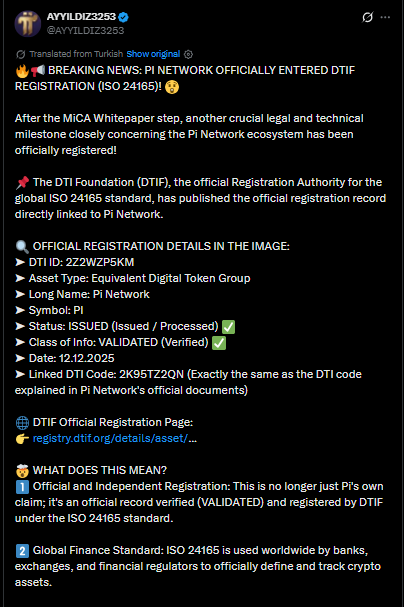
Pi Network has officially entered the registration process under the international ISO 24165 standard through the DTI Foundation (DTIF), a development that ranks among the project's most significant legal and technical achievements to date, alongside its earlier MiCA Whitepaper progress.
The news has generated considerable excitement among the project's global community of Pioneers, who view the registration as further evidence that Pi Network continues to strengthen its position on the global stage. However, the milestone should be assessed objectively: registration under an international standard does not automatically alter Pi Coin's trading status, nor does it guarantee any specific future development.
DTIF Publishes Registration Record for Pi Network
According to information circulating within the Pi Network community, the DTI Foundation has published an official registration record linked to Pi Network under the ISO 24165 standard. The DTI Foundation serves as the official Registration Authority for ISO 24165, an international standard designed to provide unique identification for digital assets through the Digital Token Identifier (DTI) system. Pi Network, launched in 2019 by a team including Stanford graduates, has grown into one of the most widely recognized mobile-first cryptocurrency projects, claiming tens of millions of engaged users known as Pioneers.
Pi Network's inclusion means the project has been formally recorded within an internationally recognized digital asset identification framework. Importantly, the registration represents an administrative and technical milestone and does not automatically imply changes to Pi Coin's listing status, market value, or the release of new network features.
Source: X post
Understanding ISO 24165
ISO 24165 is an international standard developed to assign unique identifiers to digital assets through the Digital Token Identifier system. The concept is comparable to the International Securities Identification Number (ISIN) used for stocks and bonds in traditional financial markets. By assigning a standardized identifier, each digital asset can be uniquely recognized by financial institutions, regulators, data providers, and other participants across the digital asset industry.
The standard's primary objective is to improve transparency, interoperability, and consistency in identifying digital assets worldwide. Many blockchain projects regard obtaining a Digital Token Identifier as an important step toward building a more mature and internationally recognized ecosystem. ISO 24165 was published by the International Organization for Standardization in 2021 and has since been adopted across a growing range of digital asset platforms.
Significance of the Registration
Community members have welcomed the announcement as another important milestone in the project's development. Registration under ISO 24165 demonstrates that Pi Network continues to align with internationally recognized standards used throughout the digital asset industry. The step could also simplify the integration of Pi Network data with platforms and institutions that rely on globally standardized digital asset identifiers.
Nevertheless, the registration should not be interpreted as confirmation of any future development that has not been officially announced by the Pi Core Team. Any subsequent milestones will continue to depend on the project's roadmap and official communications.
Building on the MiCA Whitepaper
Before the DTIF registration, Pi Network had already attracted attention for developments surrounding its MiCA Whitepaper. MiCA — the Markets in Crypto-Assets regulation — is the European Union's regulatory framework designed to establish legal clarity for the cryptocurrency industry and is among the most comprehensive crypto regulatory regimes implemented by a major jurisdiction.
Although the MiCA Whitepaper and ISO 24165 registration serve different purposes, many community members regard the DTIF registration as another step in Pi Network's broader effort to reinforce both its legal and technical foundation. The move signals that the project is not solely focused on blockchain development but is also actively aligning with internationally recognized industry standards.
Implications for Pi Coin
One of the most frequently raised questions within the community is whether ISO 24165 registration will directly affect Pi Coin. From a technical standpoint, obtaining a Digital Token Identifier does not automatically influence the value or trading activity of a digital asset. Market value is determined by multiple factors, including market demand, ecosystem adoption, technological development, and project governance.
Accordingly, the registration should be understood primarily as a significant improvement in digital asset identification rather than a direct catalyst for Pi Coin's market valuation.
A Step Forward for Web3 Interoperability
As the Web3 industry continues to evolve, standardized digital asset identification is becoming increasingly important. A growing number of blockchain applications require consistent identification systems to ensure efficient interoperability across multiple platforms. The Digital Token Identifier enables assets to be recognized through a unified global framework, facilitating integration with blockchain analytics providers, financial institutions, market infrastructure, and other Web3 services.
As Web3 adoption expands, standards such as ISO 24165 are expected to play an increasingly important role in supporting global interoperability.
Community Urged to Remain Objective
While the news has been received positively throughout the Pi Network community, the development warrants evaluation with realistic expectations. Pi Network has not announced that the DTIF registration is connected to the launch of the Open Mainnet, exchange listings, or any change in Pi Coin's current status. Pi Network currently operates in its Enclosed Mainnet phase, during which Pi Coins cannot be transferred to external exchanges or wallets outside the network's controlled environment. Community members are therefore encouraged to avoid drawing conclusions not supported by official announcements.
Pi Network's Broader Ecosystem Development
Over the past several months, Pi Network has remained focused on strengthening various aspects of its ecosystem, including protocol upgrades, node selection, ongoing testnet stress testing, and administrative initiatives related to international standards. This strategy reflects the project's emphasis on building a strong long-term foundation rather than pursuing rapid short-term developments — an approach generally viewed as sustainable for establishing a secure and scalable blockchain ecosystem.
What Comes Next
Following the DTIF registration, community attention will likely shift toward several upcoming milestones, including continued progress toward the Open Mainnet, further network decentralization, additional technical upgrades, and the expansion of decentralized applications built on Pi Network. The transition from Enclosed Mainnet to Open Mainnet has been a central focus of community discussion, as it would mark the point at which Pi Coins could potentially be transferred externally. None of these developments have been assigned official timelines by the Pi Core Team, and information circulating on social media should always be verified through official sources.
Conclusion
Pi Network's registration with the DTI Foundation under the ISO 24165 international standard confirms that the project is now included within a globally recognized digital asset identification framework through the Digital Token Identifier system. The achievement does not automatically alter Pi Coin's market status, guarantee exchange listings, or accelerate the Open Mainnet launch. Instead, it reflects continued progress in technical standardization, administrative development, and alignment with international digital asset frameworks. By continuing to strengthen its blockchain infrastructure, comply with internationally recognized standards, and expand its Web3 ecosystem, Pi Network demonstrates its long-term commitment to building a more robust digital economy. Community members are encouraged to rely on official announcements and avoid speculation regarding future developments.