Why Pi Network’s Compliance-Focused Strategy Could Become a Major Advantage
Key Takeaways
- •Governments in major markets are working toward clearer digital asset frameworks that balance innovation with consumer protection.
- •Compliance is increasingly viewed as a potential competitive advantage for blockchain projects seeking long-term trust and growth.
- •Pi Network has focused on ecosystem building, identity verification, and structured user participation ahead of broader adoption.
- •Digital identity is becoming an important theme in Web3 because decentralized systems still need ways to reduce abuse and fraud.
- •The article says future blockchain success will depend on security, transparency, regulatory awareness, real-world utility, and sustainable development.
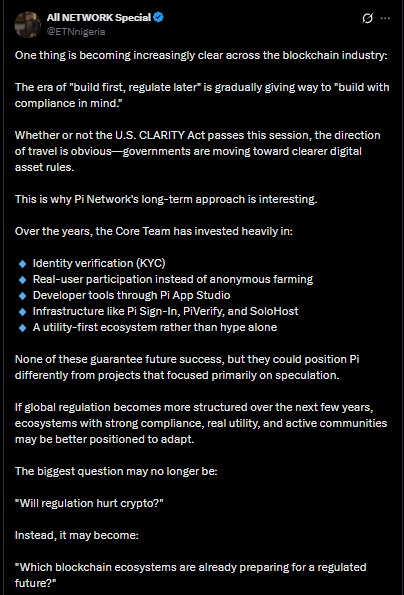
The global blockchain industry is entering a new phase in which innovation and regulation are becoming increasingly connected. For years, many cryptocurrency projects followed a “build first, regulate later” approach, prioritizing rapid development while waiting for governments to establish clearer rules.
However, that direction appears to be changing.
Governments around the world are moving toward more defined digital asset regulations, creating an environment in which blockchain projects may need to consider compliance, transparency, and legal frameworks from the start.
That shift could significantly influence the future of Crypto, Web3, and blockchain ecosystems, especially as more projects look beyond short-term experimentation and toward long-term adoption.
Within this changing landscape, Pi Network’s long-term development strategy has drawn attention because of its focus on building an ecosystem centered on identity, security, and structured participation.
While regulatory decisions continue to evolve globally, the importance of compliance is becoming increasingly clear.
The End of the “Build First, Regulate Later” Era
The early years of cryptocurrency were defined by rapid experimentation.
Many blockchain projects introduced new ideas with the goal of creating decentralized solutions before governments had developed detailed regulatory frameworks.
That approach helped accelerate innovation and allowed the industry to explore new possibilities.
It also created uncertainty.
Questions about user protection, digital asset classification, financial security, and compliance became major topics for regulators and industry participants.
Today, the blockchain sector is moving into a more mature stage.
Projects are increasingly expected to consider regulatory requirements while developing their technology.
The new approach is becoming less about avoiding regulation and more about building systems that can operate within evolving legal environments.
Governments Move Toward Clearer Digital Asset Rules
Regulation has become one of the most important issues in the cryptocurrency industry.
Governments are exploring ways to create clearer frameworks that balance innovation with consumer protection.
In the United States and other major markets, discussions around digital asset legislation reflect a growing recognition that blockchain technology is becoming part of the global financial system.
Clear regulations can provide several benefits.
They can help businesses understand how to operate, encourage institutional participation, and give users greater confidence.
For blockchain ecosystems, regulatory clarity may become an important factor in attracting developers, companies, and mainstream users.
Why Compliance Could Become a Competitive Advantage
In the early stages of cryptocurrency, some viewed regulation as a limitation.
As the industry matures, however, compliance may become a competitive advantage.
Projects that account for legal requirements, user security, and transparent operations may have stronger opportunities to build long-term trust.
For businesses and users, reliability matters.
A blockchain network that can demonstrate responsible development may be more attractive than projects that ignore regulatory concerns.
That does not mean regulation automatically determines success. Technology, adoption, and utility remain essential.
Still, compliance can provide a stronger foundation for sustainable growth.
Pi Network’s Long-Term Approach Gains Attention
Pi Network has attracted attention because of its different development approach compared with many early cryptocurrency projects.
The ecosystem has focused on building a large user community, exploring identity verification, developing applications, and creating infrastructure before broader adoption.
One of the key discussions around Pi Network is its emphasis on real users and ecosystem participation.
Identity verification mechanisms and structured user onboarding are areas that align with broader industry discussions about trust and accountability.
As regulations increasingly focus on transparency and user protection, these approaches could become more relevant.
The Importance of Digital Identity in Web3
Digital identity is becoming a major topic in the future of Web3.
Traditional internet systems often rely on centralized platforms to manage user accounts and information.
Blockchain introduces new possibilities by allowing users to interact with decentralized systems while maintaining greater control over digital assets and identities.
However, decentralized environments still need ways to prevent abuse, fraud, and manipulation.
Identity verification could become an important component of future blockchain ecosystems.
For Pi Network, the focus on verified participation represents an attempt to address some of these challenges.
Regulation and Mainstream Adoption
For cryptocurrency to achieve wider adoption, businesses and everyday users need confidence.
Mainstream adoption depends on more than technology.
People need to trust that platforms are secure, reliable, and capable of operating within accepted legal frameworks.
Businesses also require predictable environments before integrating blockchain solutions.
A clearer regulatory landscape could encourage more companies to explore digital assets and Web3 applications.
That creates opportunities for blockchain projects that have prepared for a more regulated future.
Source: Xpost
Compliance Could Shape the Next Generation of Crypto Projects
The next generation of blockchain projects may be judged differently from early cryptocurrency platforms.
Instead of focusing only on technological innovation, successful ecosystems may need to demonstrate:
- Strong security practices
- Transparent operations
- Regulatory awareness
- Real-world utility
- Sustainable development
These factors could become increasingly important as the industry moves from experimentation toward mainstream adoption.
Pi Network and the Future of Web3 Infrastructure
Web3 is expected to involve more than cryptocurrency transactions.
Future digital ecosystems may include decentralized applications, digital identity systems, online marketplaces, and new forms of digital ownership.
For these systems to grow, they need infrastructure that users and businesses can trust.
Pi Network’s development strategy reflects that broader vision by focusing on ecosystem building rather than only creating a digital currency.
The success of this approach will depend on execution, developer participation, and the ability to create practical applications.
The Role of Pi Coin in a Regulated Digital Economy
As the Crypto industry evolves, digital assets may become increasingly connected with regulated financial and technology systems.
For Pi Coin, long-term value will depend on utility, adoption, and ecosystem development.
A successful digital currency requires more than a large community.
It requires applications, businesses, and users who actively participate in the network.
A regulatory-friendly environment could potentially create opportunities for blockchain ecosystems that are prepared to operate within established frameworks.
Challenges Remain for Every Blockchain Project
Although compliance offers potential advantages, blockchain projects still face significant challenges.
Regulations differ from country to country, creating complexity for global ecosystems.
Technology must continue improving to ensure scalability, security, and usability.
Most importantly, projects must prove their value through real-world applications.
Compliance alone cannot guarantee success.
A blockchain network must still deliver meaningful solutions and create an ecosystem where users and businesses find practical benefits.
The Future of Blockchain May Belong to Responsible Innovation
The cryptocurrency industry is entering a new chapter.
The focus is shifting from rapid experimentation toward sustainable development.
Projects that combine innovation with responsibility may have stronger opportunities as the market matures.
The future of blockchain may not be defined only by who creates the most advanced technology.
It may be defined by who can build systems that people trust and businesses can confidently use.
Looking Ahead
The movement toward clearer cryptocurrency regulation appears to be accelerating worldwide.
Whether specific legislation passes or changes, the overall direction is becoming clear: digital assets are moving toward a more structured and regulated future.
For Pi Network, this environment highlights the importance of its long-term development strategy.
By focusing on ecosystem growth, user verification, and practical applications, Pi Network is positioning itself within a changing blockchain landscape.
As Crypto, Coin, Web3, and blockchain technologies continue evolving, compliance may become one of the most important foundations for building the digital economies of tomorrow.

