Pi Network, Axis Robotics, and OpenMind: Examining the Convergence of Blockchain, AI, and Robotics
Key Takeaways
- •Pi Network has not announced any official collaboration with Axis Robotics or OpenMind, and no evidence confirms that Pi Nodes will be used for AI or robotics infrastructure.
- •The analysis by @pitown89 speculates that Pi Network could eventually serve as decentralized computing infrastructure supporting AI-powered systems and intelligent robotics.
- •Pi Network currently operates in an enclosed mainnet phase, meaning Pi coins cannot yet be freely transferred to external exchanges or integrated with outside applications.
- •Pi Network reports tens of millions of engaged users globally, representing one of the largest community bases among blockchain projects that have not yet reached full open-mainnet status.
- •Decentralized computing projects such as Render Network, Akash Network, and Golem have demonstrated that blockchain-based distributed computing models are technically feasible but remain at an early stage of commercial adoption.
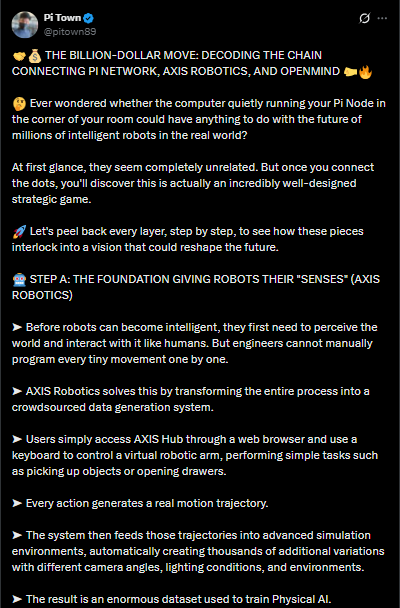
Pi Network has once again drawn the attention of the cryptocurrency and technology communities following an analysis shared by the X (formerly Twitter) account @pitown89. The analysis explores a potential connection between Pi Network, Axis Robotics, and OpenMind, suggesting that these three entities could represent components of a much larger technological vision.
Although no official confirmation of any partnership among the mentioned organizations has been provided, the discussion has generated notable interest by offering a broader perspective on how blockchain technology could extend well beyond digital asset transactions.
Three Technologies, One Vision?
Pi Network is widely recognized as a blockchain project launched in 2019 by Stanford graduates Dr. Nicolas Kokkalis and Dr. Chengdiao Fan, focused on building a decentralized ecosystem powered by a global community of users who can mine Pi coins via a mobile application without the energy-intensive proof-of-work mechanisms used by networks like Bitcoin. Axis Robotics is associated with advanced robotics technology, while OpenMind is described as an artificial intelligence platform designed to enhance the intelligence of next-generation robots. According to the analysis, these technologies may not be as unrelated as they initially appear.
The first component examined is Axis Robotics, which is described as developing intelligent robots capable of interacting with their surroundings in increasingly sophisticated ways. Modern robots are no longer limited to executing pre-programmed commands; they must recognize objects, interpret environmental conditions, analyze real-time data, and make decisions based on the information they receive. To accomplish this, robots rely on a wide array of sensors that function much like human senses, enabling machines to perceive movement, detect obstacles, measure distances, and gather information from their environment.
However, data collection is only the beginning. The information gathered by sensors must be processed by an advanced intelligence capable of learning, adapting, and improving over time. This is where OpenMind enters the analysis. OpenMind is portrayed as a potential AI brain for intelligent robotics, allowing machines not only to execute commands but also to understand context, learn from experience, and continuously refine their decision-making capabilities. This concept aligns with current global technology trends, where artificial intelligence is increasingly being integrated into physical systems such as industrial robots, autonomous vehicles, logistics automation, and service robots. The robotics-AI convergence has accelerated significantly, with companies like Boston Dynamics, NVIDIA, and Tesla investing heavily in AI-driven physical platforms.
Where Pi Network Fits
The discussion then raises a key question: where does Pi Network fit into this broader technological ecosystem? According to the analysis shared by @pitown89, Pi Network could eventually serve as a decentralized digital infrastructure supporting future AI-powered systems.
Today, Pi Network is primarily known for its blockchain ecosystem, mobile mining application, and Pi Node software, which enables community members to help secure and validate the network. Pi Nodes play a critical role in maintaining decentralization by participating in blockchain validation processes. As more users operate nodes, the network becomes more secure and resilient. The project currently operates in an enclosed mainnet phase, meaning Pi coins cannot yet be freely transferred to external exchanges or integrated with outside blockchain applications. A transition to an open mainnet has been discussed by the Pi Core Team but has not yet been completed, a milestone many observers consider critical for any future integration with external technology platforms.
The analysis speculates that distributed computing resources such as Pi Nodes could potentially become valuable if future AI applications require decentralized computing infrastructure. Artificial intelligence currently demands enormous computing power, and technology companies worldwide continue investing billions of dollars in data centers equipped with high-performance processors capable of training increasingly sophisticated AI models. At the same time, decentralized computing is gaining attention as an alternative approach that could distribute workloads across multiple independent participants rather than relying solely on centralized infrastructure. Projects such as Render Network for distributed GPU rendering, Akash Network for decentralized cloud computing, and Golem for peer-to-peer computing resources have already demonstrated that blockchain-based distributed computing models are technically feasible, though they remain at a relatively early stage of commercial adoption.
If blockchain networks eventually evolve to provide secure and scalable distributed computing, they could become an important component in supporting AI applications and intelligent robotic systems.
No Official Collaboration Confirmed
It is important to emphasize that Pi Network has not announced any official collaboration with either Axis Robotics or OpenMind. Likewise, there has been no confirmation that Pi Nodes will be used to power AI infrastructure or robotics platforms. The discussion remains speculative and should be viewed as an independent analysis rather than an official roadmap.
Nevertheless, the concept reflects a broader trend currently shaping the technology industry. The boundaries separating blockchain, artificial intelligence, cloud computing, robotics, and the Internet of Things continue to blur. Many technology companies are actively exploring ways to integrate these innovations into unified digital ecosystems.
Blockchain itself is no longer viewed solely as the foundation for cryptocurrency transactions. It is increasingly being explored as infrastructure for digital identity, secure data management, decentralized applications, and Web3 services. Within the Web3 ecosystem, blockchain enables users to maintain greater control over digital assets and personal data while reducing dependence on centralized platforms.
When combined with artificial intelligence, blockchain could unlock entirely new possibilities. Future robots, for example, might possess blockchain-based digital identities, complete automated financial transactions using digital assets, securely exchange information with one another, or independently purchase services without human intervention. Although these concepts remain under active development across the technology sector, many researchers and companies believe that AI and blockchain integration will play a significant role in the next phase of digital innovation.
A Project Viewed Beyond Cryptocurrency
For the Pi Network community, discussions like this demonstrate that the project is increasingly being evaluated from perspectives beyond cryptocurrency alone. Over the past several years, Pi Network has continued expanding its ecosystem by developing blockchain infrastructure, community-driven applications, and decentralized utilities designed to support real-world adoption. The network reports tens of millions of engaged users globally, one of the largest community bases among blockchain projects that have not yet reached full open-mainnet status. As a result, any discussion about potential future applications naturally attracts considerable attention from both community members and technology observers.
At the same time, investors and users should distinguish between community analysis and officially verified information. As of now, no official statement confirms any strategic relationship among Pi Network, Axis Robotics, and OpenMind.
Even so, the analysis published by @pitown89 offers a perspective on how blockchain, artificial intelligence, and robotics could eventually converge into a single interconnected ecosystem. If these technological trends continue to evolve, blockchain may become much more than a platform for cryptocurrency transactions. Instead, it could serve as the digital foundation for autonomous AI systems, machine-to-machine payments, decentralized identity, and distributed computing infrastructure that powers the next generation of intelligent technologies.
Whether Pi Network ultimately becomes part of that future remains uncertain. However, discussions surrounding the project are expanding well beyond PiCoin's market value or exchange listings, shifting toward its potential role within the broader evolution of Web3 and emerging technologies.

