Pi Network's Node Infrastructure Sparks Vision for AI Computing and a Machine-to-Machine Economy
Key Takeaways
- •Pi Network's Node network comprises over 420,000 computers operated by Pioneers that could potentially be coordinated for distributed computing tasks if operators opt in.
- •Pi Network launched SoloHost in 2026 as an early beta framework enabling developers to build self-hosted applications for local AI workloads, with distributed computing capabilities planned for future development.
- •A distributed workforce of one million people completed 526 million AI-related tasks through Pi Network's data labeling and evaluation initiatives as of April 2026.
- •The concept of Pi Coin serving as a payment mechanism between AI systems and robots remains a community vision rather than an officially confirmed Pi Network product or feature.
- •Significant challenges to building a Pi-powered AI economy include hardware variability across Nodes, connectivity requirements, security risks, and the necessity of an open mainnet launch for broader external integrations.
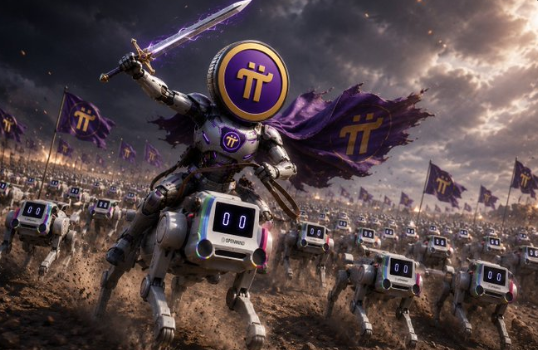
Pi Network is drawing renewed attention across the cryptocurrency community following a proposal that would link its Node network to the development of artificial intelligence and a future robot economy.
The concept was shared by X account @WeidaiBtc, which envisioned hundreds of thousands of Pi Nodes being repurposed into a distributed AI computing network. Under this vision, Pi Coin would move beyond its current role as a digital asset and peer-to-peer payment instrument, potentially becoming a medium of exchange between AI systems, robots, and other machine-based services.
While the idea may sound like a distant prospect, recent announcements from Pi Network indicate that some of the technological foundations for distributed computing and AI are already being laid.
In 2026, Pi Network introduced SoloHost, a framework that enables developers to build self-hosted applications and leverage users' computers for local AI workloads, with distributed computing capabilities planned as development progresses. Pi Network has also disclosed that its Node network comprises more than 420,000 computers operated by Pioneers.
These developments make the prospect of Pi Network participating in an AI- and robot-driven economy worth examining, though it is critical to distinguish between what Pi Network has actually built and the much broader vision that remains speculative. The concept also places Pi Network in conversation with a broader blockchain subsector known as Decentralized Physical Infrastructure Networks, or DePIN, where projects such as Render Network for GPU rendering, Akash Network for cloud computing, and Filecoin for storage have already established live marketplaces for distributed hardware resources.
From Blockchain Nodes to Computing Infrastructure
Since the project's early days, Pi Nodes have functioned primarily to support the Pi blockchain. However, the computing resources of the machines running these Nodes could potentially serve purposes beyond blockchain consensus and transaction validation.
Pi Network has stated that the Pi blockchain does not consume all of the computing capacity available across its extensive Node network. This surplus creates the possibility of allocating unused resources to other tasks.
In a case study involving OpenMind, Pi Network noted that its global Node network is being explored for decentralized AI training and computing workloads. Third parties requiring computing capacity for AI model training could potentially tap into available Node resources, with participating operators receiving cryptocurrency compensation.
If deployed at scale, Nodes could become part of a distributed computing layer supplying resources for a variety of AI applications. This is where @WeidaiBtc's vision intersects with Pi Network's current development trajectory.
More Than 420,000 Computers as a Potential Ecosystem Asset
According to Pi Network's Pi2Day 2026 announcement, the network includes more than 420,000 computers operated by Pioneers that could be coordinated for specific tasks, provided their operators opt in.
It is important to note that these computers are not currently functioning as AI data centers. Pi Network has clarified that distributed computing for various use cases remains under active development. SoloHost is still in an early beta phase, and applications that draw on Node resources for distributed computing are still being built.
Nevertheless, if the infrastructure matures, a large fleet of geographically distributed machines could become a compelling source of computing power. Rather than concentrating all AI workloads in a handful of centralized data centers, certain tasks could be distributed across participating devices, creating new opportunities for Node operators. The scale of such a network, if realized, would position Pi Network alongside established DePIN computing projects — though it would need to overcome the significant head start of networks already processing live workloads.
AI Is Driving Demand for Computing Power
The rapid expansion of artificial intelligence has generated enormous demand for computing resources. Modern AI models require substantial computational power for training, inference, data processing, and related operations. That demand has been amplified by well-documented global shortages of high-performance GPUs, the specialized chips most critical for training large language models and other advanced AI systems.
Pi Network views this environment as a potential opportunity to harness its distributed computing resources. In materials related to the OpenMind initiative, Pi Network stated that some of the computing capacity within its Node network is not fully consumed by blockchain operations and could serve as a foundation for new utilities such as decentralized cloud computing.
If this concept matures, Pi Network could assume two complementary functions: the blockchain providing the transaction and record-keeping layer, and the Node network supplying a portion of the computing capacity needed for AI and other intensive workloads. In a more advanced scenario, Pi Coin could function as a payment mechanism for services that draw on those computing resources.
From AI to Robots: The Machine-to-Machine Economy
The idea of a robot economy becomes particularly relevant when considering the requirements of AI systems and robots operating within a digital economy. Robots need the ability to receive instructions, access data, communicate with other systems, obtain computing resources, and conduct transactions.
If a robot can receive a task from an AI system or a human, automated payment mechanisms become essential. Consider a scenario in which a person requests a service through an application, an AI system determines which robot is best suited for the task, and the system automatically processes payment upon completion.
In such an economy, transactions would not always occur between humans. They could take place between humans and AI, between AI and robots, or even between robots and other digital services — a context in which cryptocurrencies could assume a new functional role. The concept of machine-to-machine micropayments has been explored in the blockchain space for years, most notably by IOTA, whose architecture was designed specifically for Internet of Things transactions between connected devices. Pi Network's vision would bring a different approach — a user-operated Node network paired with a token already held by a large community.
Pi Coin as a Payment Tool for Machines
@WeidaiBtc's concept of using Pi Coin as a payment mechanism between AI systems and robots remains a community vision rather than an officially confirmed Pi Network product or feature. Conceptually, however, it aligns with Pi Network's broader push to build utility around the token.
Pi Network has been developing a range of features intended to connect Pi with applications and external services. During Pi2Day 2026, the network introduced Pi Sign-in, which allows users to access supported third-party websites and applications using their Pi accounts. The network also launched SoloHost for local AI applications and the development of distributed computing capabilities.
These initiatives suggest Pi Network is building toward more than a cryptocurrency designed solely for peer-to-peer transfers. If devices, AI agents, and robots can eventually interact with applications built within the Pi ecosystem, demand for programmable digital payment mechanisms could increase. That stage, however, has not yet been reached.
Pi Network's Existing AI Initiatives
Pi Network is not new to the AI space. In 2025, the network introduced an AI application platform as part of an initiative to combine AI and blockchain technology while supporting application development within its ecosystem.
In 2026, that direction became more concrete. Pi Network launched SoloHost for local AI applications and distributed computing. One application introduced through SoloHost is Hermes, a local AI agent that runs and stores its data on the user's own computer.
Pi Network has also reported AI initiatives involving distributed human labor for data labeling, evaluation, and AI system improvement. In an April 2026 report, Pi Network stated that 526 million tasks had been completed by a distributed workforce of one million people, indicating that the ecosystem's AI vision extends beyond raw computing power to encompass people, applications, data, and digital infrastructure.
Key Challenges
While the concept is compelling, building a Pi-powered robot economy would face substantial hurdles:
Computing capacity: Not every Node has identical hardware. Some machines may only handle lightweight workloads, while certain AI training tasks demand powerful GPUs or specialized equipment.
Connectivity: Distributed computing requires stable networks, acceptable latency, and efficient coordination mechanisms.
Security: When users' computers are used for third-party workloads, the network must ensure that applications cannot compromise devices or user data.
Incentives: Computer owners need an economic rationale to contribute resources. If users can earn compensation for providing computing capacity, the network gains a mechanism that could drive participation.
Mainnet maturity: Pi Network's open mainnet launch, a milestone many Pioneers have anticipated, remains a prerequisite for broader external integrations and token utility beyond the enclosed ecosystem. Without open-mainnet functionality, large-scale machine-to-machine payment flows would face practical constraints.
Could Pi Become the Currency of the Robot Economy?
At present, there is no basis to claim that Pi Coin already serves as an official currency for robots or AI systems. However, Pi Network's current development direction makes such a scenario an interesting long-term possibility.
Pi Network is exploring the use of Nodes for decentralized computing and AI. SoloHost is establishing an environment for local AI applications and distributed computing development. Simultaneously, Pi continues to be developed as a utility asset within its application ecosystem.
If these three elements converge, a new economic model could theoretically emerge: Nodes supply computing power, AI provides intelligence and decision-making, robots contribute physical labor, and Pi Coin serves as a payment mechanism connecting these components. In such a model, the usefulness of the cryptocurrency would depend not solely on trading activity but also on how frequently it is used to settle payments for digital and physical services.
From Vision to Reality
Transforming hundreds of thousands of Nodes into an AI computing network and connecting Pi with robots would be a massive undertaking. Still, the first part of that vision is beginning to materialize through Pi Network's official development efforts.
Pi Network has stated that its Node network could potentially support distributed computing, while SoloHost has been introduced as a foundation for local AI applications and distributed computing use cases that remain under development.
The central question is no longer simply whether decentralized computing can be discussed, but how far Pi Network can advance these experiments and convert them into production-grade infrastructure deployed at scale. For now, projects like Render Network and Akash already operate functioning decentralized computing marketplaces, giving them a measurable lead — but Pi Network's distinguishing factor is the sheer size of its existing participant base and the number of devices already running Node software.
Whether Pi Network ultimately becomes part of a future robot economy will depend on whether the network can transform its current AI and distributed computing initiatives into real-world utility that is secure, scalable, economically sustainable, and widely adopted.
Source: Hokanews

