Pi Coin Reclaims $1 Billion Market Cap as Protocol 27 Mainnet Upgrade Approaches
Key Takeaways
- •Pi Coin briefly traded above $0.11 and regained a market capitalization of more than $1 billion during a broader crypto-market recovery.
- •The token has risen about 36% from its July low, but it remains down nearly 75% year-to-date and still trades below recent peak volume levels.
- •Price action around $0.11 included a sharp surge, a drop to about $0.0830 and a quick recovery, suggesting liquidations and aggressive selling.
- •Protocol 27 is advancing on Testnet and is scheduled for Mainnet deployment on Sept. 15, 2026, as Pi Network describes it as the final planned upgrade in the current sequence.
- •Pi App Studio will change its pricing model on Aug. 24 to favor applications that attract real users.
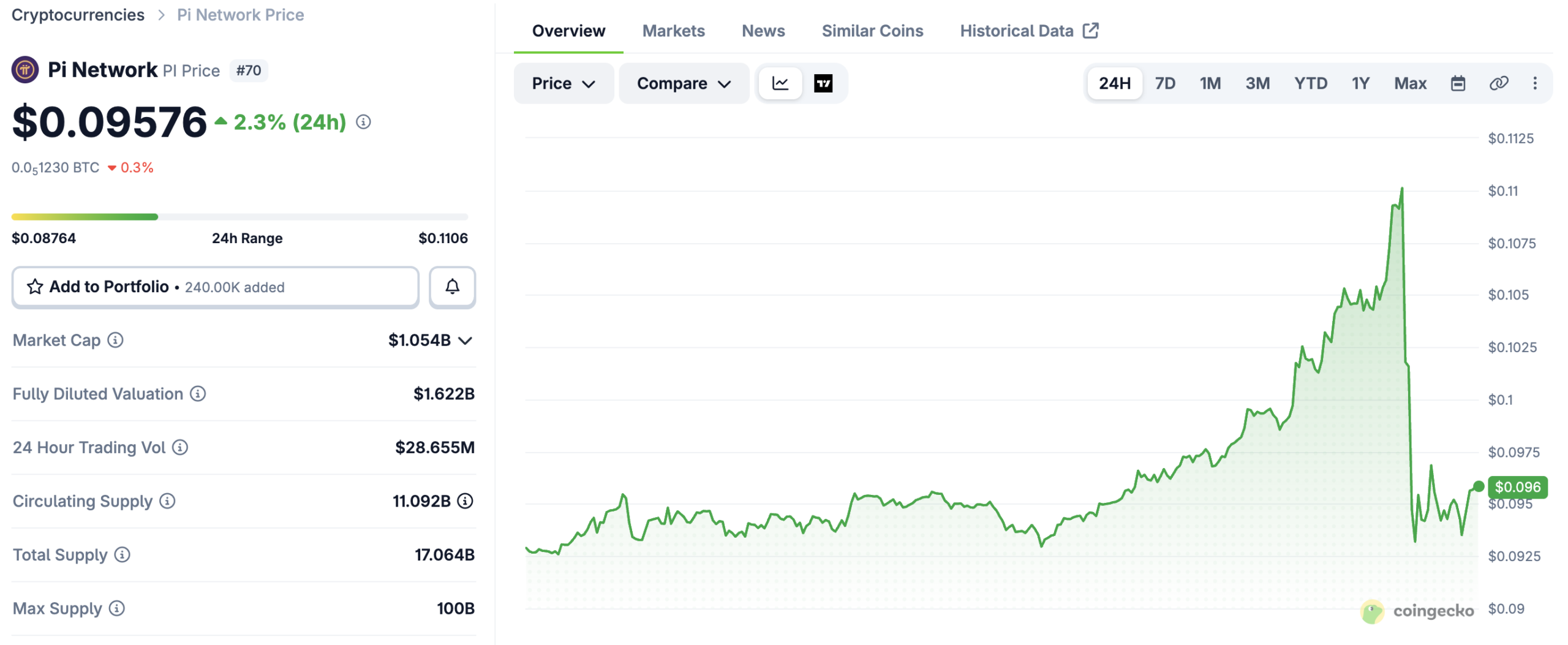
Pi Coin (PI) strengthened alongside the broader cryptocurrency-market recovery, reclaiming a market capitalization above $1 billion and briefly trading above $0.10 after a sharp rebound from its July low. Attention is now turning to Pi Network's Protocol 27 upgrade and an Aug. 24 change to Pi App Studio pricing — two developments that could strengthen the ecosystem narrative, even as the token continues to face weak liquidity and future supply pressure.
Price Action Centers on $0.11
Pi Coin's price rose to $0.11 earlier today as the wider crypto market advanced, pushing its market capitalization back above $1 billion. The gains came amid renewed volatility that triggered significant liquidations for leveraged traders.
The token has climbed roughly 36% from its July low of $0.07070 to $0.09634 as of Aug. 21. In recent weeks, PI has also appeared on CoinMarketCap's Community Bullish Sentiment and Most Visited lists.
Bullish price action, combined with positive sentiment across the broader crypto market, carried Pi Coin to the $0.11 level earlier today. The move was followed by a sharp shakeout, however: PI surged to about $0.1109, plunged to $0.0830 and then quickly recovered. That pattern points to heavy long liquidations, stop-loss triggers and aggressive selling. Swings of this kind are characteristic of tokens with shallow order books, where relatively modest order flow can amplify price moves and cascade liquidations through leveraged positions.
After the pump and rejection at $0.11, traders remain uncertain about the next direction. The amount of Taker Sell Volume during the 15-minute candle is being watched as an indicator of whether the current momentum can persist.
Despite the reclaimed $1 billion market capitalization, PI's gains remain modest compared with other altcoins. The token is still down nearly 75% year-to-date, trading volume remains below its peak levels, and PI continues to lack listings on major exchanges, which limits broader market access and liquidity. Pi Network, launched in 2019, distributes tokens through a smartphone app rather than energy-intensive proof-of-work mining and reports a user base it puts in the tens of millions — a reach that contrasts with the token's absence from the largest venues such as Binance and Coinbase. According to the project's published tokenomics, total supply is capped at 100 billion PI, with the majority allocated to community rewards released over time as users migrate balances to Mainnet — the structure behind the future supply pressure the market continues to weigh.
Protocol 27 Nears Mainnet Deployment
Pi Network has continued advancing its Mainnet infrastructure and ecosystem utility in August 2026, with current work focused on protocol upgrades, node improvements and application-development tools. The project remains in its Open Mainnet phase, which began after the network's firewall was removed in February 2025, opening the network to external wallets and outside connectivity.
The Protocol 26 Mainnet upgrade has been completed, with node operators having faced an Aug. 11 deadline to upgrade or risk disconnection. Protocol 26 — the ninth protocol update in recent months — improved contract safety, state management, interoperability and cryptography, and serves as a precursor to the final planned upgrade.
Protocol 27 is now advancing on Testnet following its announcement on Aug. 21, 2026. The upgrade introduces more flexible and secure smart-contract authentication capabilities, enabling advanced transaction authorization by both accounts and applications. The Mainnet upgrade is scheduled for Sept. 15, 2026. Pi Network's Core Team describes Protocol 27 as the final planned upgrade in the current sequence as the network shifts toward a stable foundation for applications.
Separately, Pi App Studio — the network's tool for building applications that run inside the Pi ecosystem — will change its pricing model on Aug. 24 to favor applications that attract real users.
Technical Setup Hinges on $0.11
The short-term technical picture now centers on the $0.11 level, where sellers have shown themselves to be active following the latest sharp rejection. According to the technical setup, a sustained move above $0.11 would strengthen the bullish structure and could shift attention toward higher resistance, while a failure to hold the current recovery would instead expose PI to renewed weakness toward the $0.08 region.
Protocol 27 and the App Studio pricing update provide identifiable ecosystem catalysts, though neither development guarantees that Pi Coin's price will continue higher. Traders are monitoring two separate signals: whether PI maintains its price recovery, and whether Protocol 27 and the App Studio changes generate measurable activity after deployment.
This article is for informational purposes only and does not constitute financial advice. Cryptocurrency markets can experience sharp price movements.

