Philippines Posts 2.3% Q2 2026 Growth, Lowest Among Major East Asian Economies; Author Calls for Energy Expansion and Industrialization
Key Takeaways
- •The Philippines posted 2.3% GDP growth in Q2 2026, its weakest performance since 2009 outside of the pandemic period and the lowest among major East Asian economies tracked.
- •Reaching the government's lower-bound 2026 growth target of 3.5% would require an average expansion of 4.5% across the third and fourth quarters.
- •Oplas links the Philippines' modest growth to its services-dominated economic structure, noting that 2025 total exports of $84 billion trail far behind Vietnam's $473 billion and Malaysia's $376 billion.
- •Vietnam generates 329 TWh of electricity compared with the Philippines' 129 TWh, giving Vietnamese manufacturers a structural cost and reliability advantage that the Philippines has yet to close.
- •ERC Chairman Nino Juan endorsed reducing consumer system-loss burdens but recommended targeting controllable non-technical losses first rather than imposing an outright prohibition on the charge.
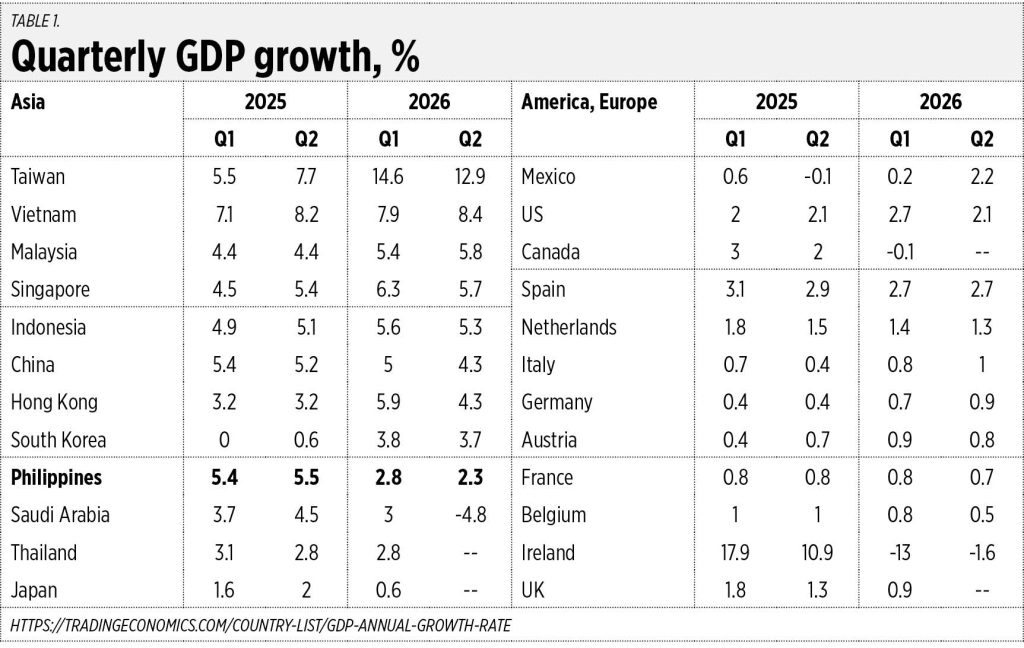
The Philippine economy grew by 2.3% in the second quarter (Q2) of 2026, the lowest figure among major East Asian economies reported so far. The country has routinely ranked among ASEAN's faster-growing economies in recent years, making the Q2 print a sharp departure from trend. Excluding the deep, self-inflicted contraction during the 2020–2021 lockdowns, it represents the country's slowest growth rate since 2009, when the global financial crisis originated in the United States. With Philippine population growth still running at roughly 1.5% annually, a 2.3% GDP expansion translates into very modest per-capita gains — a constraint on living-standard improvements that manufacturing-driven neighbors face less acutely.
The Philippines had performed steadily through the first two quarters of 2025 before a series of setbacks — including the flood control scandal, declining infrastructure spending, and weakened business confidence — contributed to a deceleration in growth.
Some neighboring economies posted stronger 2026 figures partly due to a base effect, as their 2025 growth had been subdued. Hong Kong and South Korea are cited as examples. Meanwhile, several European nations continue to experience degrowth trends, with Italy, Germany, Austria, France, Belgium, Ireland, and likely the United Kingdom unable to exceed 1% growth.
The Philippine economic team has set a 2026 growth target of 3.5% to 4.5%. Achieving even the lower end of 3.5% would require average growth of 4.5% in Q3 and Q4.
Bienvenido S. Oplas, Jr., author of the opinion piece and president of Bienvenido S. Oplas, Jr. Research Consultancy Services and Minimal Government Thinkers, argues that a recovery in the second half of 2026 is achievable for three reasons.
First, a favorable base effect: Philippine growth declined from 5.5% in Q1–Q2 2025 to 3.5% in Q3–Q4 2025, and further to 2.5% in Q1–Q2 2026. The comparatively low base in Q3–Q4 of last year could help push the growth rate higher.
Second, global prices for energy, fertilizers, and petrochemicals are stabilizing. As the US-Iran conflict recedes, prices have declined relative to Q1–Q2 levels. Dubai crude, for instance, fell from $127 per barrel in March to $77 per barrel in July.
Third, overall inflation is decelerating, from 7.2% in April to 6.2% in July. Oplas expects domestic electricity, transport, and food inflation to taper, which would improve consumer confidence and support household consumption expenditures, which account for approximately 73% of GDP.
Oplas pushes back against what he describes as a stagflation narrative advanced by some critics, noting that 2.3% still constitutes growth rather than stagnation, and that 6% inflation remains well below double-digit levels.
A significant factor behind the Philippines' modest growth, Oplas argues, is its limited industrialization and small manufacturing base. The Philippine economy is predominantly services-driven — anchored by business-process outsourcing and overseas-worker remittances — a structural difference from the export-manufacturing models of Vietnam, Thailand, and Malaysia. While the country's merchandise exports reached an all-time high of $8.8 billion in June 2026, the figure pales in comparison to monthly exports from neighboring economies over the same period: Thailand at $34.7 billion, Vietnam at $50.8 billion, and Singapore at $63.8 billion.
In 2025, total Philippine exports reached $84 billion, compared with Malaysia's $376 billion and Vietnam's $473 billion.
Oplas attributes much of this gap to disparities in power generation capacity. Vietnam generates 329 terawatt-hours (TWh) of electricity, compared with the Philippines' 129 TWh. Large manufacturing plants, electronics exporters, and major hotels and resorts in Vietnam face fewer concerns about blackouts and benefit from lower electricity prices — advantages that the Philippines has yet to match. Philippine retail electricity rates have long ranked among the highest in Southeast Asia, a structural cost disadvantage for energy-intensive industries contemplating investment in the country.
Between 2005 and 2025, Oplas calculates that Vietnam achieved the greatest expansion in both exports (14.8 times) and power generation (6.3 times), followed by China (five times for exports, 4.2 times for power generation) and the United Arab Emirates (six times for exports, three times for power).
The central challenge for Philippine energy policy, Oplas contends, is expanding electricity generation to levels comparable with at least Thailand and Indonesia. He argues that policy debates over abolishing the system loss charge of distribution utilities (DUs), eliminating the National Grid Corp. of the Philippines' line rental, or phasing out coal to address climate concerns are distractions from the core issue.
Oplas advocates an energy-agnostic approach — remaining indifferent to whether electricity comes from fossil fuels or renewables. He points to Vietnam's 2025 power mix, where coal accounted for 157 TWh (48%) and hydro for 102 TWh (31%) of the country's 329 TWh total generation. China's 10,575 TWh total generation was sourced 54% from coal and 13% from hydro. The United States, with 4,772 TWh in total generation — approximately 45% of China's output — derived 41% from gas, 17% from nuclear, and 17% from coal.
The ongoing debate over whether to abolish DUs' system loss (SL) charges is, in Oplas's view, unnecessary. System loss charges — which appear as a separate line item on Philippine electricity bills — recover the cost of power lost as heat during transmission and distribution, along with losses from theft. Oplas notes that approximately 99% of system loss stems from physics, with only about 1% attributable to theft and cheating. Undermining the financial viability of DUs, he warns, could impair their ability to contract additional power supply and potentially lead to nationwide blackouts.
Energy Regulatory Commission (ERC) Chairman Nino Juan, speaking during a recent House Committee on Energy hearing, offered a measured position: "ERC supports the goal of reducing consumer SL burden but recommends targeting the controllable non-technical loss component first, with technical loss addressed through cap tightening, not outright prohibition… Consumer protection and DU viability are not mutually exclusive."
Bienvenido S. Oplas, Jr. is the president of Bienvenido S. Oplas, Jr. Research Consultancy Services and Minimal Government Thinkers, and an international fellow of the Tholos Foundation.

