Single-Digit Poverty: A Historic Milestone, or a Trick of the Ruler?
Key Takeaways
- •The PSA said poverty incidence declined to 9.7% in 2025, marking the Philippines’ first single-digit poverty reading.
- •Regional data show large gaps, with NCR at 1.1% poverty while some areas, including the Zamboanga Peninsula and BARMM, remain above 23%.
- •The official poverty threshold is described as very low, based on a subsistence level of P13,873 a month for a family of five and about P21 per person per meal.
- •A sensitivity test that raises the threshold by 30% lifts poverty incidence from 10.9% to 22.8% on a family basis.
- •The article says current labor and price trends, including near-three-year-high underemployment and rice-driven inflation around 8.5% for the bottom 30%, point to renewed pressure on poor households.
A data reality-check on the government's poverty numbers
When the Philippine Statistics Authority (PSA) announced that poverty incidence had fallen to 9.7% in 2025 — the first single-digit reading in the country's history — the government understandably claimed victory. But set that headline against the labor market, inflation, and regional data sitting right beside it, and a more uncomfortable question emerges: is poverty actually falling, or is the ruler simply too short to measure what is happening at the bottom of the income ladder?
The trend — at first glance
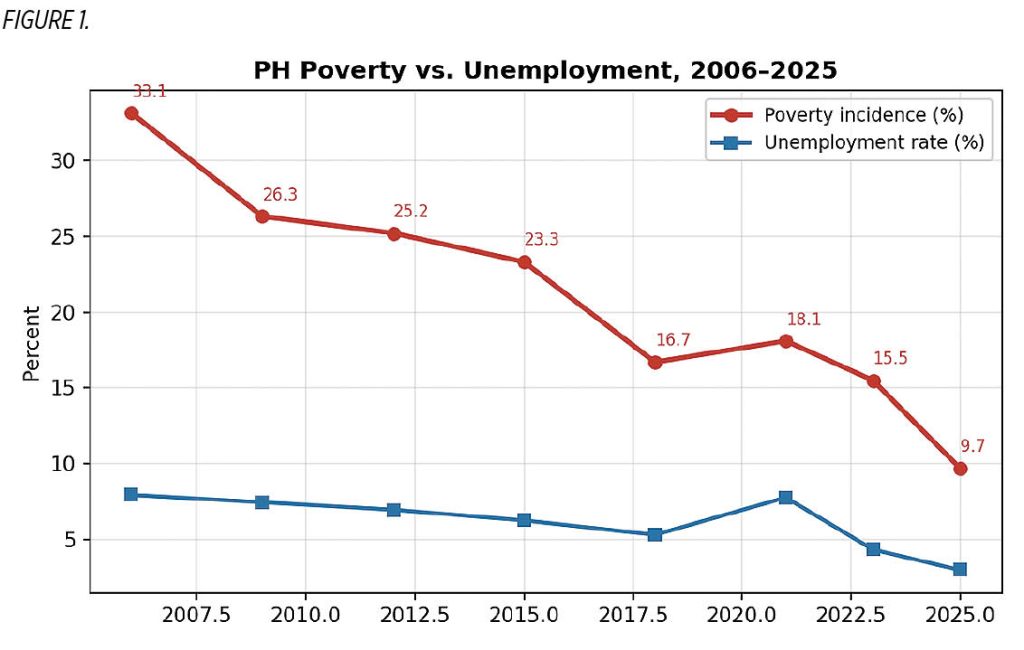
The trend looks unambiguous at first sight (see Figure 1).
The two series move together, which is reassuring: a genuinely tighter labor market plausibly drove genuine poverty reduction. The COVID-19 reversal in 2021 confirms the relationship was real rather than coincidental — unemployment spiked, poverty spiked a year later, and both recovered together afterward. That time lag also matters for reading the current moment: a poverty number can look calm even while the underlying labor market is already weakening.
The map tells a different story
The regional picture diverges sharply from the headline (see Figure 2).
The national average conceals a country running at two speeds. The National Capital Region (NCR) sits at 1.1% poverty, while the Zamboanga Peninsula and BARMM sit above 23%. Ten of the country's regions actually recorded higher poverty in 2021 than in 2018 — meaning the national “decline” story was never universal, even in the best years. The regions carrying the poverty burden today — Mindanao, Bicol, and Eastern Visayas — are the same regions carrying it in 2006. Structural poverty has not dissolved; it has been diluted by faster gains in the already-rich NCR and Calabarzon.
Stunting data makes the disconnect starker. The NCR's poverty rate is near zero, yet its child stunting rate is still 22.2% — nearly identical to the national average. Whatever “poverty” the income threshold is capturing in Metro Manila, it is not capturing the material deprivation still showing up in children's bodies. That is the first sign the measuring stick itself deserves scrutiny.
The threshold: P21 a meal, frozen between surveys
Here is where the “historic decline” claim gets genuinely shaky. The 2023 poverty threshold — the last one officially computed — pegs subsistence at P13,873 a month for a family of five, with the food component working out to roughly P21 per person, per meal. Even the PSA's own National Statistician has publicly conceded the food threshold is “insufficient.” That baseline assumes a person buys only the absolute cheapest possible ingredients and prepares every single meal at home, and it does not account for real-world costs such as eating outside during a workday.
Run a simple sensitivity test — raise the threshold by just 30% — and poverty incidence roughly doubles, from 10.9% to 22.8% on a family basis. That is not a rounding error. It means the entire “single-digit milestone” narrative rests on where exactly the government draws a line that even its own technocrats admit is uncomfortably low.
Worse, that threshold is frozen between Family Income and Expenditure Survey rounds — 2018, 2021, and 2023 — while prices for the poor keep moving. The PSA's own bottom-30% inflation series shows why this matters: it cooled to just 0.3% in 2025, the same year poverty hit its historic low, then spiked to 8.2%–8.5% from April through July this year, driven mainly by an 18% year-on-year jump in rice prices. The 2025 poverty reading, in other words, was measured in an unusually benign price environment for the poor. It tells us little about what is happening to the same households right now.
Self-rated poverty: the gap the official number can't explain
If official statistics say 9.7% of Filipinos are poor, why does SWS — asking Filipinos directly whether they consider themselves poor — consistently find 40% to 61% saying “yes,” depending on the region? Some of that gap is genuinely subjective, reflecting aspiration, relative deprivation, and inflation psychology. But the rank order — Mindanao worst, then the Visayas, then Luzon, then NCR best — matches the official regional data almost perfectly. The geography of hardship is real by both measures; only the scale of the official number looks implausibly optimistic next to how households actually describe their own condition.
The labor market is already flashing a warning the poverty stat hasn't caught up to
The warning signs are visible in the employment data (see Figure 3).
This is the crux of the problem: the 9.7% poverty figure was captured in a year of record-low joblessness and near-zero inflation for the poor. Every one of those conditions has since reversed. Underemployment — arguably the better proxy for the “working poor,” since it captures people who are employed but without enough hours or pay — has just hit a near three-year high. Rice-driven inflation for the bottom 30% is running near 8.5%, the sharpest cost-of-living squeeze on the poor in years. None of this has shown up in an official poverty number yet, simply because the PSA has not run another full survey since 2023/2025. Given how the 2020–2021 experience played out — unemployment shock first, poverty shock following with a roughly one-year lag — there is little reason to expect 2026 will be different.
The verdict
The decline in the official poverty rate from 33% in 2006 to 9.7% in 2025 is a real, methodologically consistent number, and it does track two decades of genuine, if uneven, labor-market improvement. But calling it proof that poverty has been “solved,” or even durably reduced, overreaches what the data supports. The threshold measuring it is administratively convenient rather than realistic; the regional gains are lopsided rather than universal; the subjective and nutritional indicators tell a rawer story than the headline allows; and the leading indicators for the very next survey period — rising underemployment, rising unemployment, and a rice-driven inflation spike hitting the poor hardest — are already pointing the wrong way.
The single-digit milestone is worth noting. It is not yet worth celebrating.
Alexander C. Escucha is a past president of the Philippine Economic Society (2005), a fellow of the Foundation for Economic Freedom (FEF), a former chairman of the UP Visayas Foundation (2014–2026), a former president of the Corporate Planning Society of the Philippines, and a retired SVP of China Banking Corp.

