Philippines Ranks 98th in ND-GAIN Climate Vulnerability and Adaptation Index
Key Takeaways
- •The Philippines scored 47.1 out of 100 on the ND-GAIN Country Index, placing it 98th among 190 nations and signaling high vulnerability with low readiness.
- •The index measures vulnerability across six life-supporting sectors including food, water, health, ecosystem services, human habitat, and infrastructure, alongside economic, governance, and social readiness factors.
- •According to the World Bank, natural disasters cost the Philippines billions of dollars each year, with typhoons responsible for a major share of the damage.
- •Despite having frameworks such as the National Climate Change Action Plan and participation in the Paris Agreement, substantial implementation and financing gaps persist.
- •Multilateral funders increasingly reference ND-GAIN scores to assess investment risk, meaning the Philippines' ranking could affect its capacity to secure international climate finance.
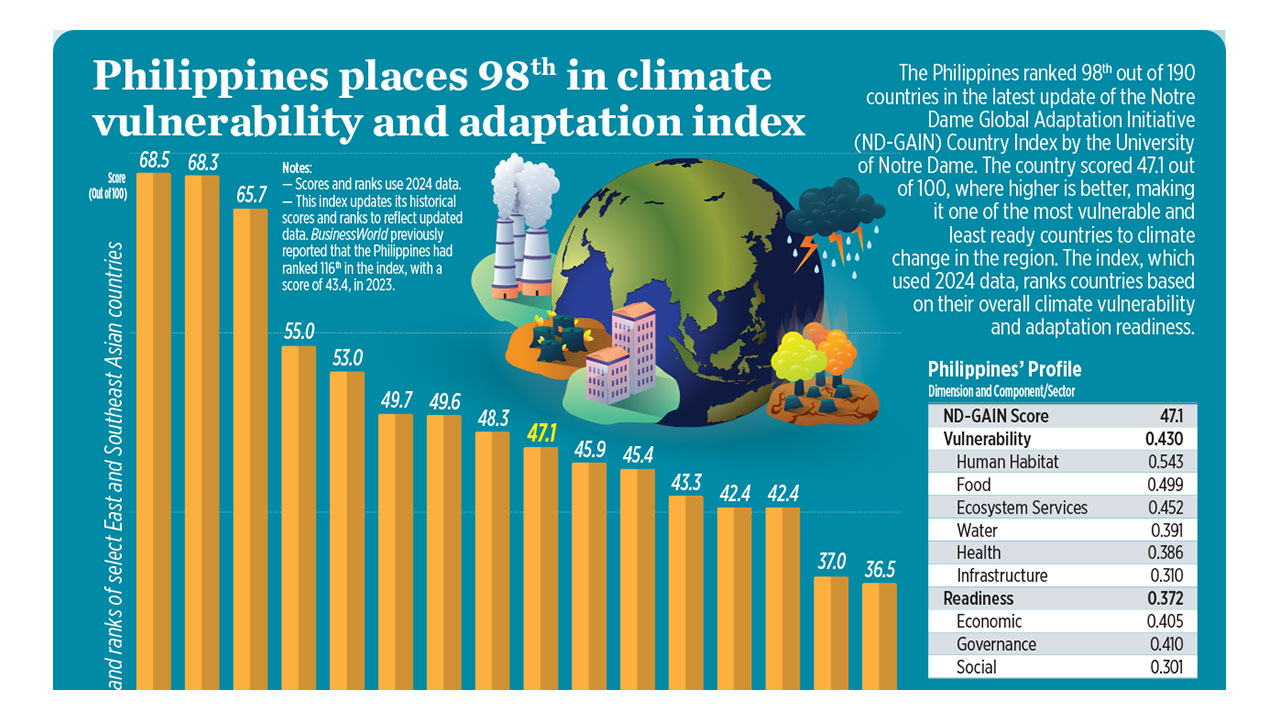
The Philippines ranked 98th out of 190 countries in the latest update of the Notre Dame Global Adaptation Initiative (ND-GAIN) Country Index, published by the University of Notre Dame. The country scored 47.1 out of 100, where a higher score indicates greater resilience, placing it among the most vulnerable and least prepared nations for climate change in the Asia-Pacific region. The score highlights a gap that has direct implications for the country's ability to attract international climate finance, as multilateral funders increasingly use indices like ND-GAIN to assess investment risk and adaptation capacity.
The ND-GAIN Country Index, which utilized 2024 data, assesses countries based on two core dimensions: vulnerability to climate-related disruptions and readiness to leverage investments for adaptation. Vulnerability is measured across six life-supporting sectors — food, water, health, ecosystem services, human habitat, and infrastructure — while readiness evaluates economic, governance, and social factors that influence a country's capacity to implement adaptive measures. The Philippines' readiness score reflects structural barriers in governance and infrastructure that affect how effectively adaptation funding can be deployed.
The Philippines' ranking reflects its persistent exposure to extreme weather events, including tropical cyclones, flooding, and sea-level rise, which regularly affect its more than 7,600 islands. The archipelago sits along the western Pacific typhoon belt and is frequently cited in international climate assessments as one of the countries most at risk from climate-related disasters. According to the World Bank, natural disasters cost the Philippines an estimated billions of dollars annually, with typhoons accounting for a significant share of damages, straining public budgets and slowing long-term development.
According to the index methodology, lower scores signal greater vulnerability coupled with lower readiness, underscoring the challenges the country faces in strengthening infrastructure, disaster response systems, and long-term climate adaptation strategies. The ND-GAIN index is widely used by governments, researchers, and international organizations as a reference tool for understanding relative climate risk and adaptation capacity across nations. The Philippines has responded with frameworks such as the National Climate Change Action Plan and participation in the Paris Agreement, but implementation and financing gaps remain significant.
The full index and country profiles are available on the ND-GAIN website.

