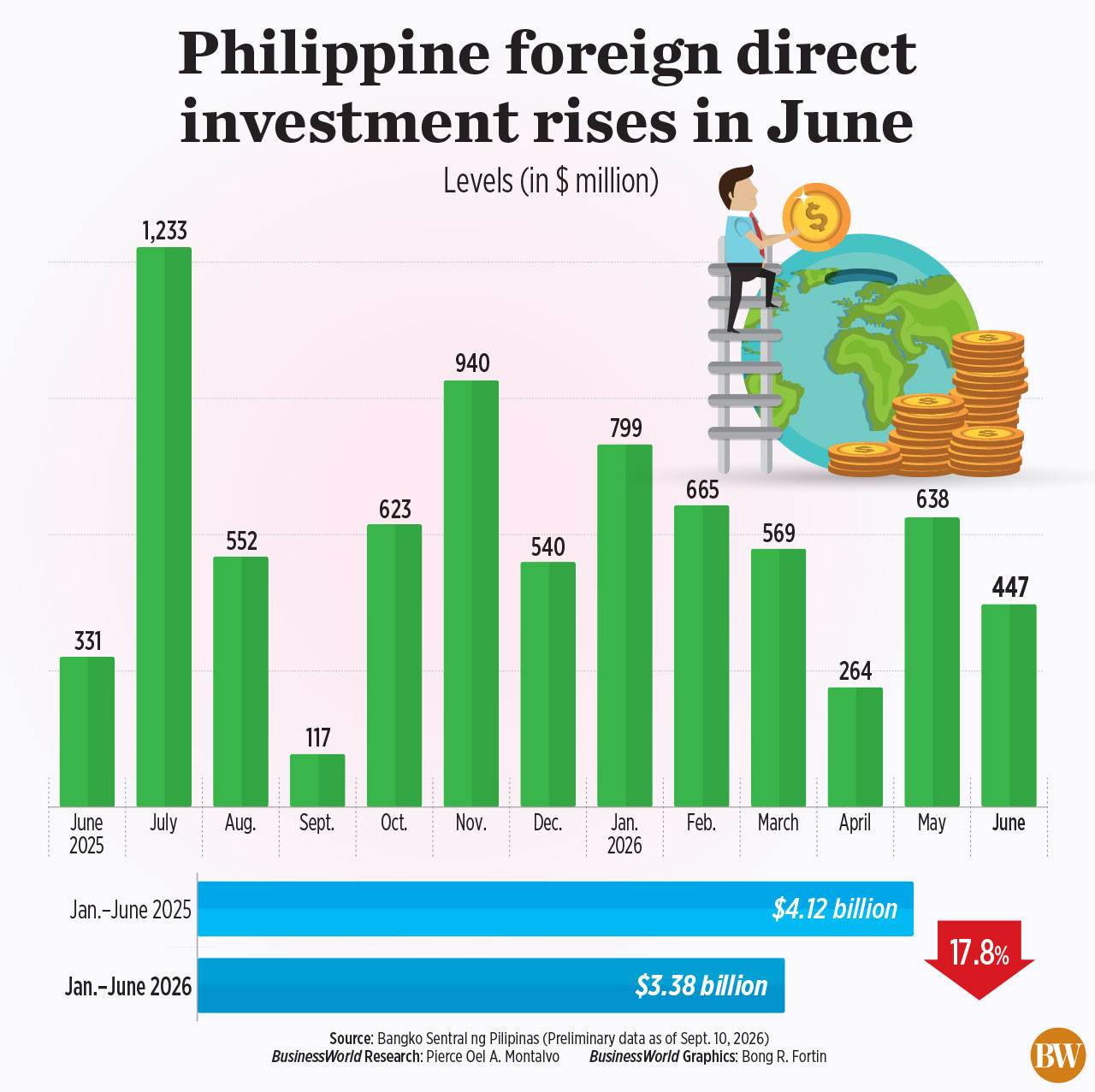
Philippines FDI net inflows rise 35.1% in June, but fall 17.8% in first half
Key Takeaways
- •June FDI inflows rose from $331 million a year earlier but fell from $638 million in May.
- •Investments in equity and investment fund shares more than doubled year on year to $78 million in June.
- •First-half reinvested earnings declined 19.4% to $829 million, while debt investments dropped 25.8% to $2.063 billion.
- •The peso averaged P61.2513 per dollar in June, about 8.7% weaker than a year earlier.
- •The BSP forecasts full-year 2026 FDI net inflows of $7 billion, down from an estimated $7.8 billion in 2025.
By Katherine K. Chan, Reporter
Foreign direct investment (FDI) net inflows to the Philippines rose by 35.1% year on year to $447 million in June, although the monthly total fell to a two-month low, preliminary central bank data showed.
The Bangko Sentral ng Pilipinas (BSP) said the June figure increased from the revised $331 million recorded in the same month last year. It marked the second consecutive month of annual growth in FDI net inflows.
On a month-on-month basis, however, FDI net inflows declined by 29.9% from the revised $638 million recorded in May. June’s inflows were the lowest in two months, since the $264 million reported in April.
FDI refers to cross-border investment in which a nonresident investor holds at least 10% equity in a resident enterprise. Such investment may take the form of equity capital, reinvested earnings or intercompany borrowings.
BSP data showed that investments in equity and investment fund shares more than doubled, rising by 129.4% to $78 million in June from $34 million a year earlier.
However, nonresidents’ net investments in equity capital, excluding reinvested earnings, returned to an outflow after a year. The outflow reached $52 million, although this was 8.9% lower than the $57 million recorded in June 2025.
Equity capital placements fell by 13.8% year on year to $112 million in June from $130 million, while withdrawals declined by 12.3% to $164 million from $187 million.
Reinvestment of earnings, meanwhile, climbed by 43.1% to $130 million in June from $91 million a year earlier. Net foreign investments in debt instruments also increased by 24.2% annually to $369 million from $297 million.
Union Bank of the Philippines Chief Economist Ruben Carlo O. Asuncion said via Viber that the June FDI figures reflected the “inherent volatility of monthly investment flows, particularly in intercompany borrowing and reinvestment activity.”
Leonardo A. Lanzona, an economics professor at the Ateneo de Manila University, said the month-on-month decline in FDI net inflows was likely linked to higher US Federal Reserve interest rates and a stronger dollar, which weakened the peso.
“Elevated US rates and peso depreciation likely reduced the incentive to route working capital through Philippine affiliates as debt, while falling reinvested earnings points to either compressed affiliate profitability (consistent with the 2.3% Q2 gross domestic product print, the weakest non-pandemic reading since 2009) or a shift toward repatriating profits rather than reinvesting — itself a soft confidence signal, compounded by the governance overhang from the flood control scandal,” he said in a Viber message.
Uncertainty surrounding the war in the Middle East continued to drive safe-haven demand for the US dollar in June, pushing the peso to the P61-per-dollar level from its prewar range of P58 to P59 per dollar.
The peso averaged P61.2513 against the dollar in June, or P4.8927, equivalent to about 8.7%, weaker than its average of P56.3586 in the same month in 2025, according to BSP data.
First-half decline
In the first half of 2026, FDI net inflows declined by 17.8% to $3.382 billion from the revised $4.116 billion recorded a year earlier.
“Foreign direct investment net inflows fell in the first half of 2026 compared to the same period last year,” the central bank said in a statement.
“The decline was driven by the decreases in both foreign net investments in debt instruments, which indicated lower intercompany borrowings, and reinvestment of earnings,” it added.
Preliminary BSP data showed that investments in equity and investment fund shares reached $1.319 billion during the six-month period, down 1.2% from $1.335 billion a year earlier.
Net foreign investments in equity capital, excluding reinvested earnings, grew by 59.4% to $489 million in the first semester from $307 million in the same period a year earlier.
“The 59% jump in equity capital is the more meaningful read on genuine new investment appetite, since it reflects fresh capital rather than balance-sheet shuffling,” Mr. Lanzona said. “But at $489 million against $3.4 billion total, it’s coming off a low base — real, but too small to offset the aggregate decline.”
Equity capital placements came mostly from Japan, the United States and Singapore. These placements declined by 2.9% annually to $725 million from $747 million.
“These funds were channeled largely into the manufacturing, financial and insurance, and real estate industries,” the BSP said.
Equity capital withdrawals plunged by 46.24% to $236 million in June from $439 million a year earlier.
Reinvestment of earnings totaled $829 million in the first half of 2026, down 19.4% from $1.028 billion a year earlier. Net investments in debt instruments also declined by 25.8% to $2.063 billion during the period from $2.781 billion a year earlier, BSP data showed.
Mr. Asuncion said global economic conditions, trade and geopolitical developments, and investor confidence would likely remain the main factors driving FDI to the Philippines.
“Looking ahead, FDI prospects will likely depend on global economic conditions, trade and geopolitical developments, and investor confidence, although the continued rise in equity investments suggests that foreign investors remain interested in long-term opportunities in the Philippines,” he said.
Jonathan L. Ravelas, a senior adviser at Reyes Tacandong & Co., said FDI inflows would likely remain subdued in the near term, while reforms would be important in attracting foreign investment over the longer term.
“Near-term FDI flows may remain soft, but the longer-term story will depend on how effectively the country converts reforms into actual investment projects,” he said in a Viber message.
Mr. Lanzona said foreign investors might approach the country’s investment climate cautiously in the second half of the year. He noted that government commitments did not appear to be translating into “disbursed, labor-absorbing investments.”
“Absent a clearer BSP easing path, faster post-scandal infrastructure disbursement, and resolution on trade or tariff uncertainty, net FDI likely stays subdued, with equity capital the metric to watch for a genuine inflection,” he added.
For 2026, the central bank expects FDI net inflows to decline to $7 billion from an estimated $7.8 billion last year.
The BSP’s FDI data measure actual investment flows. They differ from the Philippine Statistics Authority’s approved foreign investment data, which represent investment commitments that may not necessarily be realized during the reference period.
Source: BusinessWorld

