Oplas Proposes TWh-Based Power Generation Targets Over Renewable Share Goals to Sustain Philippine Growth
Key Takeaways
- •Under the HPGT proposal, the Philippines would raise annual generation increases from the 2015-2025 average of 4.7 TWh to 7 TWh in 2025-2030, 10 TWh in 2030-2035, and 15 TWh in 2035-2040, reaching about 289 TWh by 2040.
- •The Department of Energy's renewable energy plan targets raising the RE share of generation from 25% in 2025 to 35% by 2030 and 50% by 2040, with a major offshore wind buildout planned by 2050 from 502 MW of onshore-only wind capacity in 2025.
- •Oplas argues that because about 99% of system loss stems from physics rather than politics, Senator Tulfo's push to remove the system loss charge is improbable without taxpayer subsidies or risking bankruptcies among distribution utilities and nationwide blackouts.
- •Vietnam expanded generation by an average of 16.7 TWh per year over 2015-2025 — versus 15 TWh for Indonesia and 4.7 TWh for the Philippines — using both coal additions and utility-scale solar, alongside GDP growth of 14.7% per year.
- •Oplas expects power demand to surge from EVs and appliances, data centers, and new electric train systems, and projects HPGT could lift GDP growth from $78 billion to $100 billion per year and per-capita GNI to roughly $8,550 by 2040.
Energy policymakers should target total terawatt-hour output rather than renewable-energy shares if the Philippines is to sustain economic growth, Bienvenido S. Oplas, Jr. argues in his column, laying out a proposal he calls “High Power Generation Targeting” (HPGT) that would raise generation by as much as 15 TWh per year through 2040.
The column follows the AmCham Philippines’ 9th Annual Energy Forum, held on Aug. 13 at the Marriott Manila Hotel in Newport, where Senator Erwin Tulfo, Chairman of the Senate Committee on Energy, and Department of Energy (DoE) Secretary Sharon Garin delivered the keynote addresses.
Mr. Tulfo discussed, among other topics, measures to remove or reduce the system loss charge and voiced his support for nuclear energy — a position with long roots in a country whose Bataan Nuclear Power Plant was completed in the 1980s but never fueled. Oplas countered that because about 99% of system loss stems from physics rather than politics, abolishing the charge is improbable without seeking a subsidy from taxpayers or the national budget — or risking large-scale bankruptcy among many distribution utilities and electric cooperatives, an outcome he warned would be followed by nationwide regular blackouts. System loss is electricity dissipated as heat as power moves through lines and transformers, a physical constraint that regulators cap rather than eliminate.
Ms. Garin spoke again about the DoE’s high renewable energy (RE) targeting: raising the RE share of total generation from 25% in 2025 to 35% in 2030, 50% by 2040, and 50% or more by 2050. Under the plan, wind power installed capacity is to be raised from 502 megawatts (MW) in 2025 — onshore only, with no offshore wind yet — to between 19,000 MW of offshore wind (OSW) alone and 50,000 gigawatts (GW) of OSW by 2050.
Oplas argued that targeting high renewable energy usage is dangerous for the economy because RE, especially solar and wind, is intermittent, unstable, and weather-dependent, producing little or zero output when the sun is not shining — at night or under heavy cloud and rain — and when the wind is not blowing. Adding battery storage and ancillary services, he noted, adds cost to electricity bills.
His column has consistently proposed raising power generation regardless of source, remaining energy-agnostic on whether the fuel is renewable. He brands this approach High Power Generation Targeting.
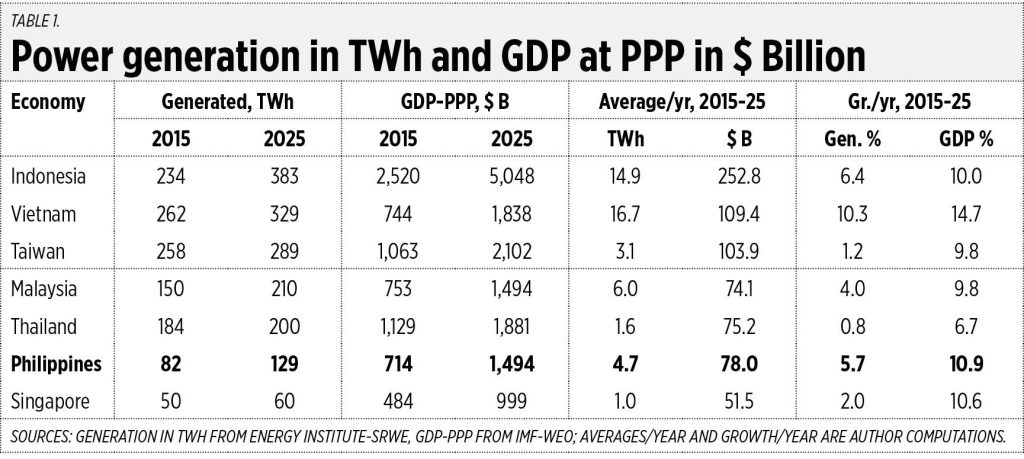
Citing Table 1 on power generation in the ASEAN-6 plus Taiwan, Oplas observed that Indonesia has the largest power generation, followed by Vietnam. What stands out is the speed of Vietnam’s increase: an average of 16.7 terawatt-hours (TWh) per year from 2015 to 2025, compared with 15 TWh per year for Indonesia and only 4.7 TWh per year for the Philippines. Vietnam’s expansion over that period drew on both large additions of coal-fired capacity and a rapid build-out of utility-scale solar — a mix that spans the renewables-versus-thermal divide at the center of the Philippine debate.
In GDP size at purchasing power parity (PPP) values, Indonesia remains the largest economy in the ASEAN. Vietnam posted a power generation growth rate of 10.3% per year and GDP growth of 14.7% per year over 2015-2025. High power generation, Oplas wrote, leads to a larger GDP size and faster GDP growth (see Table 1).
Under his “Oplas HPGT” proposal, the Philippines would move from the average 4.7 TWh-per-year increase recorded in 2015-2025 to 7 TWh per year from 2025 to 2030, then 10 TWh per year from 2030 to 2035, and 15 TWh per year from 2035 to 2040.
He justified prioritizing total generation over high RE targeting on expectations of huge power demand in the coming years from three sources: a.) a rising number of EVs, gadgets, and appliances; b.) a rising number of data centers; and c.) more big train systems such as the Metro Manila subway, the North Luzon railways, the PNR trains down to Bicol, and proposed trains in Mindanao. Trains run on electricity, not diesel, gasoline, or solid coal.
With HPGT, Oplas hopes the Philippines would reach around 289 TWh by 2040 — still modest, he noted, as that is what Taiwan had in 2025 and remains below Vietnam’s and Indonesia’s 2025 levels of 329 and 383 TWh. Even so, he argued, it could push GDP growth from the $78-billion-per-year increase of 2015-2025 to $100 billion per year in 2025-2030, and hopefully to a $3,570-billion economy by 2040, similar to Mexico’s GDP size in 2025.
In 2025, the Philippines attained Upper-Middle Income Country (UMIC) status with a gross national income (GNI) of $4,850 per capita, after an average increase of $157 per year from 2015 to 2025. HPGT and higher yearly GDP growth, Oplas wrote, could help the country reach possibly $8,550 per person by 2040 — similar to what Peru had in 2025 (see Table 2).
Among the other AmCham forum speakers who shared insights were Arnel Santos, president and CEO of Meralco PowerGen Corp. (MGEN) Thermal Energy, Inc.; Don Paulino of Aboitiz Power (AP) thermal engineering and projects; Jocot de Dios, president and CEO of Prime CoreGen, which operates thermal gas plants; and Noel Felicia of SK Liguasan Oil and Gas Corp.
Thermal energy — coal, gas, and oil — is what will provide stable, dependable power sources 24/7 except during scheduled maintenance, Oplas wrote. While more solar and wind also contribute to higher generation, they do not provide the same operating characteristics as conventional thermal plants, whose large rotating turbines create physical inertia that helps resist sudden changes in system frequency and gives the grid more time to respond when a generator trips.
The big issue, he argued, is not simply how many megawatts of installed capacity are added, but how stable the generation is in supporting the system and the grid.
Electricity bills this month will be higher than last year’s, Oplas noted, because of higher generation costs amid the continuing Middle East conflict, higher ancillary services (AS) in the transmission charge, a higher universal charge for missionary electrification (UCME), and a higher FIT-Allowance for RE. The scrutiny of each line item is acute in a market where Philippine retail power rates have long ranked among the highest in Southeast Asia. These increases have drowned the new refund of P0.59/kWh, on top of the existing refund of P0.42/kWh by Meralco as ordered by the Energy Regulatory Commission.
More RE in the grid, he added, means more subsidies via the feed-in tariff allowance (FIT-All) and the GEA-Allowance — the recovery mechanism for contracts awarded under the government’s Green Energy Auction program for renewable capacity — plus higher AS to further stabilize the grid. The largest percentage increases from 2022 to 2026 came from FIT-All, UCME, and AS in the transmission charge (see Table 3).
How the dueling targets resolve will be visible in markers readers can track: the DoE’s progress toward its 35% RE share by 2030, the arrival of the country’s first offshore wind projects — none installed as of 2025 — and whether the system loss measures Senator Tulfo outlined advance in Congress.
Taxes on each item are not yet included. The VAT rates are as follows: generation 11.5%; transmission 11.1%; system loss 11.5%; DSM and other charges 12%; and 0% for the universal charge, FIT-All, and the energy tax.
Bienvenido S. Oplas, Jr. is the president of Bienvenido S. Oplas, Jr. Research Consultancy Services and Minimal Government Thinkers, and an international fellow of the Tholos Foundation. He can be reached at minimalgovernment@gmail.com.

