Philippine Budget Deficit Widens More Than Fivefold in July on Surge in Spending
Key Takeaways
- •The July budget deficit ballooned 461.73% year on year to P106.3 billion, though it narrowed 59.8% from June's P264.3-billion gap.
- •Expenditures rose 19.82% to P588.6 billion in July, driven by social assistance, AFP modernization projects, and foreign-assisted rail transport disbursements.
- •Total revenues grew just 2.12% to P482.3 billion, as nontax revenues fell 39.92% mainly due to timing of BSP dividend remittances.
- •The January-to-July fiscal gap of P893.1 billion represents 53.84% of the upwardly revised P1.659-trillion full-year deficit ceiling.
- •Analyst Francisco Cid L. Terosa said the deficit will keep widening due to elevated spending priorities and slower GDP growth, after first-half growth slowed to 2.6%.
By Justine Irish D. Tabile, Senior Reporter
The National Government's (NG) budget deficit widened more than fivefold in July as spending jumped nearly 20%, driven by higher disbursements for social assistance and capital projects, the Bureau of the Treasury (BTr) said.
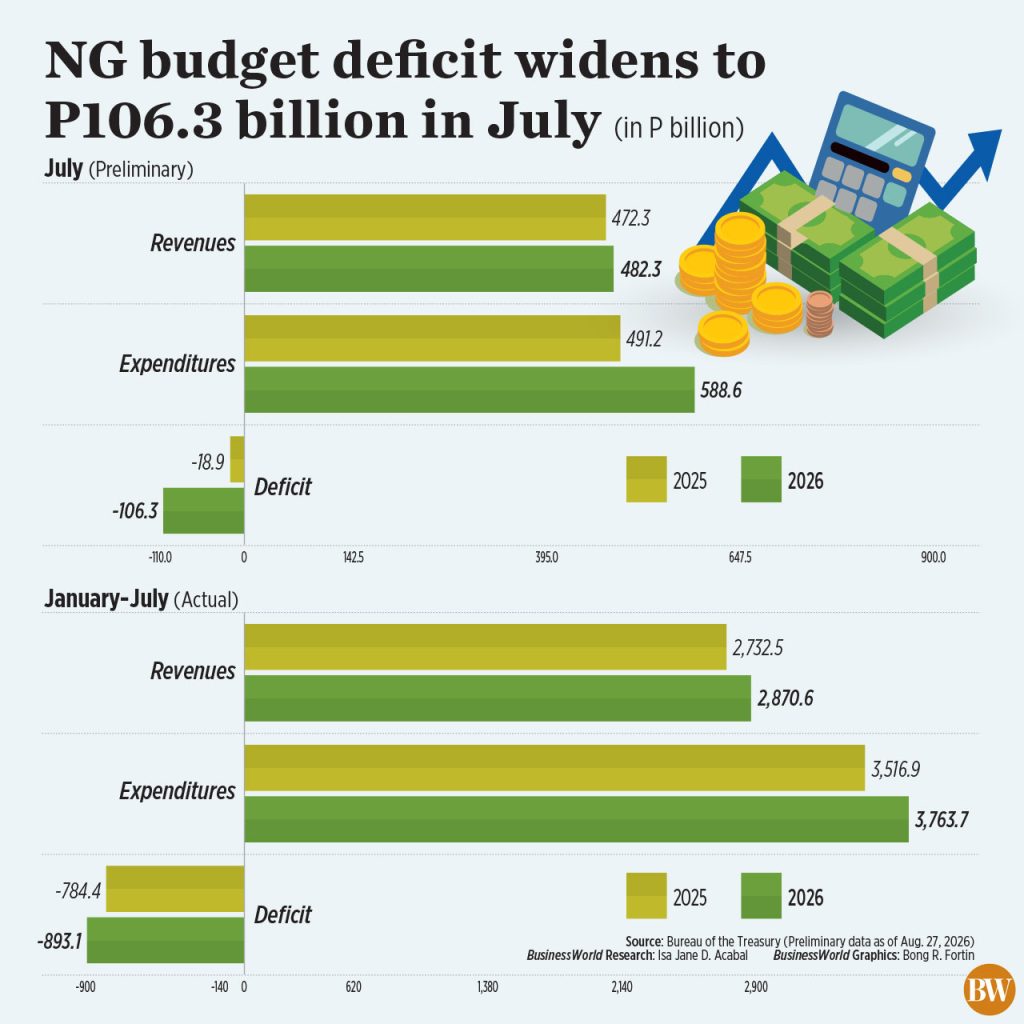
Treasury data showed the fiscal gap ballooned by 461.73% to P106.3 billion in July from P18.9 billion in the same month a year earlier. Month on month, however, the deficit narrowed by 59.8% from the P264.3-billion gap recorded in June.
According to the BTr, expenditures rose by 19.82% as the government ramped up disbursements for key programs and projects, while a base effect-driven decline in nontax collections limited revenue growth to 2.12%.
Government spending increased to P588.6 billion in July from P491.2 billion a year ago, mainly due to the implementation of various social assistance programs under the Unified Package for Livelihood, Industry, Food, and Transport framework, which aims to help address the impact of the Middle East conflict.
Spending was also driven by disbursements for capital outlay projects under the Revised Armed Forces of the Philippines Modernization Program, as well as direct payments made by development partners for various foreign-assisted rail transport projects of the Department of Transportation.
Primary expenditure, net of interest payments, went up by 17.25% to P451.4 billion in July from P385 billion in the same month last year, accounting for 76.69% of total disbursements.
Interest payments increased by 29.14% to P137.2 billion in July from P106.2 billion a year prior.
"This was attributed to coupon servicing on additional domestic debt securities and global bonds, as well as the impact of foreign exchange fluctuations on foreign-currency payments," the BTr said.
On the revenue side, total collections inched up by 2.12% to P482.3 billion in July from P472.3 billion in the same month a year ago.
Tax revenues, which made up 93.86% of total collections, rose by 7.02% to P452.7 billion in July from P423 billion a year ago.
The Bureau of Internal Revenue's (BIR) collections increased by 6.92% to P358.4 billion in July from P335.3 billion a year prior, while collections by the Bureau of Customs (BoC) jumped by 7.48% to P91.6 billion from P85.2 billion a year earlier.
Nontax revenues declined by 39.92% to P29.6 billion in July from P49.3 billion last year, as Treasury income plunged by 48.31% to P18.8 billion and revenues from other offices fell by 16.38% to P10.8 billion.
The Treasury attributed the decline mainly to the timing of dividend remittances by the Bangko Sentral ng Pilipinas (BSP). The central bank remitted P59 billion in February and P3.4 billion in July this year, compared with P18.9 billion in July 2025.
In July, the NG recorded a primary surplus of P30.9 billion, narrowing by 64.59% from the P87.3-billion surplus a year earlier.
Seven-Month Budget Gap
For the January-to-July period, the fiscal gap widened by 13.85% to P893.1 billion from the P784.4-billion deficit last year, BTr data showed. This represented 53.84% of the upwardly revised P1.659-trillion deficit ceiling approved by the Development Budget Coordination Committee (DBCC) in May.
With seven months of the year elapsed, the cumulative gap of 53.84% of the full-year ceiling means the government still has fiscal headroom under the program, though the pace of disbursements in the remaining months — particularly for infrastructure and social programs — will determine whether the ceiling is respected.
Total revenue collections rose by 5.05% to P2.87 trillion in the first seven months from P2.73 trillion in the same period a year ago, representing 59.72% of the P4.807-trillion program for the year.
As of end-July, tax revenues increased by 5.66% to P2.595 trillion, as BIR collections went up by 5.31% to P1.99 trillion and Customs collections rose by 7.25% to P583.4 billion.
"The BIR's improved performance is due to better taxpayer services to support stronger compliance and boost collection," the Treasury said.
Meanwhile, the BTr said the increase in BoC collections was driven by "the significant uptick in duties and value-added tax (VAT) collection from imports primarily due to the stronger US dollar and higher crude oil price."
"In addition, the agency's sustained collection was supported by improved customs procedures, intensified border protection measures, digital transformation initiatives, and closer collaboration with stakeholders," it added.
Nontax revenues slipped by 0.31% to P276.1 billion as of end-July, as a 10.97% increase in BTr income to P201.5 billion partly offset the 21.78% drop in other offices' revenues to P74.6 billion.
For the seven-month period, expenditures increased by 7.02% to P3.764 trillion from P3.517 trillion a year ago, accounting for 58.21% of the DBCC's P6.466-trillion disbursement program.
The primary budget deficit widened by 3.36% to P272.2 billion in the first seven months from P263.4 billion in the same period last year.
Analyst Comment
Francisco Cid L. Terosa, an associate professor and former dean of the University of Asia and the Pacific School of Economics, said the widening deficit could be attributed to greater cash disbursements and expenditures relative to revenue collections.
"Revenue growth was slow due to the economic slowdown in the first half of 2026. Slower consumer spending and capital formation led to sluggish VAT and excise tax collections," he told BusinessWorld in a Viber message.
"Corporate income tax collections were impeded by slower corporate expansion and downscaled business activities," he added.
In the first half, the Philippine economy grew by just 2.6%, much slower than the 5.4% expansion a year ago, as elevated inflation dampened household consumption while a steep decline in public construction dragged investment.
"The deficit will continue increasing due to elevated deficit targets by the government, prioritization of public spending and infra rollout to revitalize the economy even if it leads to a larger deficit, and slower forecasted GDP (gross domestic product) growth," Mr. Terosa said.

